Researchers go underground to reveal 850 new species
September 28, 2009
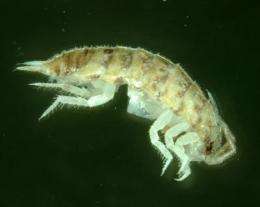
A new woodlice species whose distribution is restricted to mound springs in South Australia. Credit: Courtesy of the Australian Center for Evolutionary Biology & Biodiversity, University of Adelaide.
Australian researchers have discovered a huge number of new species of invertebrate animals living in underground water, caves and "micro-caverns" amid the harsh conditions of the Australian outback.
A national team of 18 researchers has discovered 850 new species of invertebrates, which include various insects, small crustaceans, spiders, worms and many others.
The team - led by Professor Andy Austin (University of Adelaide), Dr Steve Cooper (South Australian Museum) and Dr Bill Humphreys (Western Australian Museum) - has conducted a comprehensive four-year survey of underground water, caves and micro-caverns across arid and semi-arid Australia.
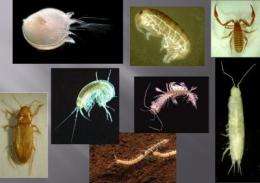
Some of the 850 new species discovered in underground water, caves and micro-caverns across outback Australia. Credit: Courtesy of the Australian Center for Evolutionary Biology & Biodiversity, University of Adelaide.
"What we've found is that you don't have to go searching in the depths of the ocean to discover new species of invertebrate animals - you just have to look in your own 'back yard'," says Professor Austin from the Australian Center for Evolutionary Biology & Biodiversity at the University of Adelaide."Our research has revealed whole communities of invertebrate animals that were previously unknown just a few years ago. What we have discovered is a completely new component to Australia's biodiversity. It is a huge discovery and it is only about one fifth of the number of new species we believe exist underground in the Australian outback."
Only half of the species discovered have so far been named. Generically, the animals found in underground water are known as "stygofauna" and those from caves and micro-caverns are known as "troglofauna".
Professor Austin says the team has a theory as to why so many new species have been hidden away underground and in caves.
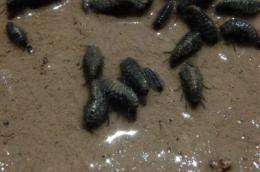
This new species is Phreatomerus latipes, from Coward Springs, South Australia. Credit: Courtesy of the Australian Center for Evolutionary Biology & Biodiversity, University of Adelaide.
"Essentially what we are seeing is the result of past climate change. Central and southern Australia was a much wetter place 15 million years ago when there was a flourishing diversity of invertebrate fauna living on the surface. But the continent became drier, a process that last until about 1-2 million years ago, resulting in our current arid environment. Species took refuge in isolated favorable habitats, such as in underground waters and micro-caverns, where they survived and evolved in isolation from each other.
"Discovery of this 'new' biodiversity, although exciting scientifically, also poses a number of challenges for conservation in that many of these species are found in areas that are potentially impacted by mining and pastoral activities," he says.
The research team has reported its findings at a scientific conference on evolution and biodiversity in Darwin, which celebrates the 200th anniversary of Charles Darwin: www.evolutionbiodiversity2009.org. The conference finishes today.
-
Genetic study finds treasure trove of new lizards
Mar 04, 2009 |
not rated yet |
0
-
Giant bird feces records pre-human New Zealand
Jan 12, 2009 |
not rated yet |
0
-
Unique Underground Ecosystem Revealed by Hebrew University Researchers Uncovers Eight Previously Unknown Species
May 31, 2006 |
not rated yet |
0
-
Scientists uncover new dolphin species in Australian waters
Nov 21, 2008 |
not rated yet |
0
-
Why are some groups of animals so diverse?
Sep 19, 2007 |
not rated yet |
0
-
Engineers build first sub-10-nm carbon nanotube transistor
Feb 01, 2012 |
4.9 / 5 (30) |
30
-
Something old, something new: Evolution and the structural divergence of duplicate genes
Jan 31, 2012 |
4.6 / 5 (7) |
1
-
The hidden nanoworld of ice crystals: Revealing the dynamic behavior of quasi-liquid layers
Jan 30, 2012 |
5 / 5 (3) |
1
-
Stock market network reveals investor clustering
Jan 27, 2012 |
3.9 / 5 (23) |
8
-
Of microchemistry and molecules: Electronic microfluidic device synthesizes biocompatible probes
Jan 26, 2012 |
5 / 5 (1) |
0
-
Cancer drugs and Alzheimer's, Oh my!
7 hours ago
-
Squishing cells
7 hours ago
-
Any books/articles for evolutionary stable strategy models in humans?
19 hours ago
-
Science behind the bore feeling?
Feb 09, 2012
-
Homo Sapien vs. Chimpanzee - Divergence Timeline
Feb 09, 2012
-
a single mRNA strand is attached to sevaral ribosomes?
Feb 08, 2012
- More from Physics Forums - Biology
More news stories
Protein libraries in a snap
(PhysOrg.com) -- A Rice University undergraduate will depart with not only a degree but also a possible patent for his invention of an efficient way to create protein libraries, an important component of biomolecular ...
44 minutes ago |
5 / 5 (1) |
0
|
Miami battling invasion of giant African snails
No one knows how they got there. But an invasion of African giant snails has southern Florida in a panic over potential crop damage, disease and general yuckiness surrounding the slimy gastropods.
1 hour ago |
not rated yet |
0
Fighting crimes against biodiversity: How to catch a killer weed
Invasive species which have the potential to destroy biodiversity and influence global change could be tracked and controlled in the same way as wanted criminals, according to new research from Queen Mary, University of London.
2 hours ago |
not rated yet |
0
Ultraviolet protection molecule in plants yields its secrets
Lying around in the sun all day is hazardous not just for humans but also for plants, which have no means of escape. Ultraviolet (UV) radiation from the sun can damage proteins and DNA inside cells, leading ...
15 hours ago |
5 / 5 (5) |
0
|
Deadly bird parasite evolves at exceptionally fast rate
A new study of a devastating bird disease that spread from poultry to house finches in the mid-1990s reveals that the bacteria responsible for the disease evolves at an exceptionally fast rate. What's more, ...
14 hours ago |
5 / 5 (2) |
0
|
Neurologic improvement detected in rats receiving stem cell transplant
In a study to be presented today at the Society for Maternal-Fetal Medicine's annual meeting, The Pregnancy Meeting, in Dallas, Texas, researchers will report that early transplantation of human placenta-derived mesenchymal ...
NASA budget will axe Mars deal with Europe: scientists
US President Barack Obama's budget proposal to be submitted next week for 2013 will cut NASA's budget by 20 percent and eliminate a major partnership with Europe on Mars exploration, scientists said Thursday.
Breastfeeding protects against asthma up to six years of age
(Medical Xpress) -- Research by the University of Otago in Christchurch and Wellington has shown that breastfeeding of infants has a clear protective effect against children developing asthma or wheezing up to six years of ...
Study finds stress hormones fluctuate with mood during pregnancy
(Medical Xpress) -- While pregnant, women pay particular attention to factors such as diet and exercise to ensure their babies are born healthy and develop normally. New research from the University of Calgarys Faculty ...
Clinical trial teaches binge eaters to toss away cravings
Of 190 million obese Americans, approximately 10-15 percent engage in harmful binge eating. During single sittings, these over-eaters consume large servings of high-caloric foods. Sufferers contend with weight gain and depression ...
Humans may have helped the decline of African rainforests 3000 years ago
(PhysOrg.com) -- Large areas of rainforests in Central Africa mysteriously disappeared over three thousand years ago, to be replaced by savannas. The prevailing theory has been that the cause was a change ...

