Pushing the cold frontier in an orderly fashion
September 28, 2009 Pushing the cold frontier in an orderly fashion

Enlarge

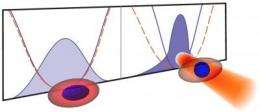
In a cloud of cold gases (left) entropy can be reduced (right) by focusing a laser that compresses one component (blue) without affecting the other (red). Rather than heating up the blue component, some of the disorder in the squeezed gas moves to the surrounding gas cloud. Credit: J. Catani et al., Phys. Rev. Lett. 103, 140401 (2009)

Physicists are continually reaching new lows as they reduce the temperatures of samples in their laboratories. But even nano-kelvins are not low enough to overcome the entropy (a measure of the disorder in a system) that stands between them and the discovery of exotic states of ultra-cold matter.

Now physicists at two Italian universities have developed a technique that siphons out of a collection of atoms in much the same way that a kitchen removes heat from the food stored inside.

The new method is described in Physical Review Letters and highlighted in the September 28 issue of Physics.

The system that Jacopo Catani (University of Florence) and colleagues assembled begins with a cloud of and atoms held in a magnetic trap. They selected a laser with a wavelength of light that interacted with the potassium atoms, but had little effect on the rubidium atoms. They then compressed the potassium atom cloud by focusing the laser to a point in the trap.

Compressing a gas usually increases its temperature, but the surrounding rubidium kept things in check, allowing the researchers to hold the temperature roughly constant as entropy was shifted from the potassium to the rubidium atoms.

The novel technique should work with other combinations of atoms as well, offering researchers a new tool to aid them in their pursuit of physics at ultra-low temperatures and entropies.

More information: Entropy Exchange in a Mixture of , Phys. Rev. Lett. 103, 140401 (2009), DOI: 10.1103/PhysRevLett.103.140401

Source: American Physical Society


print this article email this article download pdf blog this article bookmark this article     Stumble it Digg this share on Facebook retweet share on Reddit add to delicious
Rate this story - 5 /5 (4 votes)


September 28, 2009 all stories

Comments: 0

5 /5 (4 votes)
  • Stumble this up

  • Digg this

  • share this

  • hide
  • Related Stories

  • Scientists work to squeeze atoms
    created Jan 04, 2006 | popularity not rated yet | comments 0
  • Cross-Dressing Rubidium May Reveal Clues for Exotic Computing
    created Feb 25, 2009 | popularity not rated yet | comments 0
  • New way found to cool atoms and molecules
    created Aug 09, 2005 | popularity not rated yet | comments 0
  • Atom 'noise' may help design quantum computers
    created Mar 02, 2007 | popularity not rated yet | comments 0
  • New Technique Reveals Hidden Properties of Ultracold Atomic Gases
    created Aug 06, 2008 | popularity not rated yet | comments 0


  • hide
  • Relevant PhysicsForums posts

  • vacuum question
    created 1hour ago
  • inertia
    created 2 hours ago
  • Enthalpy and it's use in Gibb's Free Energy
    created 4 hours ago
  • Microwave vs metallic objects
    created 7 hours ago
  • More from Physics Forums - General Physics

Other News

Superconductor magnet heat shield being developed

Superconductor magnet spacecraft heat shield being developed

Physics / General Physics

created 34 minutes ago | popularity not rated yet | comments 1

(PhysOrg.com) -- European space agencies and an aerospace giant are developing a new re-entry heat shield that will use superconductor magnets to generate a magnetic field strong enough to deflect the superhot ...


Bacteria

Plasma produces KO cocktail for MRSA

Physics / General Physics

created 2 hours ago | popularity 5 / 5 (2) | comments 0

MRSA (methicillin-resistant Staphylococcus Aureus) and other drug-resistant bacteria could face annihilation as low-temperature plasma prototype devices have been developed to offer safe, quick, easy and un ...


Scientists react as they stand in front of a screen at CERN

First atoms reported smashed in Large Hadron Collider (Update)

Physics / General Physics

created Nov 23, 2009 | popularity 4.5 / 5 (30) | comments 21

Two circulating beams on Monday produced the first particle collisions in the world's biggest atom smasher, the Large Hadron Collider (LHC), three days after its restart, scientists announced.


Restored machine to explore mysteries of Big Bang (AP)

Restored machine to explore mysteries of Big Bang

Physics / General Physics

created Nov 21, 2009 | popularity 4.6 / 5 (18) | comments 26

(AP) -- Scientists are preparing the world's largest atom smasher to explore the depths of matter after successfully restarting the $10 billion machine following more than a year of repairs.


nuclear power plant

Doubts raised on nuclear industry viability

Physics / General Physics

created Nov 19, 2009 | popularity 3 / 5 (22) | comments 19

(PhysOrg.com) -- The investment in nuclear power has been growing around the world over the last few years, being viewed as a means for countries to control their energy security, avoid the price fluctuations ...