Volunteers key to success of Thai vaccine trials
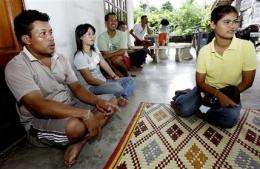
(AP) -- Nearly 16,000 Thais ignored the false rumors that they were being infected by the AIDS virus, and overcame their fears of becoming social outcasts to participate in the first HIV vaccine trials to show positive results.
Many of the volunteers - an eclectic mix of housewives, fishermen, factory workers, laborers and prostitutes - had seen firsthand how the disease ravaged this region of plantations and industrial estates in southeast Thailand, part of the epidemic that kills millions worldwide each year.
"In the '80s, the coffin business was booming around here. It was one family after another," said Tanad Yomaha, a volunteer whose sister and brother-in-law died of AIDS. "The temple here had at least one cremation ceremony every night and people were in perpetual mourning."
Their dedication - 90 percent of the volunteers stuck with the trial for more than six years - paid off when American and Thai authorities announced Thursday that the experimental vaccine had been found in some measure to prevent infection with the AIDS virus, an unexpected result that many scientists thought would never be possible.
The vaccine was shown to cut the risk of HIV infection by more than 31 percent. While the vaccine did not meet the researchers' goal of 50 percent, it could still have a big impact. Every day, 7,500 people worldwide are newly infected with HIV; 2 million died of AIDS in 2007, the U.N. agency UNAIDS estimates.
Soon after the Thai trials started, Col. Jerome Kim, who helped lead the study for the U.S. Army, said volunteers heard neighbors say the vaccine contained HIV and that the U.S. Army - which sponsored the study with the National Institute of Allergy and Infectious Diseases - was using a vaccine too dangerous to test in the United States.
Some even complained they risked losing their girlfriends or jobs after word spread they were participating in the trials.
"I was scared I would become a guinea pig and that they would inject us with AIDS," said Saichon Booncharoen, a 36-year-old who later became a volunteer and helped recruit other participants.
The volunteers, however, said their doubts subsided when they learned the vaccine was not made from whole virus - dead or alive - and cannot cause HIV. Ministry health workers educated potential volunteers about the vaccine and AIDS, and researchers worked with communities to stamp out misinformation.
"I spoke to my parents and local doctors and thought about it for months," Saichon said. "Eventually, I decided I wanted to do this to be a part of something bigger, something beyond myself."
The study was conducted by the Thai Ministry of Public Health, which used strains of HIV common in Thailand. Scientists stressed, however, that it was unknown whether the vaccine would work against other strains found in places like the U.S. or Africa.
The study tested a two-vaccine combo in a "prime-boost" approach, where the first one primes the immune system to attack HIV and the second one strengthens the response.
The first, named ALVAC, is made by Sanofi Pasteur, the vaccine division of French drugmaker Sanofi-Aventis, and the second is AIDSVAX, originally developed by VaxGen Inc. and now held by Global Solutions for Infectious Diseases, a nonprofit founded by former VaxGen employees.
Kim said researchers settled on Rayong and Chonburi provinces because they had slightly higher rates of HIV than other parts of Thailand and a relatively stationary population.
The study tested the combination in HIV-negative men and women ages 18 to 30 who were in good health and at average risk of becoming infected. They were counseled against having unsafe sex or intravenous drug use and were allowed to drop out at any time. No other conditions or limitations applied.
Half received the vaccine combination and others received placebo shots. No one knew who got what.
New infections occurred in 51 of the 8,197 people given the vaccine, and in 74 of the 8,198 people given placebo shots. That worked out to a 31 percent lower risk of infection for the vaccine group.
"We enrolled people irrespective of where they worked and what they did," said Kim, who oversaw the trials for four years in Thailand with the Armed Forces Research Institute of Medical Sciences. "It is a true representation of the people who live and work there."
Volunteers received 300 baht ($9) to 500 baht ($15) for each clinic visit, Kim said.
Health workers tracked the volunteers with regular phone calls and house visits. They also organized community health forums and established volunteer groups that allowed participants to bond over trips to the beach or activities like cleaning temples.
"It is something very uniquely Thai. Everyone does everything together," Kim said. "It's a lot of social mobilization which would be difficult to do in the United States."
The trials may be over, but many participants say they formed lasting bonds.
"We are still doing volunteer work together, taking trips together and going out together," Tanad said. "Now, we are having problems with landfills and garbage dumping in the area so we are brainstorming about what to do next to keep our village unharmed."
---
On the Net:
Study information: http://www.hivresearch.org/phase3/factsheet.html
Vaccine coalition: http://www.avac.org/
UNAIDS: http://tinyurl.com/krq7kr
Government AIDS info: http://www3.niaid.nih.gov/topics/HIVAIDS/
©2009 The Associated Press. All rights reserved. This material may not be published, broadcast, rewritten or redistributed.


