New study resolves the mysterious origin of Merkel cells
September 28, 2009 New study resolves the mysterious origin of Merkel cells

Enlarge

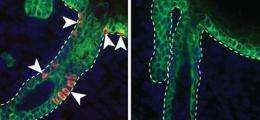
Merkel cells (red) fail to differentiate from epidermal stem cells in mouse skin lacking Atoh1 (right). The study appears in the October 5, 2009, issue of the Journal of Cell Biology. Credit: Van Keymeulen, A., et al. 2009. J. Cell Biol. doi:10.1083/jcb.200907080.

A new study resolves a 130-year-old mystery over the developmental origin of specialized skin cells involved in touch sensation. The findings will appear in the October 5, 2009 issue of the Journal of Cell Biology.

First described in 1875, Merkel are neuroendocrine cells that reside in the vertebrate epidermis, passing mechanical stimuli on to sensory neurons. In mice, they are mainly found in the paws and around the whiskers but, because they express proteins characteristic of both epithelial and neuronal cells, scientists have long debated whether Merkel cells develop from the epidermis or neural crest.

Van Keymeulen et al. traced the lineage of Merkel cells by fluorescently labeling cells derived from either epidermal or neural crest . This revealed that Merkel cells originally emerge from the embryonic epidermis. In addition, epidermal stem cells in adult mouse replenish the Merkel cell population as they slowly die off over time. The researchers also found that a transcription factor called Atoh1 is required for epidermal progenitors to differentiate into Merkel cells--mice lacking Atoh1 in their skin failed to develop any of the mechanotransducing cells.

Atoh1 acts as a tumor suppressor to prevent an aggressive skin cancer called Merkel cell , says senior author Cédric Blanpain. His team now wants to investigate the precise function of the transcription factor in Merkel cell differentiation, as well as the signaling pathways that regulate the process.

More information: Van Keymeulen, A., et al. 2009. J. Cell Biol. doi:10.1083/jcb.200907080

Source: Rockefeller University (news : web)


print this article email this article download pdf blog this article bookmark this article     Stumble it Digg this share on Facebook retweet share on Reddit add to delicious
Rate this story - 5 /5 (3 votes)


September 28, 2009 all stories

Comments: 0

5 /5 (3 votes)
  • Stumble this up

  • Digg this

  • share this

  • hide
  • Related Stories

  • Link between light touch and Merkel cells solves 100-year mystery
    created Jun 18, 2009 | popularity not rated yet | comments 0
  • Research indicates new virus is culprit, not bystander, in deadly skin cancer
    created Sep 22, 2008 | popularity not rated yet | comments 0
  • Merkel cell polyomavirus associated with Merkel cell carcinoma
    created Sep 23, 2009 | popularity not rated yet | comments 0
  • Suppressing cancer with a master control gene
    created Feb 23, 2009 | popularity not rated yet | comments 0
  • Epigenetic mark guides stem cells toward their destiny
    created Mar 19, 2009 | popularity not rated yet | comments 0


  • hide
  • Relevant PhysicsForums posts

  • What is transpulmonary pressure?
    created Nov 24, 2009
  • Is there a gay gene?
    created Nov 23, 2009
  • Super quick question about Starling forces?
    created Nov 22, 2009
  • Questions about diffusion
    created Nov 22, 2009
  • More from Physics Forums - Biology

Other News

When camouflage is a plant's best protection

Rare woodland plant uses 'cryptic coloration' to hide from predators

Biology / Plants & Animals

created 56 seconds ago | popularity not rated yet | comments 0

It is well known that some animal species use camouflage to hide from predators. Individuals that are able to blend in to their surroundings and avoid being eaten are able to survive longer, reproduce, and ...


'Safety valve' protects photosynthesis from too much light

Biology / Cell & Microbiology

created 1hour ago | popularity not rated yet | comments 0

Photosynthetic organisms need to cope with a wide range of light intensities, which can change over timescales of seconds to minutes. Too much light can damage the photosynthetic machinery and cause cell death. Scientists ...


Cells defend themselves from viruses, bacteria with armor of protein errors

Biology / Cell & Microbiology

created 1hour ago | popularity not rated yet | comments 0

When cells are confronted with an invading virus or bacteria or exposed to an irritating chemical, they protect themselves by going off their DNA recipe and inserting the wrong amino acid into new proteins to defend them ...


Researchers discover biological basis of 'bacterial immune system'

Biology / Cell & Microbiology

created 2 hours ago | popularity 4 / 5 (1) | comments 0

Bacteria don't have easy lives. In addition to mammalian immune systems that besiege the bugs, they have natural enemies called bacteriophages, viruses that kill half the bacteria on Earth every two days.


Redback spiders were first spotted in Japan in 1995

Venomous Aussie redback spiders invading Japan

Biology / Ecology

created 8 hours ago | popularity 5 / 5 (2) | comments 0

Australia's venomous redback spiders are on the march in Japan, where they are believed to have arrived years ago as stowaways on cargo ships, a wildlife expert warned Wednesday.