Improved robotic hand captures mechanical engineering top award
September 28, 2009 Improved robotic hand captures mechanical engineering top award

Enlarge

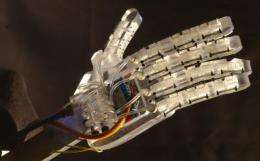
The Virginia Tech College of Engineering's Robotics and Mechanisms Laboratory created an improved fully articulated robotic hand. RAPHaEL 2 can firmly hold objects ranging from a soup can to a raw egg. It uses force and position feedback to automatically control the grasping force and finger position. Credit: Virginia Tech Photo

The Virginia Tech College of Engineering's Robotics and Mechanisms Laboratory (RoMeLa) has captured another top award for its updated innovative robotic hand that can automatically change its grasping force using compressed air.

A team of five undergraduate students won First Place in the American Society of Mechanical Engineers (ASME) Student Mechanism and Robot Design Competition at the International Design Engineering Technical Conference. The winning entry was RAPHaEL 2, a second-generation version of a robotic hand that previously won an award from the Compressed Air and Gas Institute.

Held in San Diego, the ASME competition included undergraduate and graduate school teams. RoMeLa bested graduate student teams from MIT and the University of California Berkeley, and an undergraduate team from Purdue University, said Dennis Hong, director of RoMeLa and an associate professor with the Virginia Tech department.

The RAPHaEL (Robotic Air Powered Hand with Elastic Ligaments) series robotic hand is powered by compressed air and a novel accordion type tube actuator. Because the hand's grasping force and compliance is adjusted by changing the air pressure, it does not require the use of motors or other expensive and bulky actuators, Hong said.

The most significant change for RAPHaEL 2 is the closed loop control mechanism and sensors for automatic position and force feedback of the fingers using LabVIEW and data acquisition hardware donated by National Instruments. The first version of RAPHaEL relied on solenoids with a microcontroller to operate. The material that comprises the hand also were changed to a durable polycarbonate material, replacing a fragile acrylic-based material that was prone to breakage, said Cothern.

"This gives us a lot more control over the kinds of things we can do with the hand," said Cothern. "Eventually, we might be able to tell how soft an object you're grabbing is just by touching it."

Additional tweaks to come: The ability to grasp small moving objects as well as the use of silicone, carbon fiber and other materials to make the hand lighter, simpler in structure, and also appear more human. As a possible prosthetic, the hand is easy to operate and its fingers are easy to replace if broken, Cothern said.

RAPHaEL 2 is part of a larger RoMeLa project: The humanoid robot CHARLI (Cognitive Humanoid Robot with Learning Intelligence). Once the hand is connected to the larger body, it will be able to pick up - not just grasp and hold - objects as would a person, said Hong. CHARLI is expected one day to walk about campus giving tours of Virginia Tech to visitors and potential students.

More information: Learn more about RoMeLa: http://www.me.vt.edu/romela/

Source: Virginia Tech (news : web)


print this article email this article download pdf blog this article bookmark this article     Stumble it Digg this share on Facebook retweet share on Reddit add to delicious
Rate this story - 5 /5 (1 vote)


September 28, 2009 all stories

Comments: 0

5 /5 (1 vote)
  • Stumble this up

  • Digg this

  • share this

  • hide
  • Related Stories

  • Researcher to create robotic locomotion that mimics amoeba
    created Mar 19, 2007 | popularity not rated yet | comments 0
  • Innovative Concepts for Future Aircraft Design: Virginia Tech's 'Centura' wins NASA's competition
    created Aug 02, 2004 | popularity not rated yet | comments 0
  • Robots compete this week at Purdue
    created Mar 13, 2006 | popularity not rated yet | comments 0
  • Scientists develop 'clever' artificial hand
    created Sep 07, 2005 | popularity not rated yet | comments 0
  • As robots learn to imitate
    created Dec 22, 2004 | popularity not rated yet | comments 0


  • hide
  • Relevant PhysicsForums posts

  • Aspiring Engineering major looking for general answers
    created Nov 19, 2009
  • Calculating max load of square tube (steel)
    created Nov 19, 2009
  • Passive Chemical Heating
    created Nov 19, 2009
  • Shortening Boat Trailer
    created Nov 18, 2009
  • More from Physics Forums - General Engineering

Other News

Hackers leak e-mails, stoke climate debate

Technology / Internet

created 1hour ago | popularity 5 / 5 (5) | comments 2

(AP) -- Computer hackers have broken into a server at a well-respected climate change research center in Britain and posted hundreds of private e-mails and documents online - stoking debate over whether some scientists have ...


plug-in hybrid electric vehicle

Pulling the plug on hybrid myths

Technology / Energy

created Nov 19, 2009 | popularity 3.8 / 5 (12) | comments 16

(PhysOrg.com) -- Whether you call them myths, urban legends, fables or old wives' tales, there's a lot of misinformation out there about plug-in electric hybrid vehicles. These vehicles, abbreviated PHEVs, ...


UK police make 2 Trojan computer virus arrests

Technology / Internet

created Nov 18, 2009 | popularity 5 / 5 (1) | comments 10

(AP) -- A couple suspected of helping spread some of the Internet's most aggressive computer viruses has been arrested in the English city of Manchester, police said Wednesday.


A sign marks the entrance to IBM Corporate Headquarters

IBM makes Big Blue cloud

Technology / Software

created Nov 16, 2009 | popularity 2.9 / 5 (8) | comments 8

IBM on Monday announced it has created the world's largest business computing "cloud" capable of holding an amount of digital data on a par with 250 billion iTunes songs.


Google SPDY

Google's SPDY will speed up downloads

Technology / Internet

created Nov 16, 2009 | popularity 4.4 / 5 (16) | comments 7

(PhysOrg.com) -- As part of its effort to speed up the Web, Google is experimenting with SPDY, a new application layer protocol, that it hopes will speed up the conversation between browsers and Web servers ...