Textile antenna promises futuristic communications
September 28, 2009 Textile antenna promises futuristic communications

Enlarge

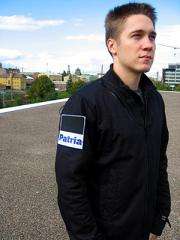
Through the ESA Advanced Research in Telecommunications Systems (ARTES) 5 project 'Textile Antennas', the Finnish Patria Aviation Oy company has demonstrated that an antenna can be built using textiles that can be worn and used for personal satellite communication. The antenna is here seen attached to the sleeve of a jacket. Credits: Patria Aviation Oy

(PhysOrg.com) -- With a simple press on his shirt insignia, the captain of the Star Ship Enterprise could send and receive messages. Now, thanks to the efforts of a Finnish company, this futuristic communication may not be limited to fiction.

Through the ESA Advanced Research in Telecommunications Systems (ARTES) 5 project 'Textile Antennas', the Finnish Patria Aviation Oy company has demonstrated that an antenna can be built using textiles that can be worn and used for personal satellite communication.

"Flexible antennas are becoming attractive, since the recent developments in 'wearable computing' have opened several possibilities to integrate wireless functions into clothing," explained Rolv Midthassel, ESA’s representative on the project.

The project included the complete process, from selecting and characterising the materials, to making and verifying the design. The resulting demonstrator antenna looks like a simple patch of cloth and is capable of operating in the Iridium and GPS as part of clothing.

"The use of GPS and the Iridium satellite phone system for this project may be an attractive combination for a later product," said Mr Midthassel. "The Iridium satellites allow two-way voice and data communication, while GPS provides positional data to the user. Iridium could also relay the position of the user to operational centres."

The project's main issue was selecting the material to use. Then the material’s electrical characteristics had to be measured using a number of techniques. The next goal was to determine the antenna's performance when the wearer was moving around or bending.

Peter de Maagt, ESA's technical officer on the project, explained that the antenna's geometry allows it to bend in a direction that least reduces performance. Testing proved that the antenna meets the electrical specifications under bending conditions.

The radiating patch antenna is shielded against environmental conditions by a protective layer. The selected geometry meets the stringent requirements imposed by Iridium and GPS, maintaining 'circular polarisation' of its radio signal over the full bandwidth even when bent, which is commonly recognised to be difficult to achieve with soft, wearable antennas.

Then there was the question of handling the material itself. Could it be washed and at what temperature? How must it be stitched? Could it be ironed?

Dr Pekka Salonen, Research and Development Manager at Patria Aviation Oy, said that working with ESA through the ARTES programme has been beneficial. "We have been pushed to go further to reach the goal of what we promised to do," he said.

"Comments and suggestions from ESA staff during the project have been valuable, giving us new insight into all the variables we should take into account, apart from the engineering factors. The results are a good example of close cooperation between the customer and contractor."

Testing has indicated that a textile antenna is feasible. One of the tests used the antenna to place calls with the Iridium phone to ESTEC, in Noordwijk, the Netherlands, from the company in Finland.

"We are pleased with the results of this project," said Mr Midthassel, who sees many potential applications. "Such an could be used in occupations such as fire fighting and other emergency situations."

Provided by European Space Agency (news : web)


print this article email this article download pdf blog this article bookmark this article     Stumble it Digg this share on Facebook retweet share on Reddit add to delicious
Rate this story - 4.3 /5 (10 votes)

Rank Filter

Move the slider to adjust rank threshold, so that you can hide some of the comments.


Display comments: newest first

  • otto1923 - Sep 28, 2009
    • Rank: not rated yet
    I dunno... phones, computers, batteries, solar power in clothes; you need to wash them, or the weather gets hot or you need to dress up ... And duplicating that expensive tech in milspec clothes will cost us $$$. I think I'd like to keep the electronics separate from the garments. Add many pockets, slots, velcro tabs for the peripherals. Uncompromised flexible antennas can be velcroed to backpacks, backs, sleeves w/o needing to design them for laundering.
  • fixer - Sep 28, 2009
    • Rank: not rated yet
    I'm assuming that the antenna connects to the phone by bluetooth, so how is it powered?
    would you need a completely new wardrobe? because a ripoff patch does'nt offer anything new over a car kit!

September 28, 2009 all stories

Comments: 2

4.3 /5 (10 votes)
  • Stumble this up

  • Digg this

  • share this

  • hide
  • Related Stories

  • Iridium sees satellite growth in aviation
    created Nov 10, 2005 | popularity not rated yet | comments 0
  • NEC Develops Wideband Wearable Antenna Prototype
    created Oct 31, 2007 | popularity not rated yet | comments 0
  • Briefs: Iridium supports maritime safety system
    created Dec 19, 2005 | popularity not rated yet | comments 0
  • Multimedia car radio of the future
    created Jan 25, 2007 | popularity not rated yet | comments 0
  • Space test for Swiss-designed solar antennas
    created Sep 27, 2005 | popularity not rated yet | comments 0


  • hide
  • Relevant PhysicsForums posts

  • Control System
    created 20 hours ago
  • Base Isolation Systems in Skyscrapers?
    created Nov 23, 2009
  • Need to interview a Computer Hardware Engineer for school project
    created Nov 23, 2009
  • transient heat transfer
    created Nov 23, 2009
  • More from Physics Forums - General Engineering

Other News

Design chosen for British 1,000 mph car

Design chosen for British 1,000 mph car (w/ Video)

Technology / Engineering

created 18 minutes ago | popularity not rated yet | comments 0

(PhysOrg.com) -- A British team hoping to be the first to get a car to 1,000 mph (1,610 km/h) has made its final design selection. The six-tonne car, known as the Bloodhound, will be powered by a Eurofighter ...


The number of text messages that a mobile user in S.Korea can send out a day has been restricted to 500, down from 1,000

S.Korea halves ceiling on text messages to fight spam

Technology / Telecom

created 3 hours ago | popularity not rated yet | comments 0

South Korean authorities on Wednesday halved the daily limit on text messages sent out by mobile phones as part of a campaign against spam, officials said.


AT&T and Verizon ads duel on airwaves and in court

Technology / Business

created 3 hours ago | popularity not rated yet | comments 0

(AP) -- What would the holidays be without bickering between siblings? AT&T and Verizon are swamping TV with ads attacking facets of each other's wireless networks. While the ads stick fairly close to the truth, there's ...


Selling chip makers on optical computing

Selling chip makers on optical computing

Technology / Semiconductors

created 17 hours ago | popularity 4.9 / 5 (8) | comments 1

(PhysOrg.com) -- Computer chips that transmit data with light instead of electricity consume much less power than conventional chips, but so far, they've remained laboratory curiosities. Professors Vladimir ...


Taking the drudgery out of software development

Taking the drudgery out of software development

Technology / Software

created 14 hours ago | popularity 3.6 / 5 (7) | comments 3

(PhysOrg.com) -- Software developers will no longer have to reinvent the wheel when writing new programs and applications thanks to a clever new set of tools and a central repository of 'building blocks'.