Spallation Neutron Source first of its kind to reach megawatt power (w/ Podcast)
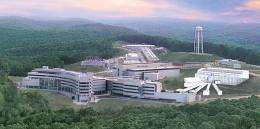
(PhysOrg.com) -- The Department of Energy's Spallation Neutron Source (SNS), already the world's most powerful facility for pulsed neutron scattering science, is now the first pulsed spallation neutron source to break the one-megawatt barrier.
"Advances in the materials sciences are fundamental to the development of clean and sustainable energy technologies. In reaching this milestone of operating power, the Spallation Neutron Source is providing scientists with an unmatched resource for unlocking the secrets of materials at the molecular level," said Dr. William F. Brinkman, Director of DOE's Office of Science.
SNS operators at DOE's Oak Ridge National Laboratory pushed the controls past the megawatt mark on September 18 as the SNS ramped up for its latest operational run.
"The attainment of one megawatt in beam power symbolizes the advancement in analytical resources that are now available to the neutron scattering community through the SNS," said ORNL Director Thom Mason, who led the SNS project during its construction. "This is a great achievement not only for DOE and Oak Ridge National Laboratory, but for the entire community of science."
Before the SNS, the world's spallation neutron sources operated in the hundred-kilowatt range. The SNS actually became a world-record holder in August 2007 when it reached 160 kilowatts, earning it an entry in the Guinness Book of World Records as the world's most powerful pulsed spallation neutron source.
Beam power isn't merely a numbers game. A more powerful beam means more neutrons are spalled from SNS's mercury target. For the researcher, the difference in beam intensity is comparable to the ability to see with a car's headlights versus a flashlight. More neutrons also enhance scientific opportunities, including flexibility for smaller samples and for real-time studies at shorter time scales. For example, experiments will be possible that use just one pulse of neutrons to illuminate the dynamics of scientific processes.
Eventually, the SNS will reach its design power of 1.4 megawatts. The gradual increase of beam power has been an ongoing process since the SNS was completed and activated in late April 2006.
In the meantime, scientists have been performing cutting-edge experiments and materials analysis as its eventual suite of 25 instruments comes on line. As DOE Office of Science user facilities, the SNS and its companion facility, the High Flux Isotope Reactor, host researchers from around the world for neutron scattering experiments.
Provided by Oak Ridge National Laboratory (news : web)


