Radiation-Hardened Microelectronics Could Reduce Spacecraft Weight
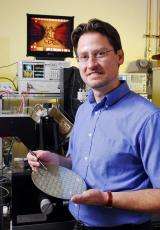
(PhysOrg.com) -- Space environments can deliver a beating to spacecraft electronics. For decades, satellites and other spacecraft have used bulky and expensive shielding to protect vital microelectronics -- microprocessors and other integrated circuits -- from space radiation.
Researchers at the Georgia Institute of Technology are developing ways to harden the microchips themselves against damage from various types of cosmic radiation. With funding from NASA and other sponsors, a Georgia Tech team is investigating the use of silicon-germanium (SiGe) to create microelectronic devices that are intrinsically resistant to space-particle bombardment.
Key to the investigation is determining exactly what happens inside a device at the instant a particle hits, says principal investigator John D. Cressler, who is a Ken Byers Professor in the Georgia Tech School of Electrical and Computer Engineering.
"Cosmic radiation can go right through the spacecraft, and right through electronics on the way, generating charge inside the device that can cause electronic systems to produce errors or even die," Cressler said. "There’s a lot of interest in improved hardening capabilities from NASA, the Department of Defense and communications companies, because anything that flies into space has to withstand the effects of this radiation."
Silicon-germanium holds major promise for this application, he adds. SiGe alloys combine silicon, the most common microchip material, with germanium, at nanoscale dimensions. The result is a material that offers important gains in toughness, speed and flexibility.
Any space vehicle, from NASA spacecraft and military vehicles to communications and global positioning system (GPS) satellites, must contend with two principal types of cosmic radiation.
—Ionizing radiation includes ubiquitous particles such as electrons and protons that are relatively high in energy but not deeply penetrating. A moderate amount of metal shielding can reduce their destructive effect, but such protection increases a space vehicle's launch weight.
—Galactic cosmic rays include heavy ions and other extremely high-energy particles. It is virtually impossible to protect against these dangers.
Faced with damaging radiation, engineers have for decades augmented shielding with a circuit-design technique called “triple modular redundancy.” This approach utilizes three copies of each circuit, all tied into logic circuitry at one end. If one copy of the circuit is corrupted by cosmic radiation and begins producing bad data, the logic circuit opts for the matching data produced by the other two circuits.
"The problem with this approach is that it requires three times the overhead in power, real-estate and cost,"ť Cressler said.
Other traditional circuit-protecting techniques have included the hardening-by-process method. In this approach, integrated circuits are produced using special processes that harden the chips against radiation damage. The problem is this processing generally increases chip costs by 10 to 50 times.
As a result, the space community is eager to find ways to produce space-hardened microelectronic devices using only everyday commercial chip-making technologies, Cressler says. The savings in cost, size and weight could be very significant.
Silicon-germanium is a top candidate for this application because it has intrinsic immunity to many types of radiation. The catch is that, like other materials, SiGe cannot stand up to the extremely destructive heavy ions present in galactic cosmic rays.
At least, not yet.
Cressler's team is analyzing exactly what happens inside a SiGe device when it's subjected to the type of energy found in heavy ions. Using sophisticated new equipment, including an extremely high-speed oscilloscope, researchers can capture details of particle-strike events that last only trillionths of a second (picoseconds).
Working with NASA and the U.S. Naval Research Laboratory, Cressler is using an ultrafast laser to inject current into a silicon-germanium transistor. The aim is to emulate the effect of a heavy-ion strike in space.
"When I shine a laser on the device, it generates a pulse of current that may only last for a few picoseconds,"ť Cressler said. "Capturing the dynamics of that process—what it looks like in time and in its magnitudes—is important and challenging."
Cressler's investigation also involves firing actual ions at SiGe circuits. Using a focused ion microbeam at the Sandia National Laboratories, the Georgia Tech team can aim a single heavy ion at a given point on a device and capture those results as well.
The ultimate aim is to alter silicon-germanium devices and circuits in ways that will make them highly resistant to nearly all cosmic radiation, including heavy ions, without adding overhead.
Observing actual particle impacts in real time is key, Cressler says. Detailed computer 3-D models of particle strikes on SiGe devices and circuits—created with sophisticated numerical simulation techniques—have already been developed. But until researchers can compare these models to actual observed data, they can't be sure the models are correct.
"If we get good fidelity between the two,"ť he added, "then we've know we have a good understanding of the physics."
Step two, he adds, will involve using that information to design devices and circuits that are highly immune to radiation.
"One of the holy grails in this field is getting sufficient radiation hardness without resorting to any of the high overhead schemes such as shielding, process hardening, or triple modular redundancy,"ť he said. "And, in fact, we are closing in on that goal, using SiGe electronics."
Provided by Georgia Institute of Technology


