Hydrogen-making algae's 'Achilles' heel' discovered
September 29, 2009 Hydrogen-making algae's 'Achilles' heel' discovered

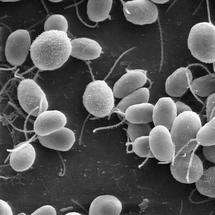
The hydrogen-producing green algae Chlamydomonas reinhardtii

(PhysOrg.com) -- Scientists have discovered how oxygen stops green algae from producing hydrogen. The findings could help those working towards 'solar H2-farms' in which microorganisms produce hydrogen fuel from sunlight and water.

An international team of scientists from Oxford University and universities in Germany report their results in two papers, one in the journal JACS and one in PNAS, published this week.

For years scientists have been interested in how we could, potentially, produce from just sunlight and water to power vehicles and other devices. One option is to use photosynthetic microorganisms that are able to produce hydrogen as well as starch. Green algae are one of the microorganisms that many have suggested could be turned into living hydrogen factories.

‘The hydrogen-producing enzyme found in green algae, known as an iron-iron hydrogenase, has evolved a structure that makes it particularly susceptible to attacking oxygen molecules,’ said Professor Fraser Armstrong from Oxford University’s Department of Chemistry, an author of both papers. ‘Because oxygen is a major by-product of the hydrogen-making photosynthetic process in such organisms, the build-up of oxygen, which rapidly attacks the active site of the enzyme, quickly brings the hydrogen-making process to an irreversible halt. Our work has revealed the mechanism of this process.’

The team used electrochemical kinetic methods to determine the order of events in which oxygen attacks the active site of an iron-iron hydrogenase found in the green algae Chlamydomonas reinhardtii. They combined their observations with data obtained from X-ray . By measuring ripples in the photoelectron of the enzyme under X-ray bombardment they were able to deduce the nature of the damage caused to the active site following attack by oxygen.

Yet while the research reported in PNAS shows just how destructive oxygen is to the enzyme powering ’s hydrogen-making process, the team’s research reported in JACS shows that similar hydrogenases produced by other microorganisms may possess greater tolerance to oxygen, sufficient perhaps to survive in the presence of oxygen released during photosynthetic hydrogen production.

Professor Armstrong said: ‘It shows that whilst we may have found a major obstacle along one route to the biological production of hydrogen, this knowledge could help us to identify new routes where nature could suggest an answer to the problem of ’s destructive effect on hydrogen-producing enzymes.’

The team will shortly be publishing the results of similar research into nickel-iron hydrogenases, enzymes related to those that enable blue-green algae to produce hydrogen.

Provided by Oxford University (news : web)


print this article email this article download pdf blog this article bookmark this article     Stumble it Digg this share on Facebook retweet share on Reddit add to delicious
Rate this story - 4.5 /5 (11 votes)

Rank Filter

Move the slider to adjust rank threshold, so that you can hide some of the comments.


Display comments: newest first

  • Sean_W - Sep 29, 2009
    • Rank: not rated yet
    If this could become a less expensive method of producing hydrogen it's great even if hydrogen is not the eventual energy carrier of the future. Making any chemical cheaper will always have spinoff benefits. Biotic generation seems a rather inefficient means of production but maybe lower capital costs and byproducts could make it economical.
  • E_L_Earnhardt - Sep 30, 2009
    • Rank: not rated yet
    Workers in these greenhouses may have to carry oxygen tanks for breathing!
  • jerryd - Oct 01, 2009
    • Rank: not rated yet
    Just what are you going to do with the H2 once you have it? It's not eff to store or use other than making chemicals right away.

    Far better is a fast growing biomass like hemp or bamboo and by FT process make about any HC/ syn fuel you want and electricity. Or dry the algae and do the same. Better would be harvesting floating plants, algae from lakes, ponds, rivers and FTing it. This not only makes energy but cleans the water too.

September 29, 2009 all stories

Comments: 3

4.5 /5 (11 votes)
  • Stumble this up

  • Digg this

  • share this

  • hide
  • Related Stories

  • Outlook bright for hydrogen biofuel cell
    created Oct 24, 2005 | popularity not rated yet | comments 0
  • Algae could generate hydrogen for fuel cells
    created Nov 13, 2007 | popularity not rated yet | comments 0
  • Research advances understanding of how hydrogen fuel is made
    created Oct 05, 2005 | popularity not rated yet | comments 0
  • New 'biofuel cell' produces electricity from hydrogen in plain air
    created Mar 26, 2007 | popularity not rated yet | comments 0
  • Algae could one day be major hydrogen fuel source
    created Apr 01, 2008 | popularity not rated yet | comments 0


  • hide
  • Relevant PhysicsForums posts

  • a question in Lewis structure???
    created 2 hours ago
  • Paint Technology
    created 18 hours ago
  • About pH, Metallic electrodes
    created Nov 24, 2009
  • Goddard
    created Nov 21, 2009
  • More from Physics Forums - Chemistry

Other News

Chemists get custom-designed microscopic particles to self-assemble in liquid crystal

Chemists get custom-designed microscopic particles to self-assemble in liquid crystal

Chemistry / Materials Science

created 38 minutes ago | popularity 5 / 5 (1) | comments 0

(PhysOrg.com) -- The scientists anticipate their "LithoParticles" will have significant applications in photonics, optical communications and other areas.


Study shows flavanol antioxidant content of US chocolate and cocoa-containing products

Chemistry / Other

created 2 hours ago | popularity not rated yet | comments 0

A recent study confirms that the antioxidants and other plant-based nutrients in chocolate and cocoa products are highly associated with the amount of non-fat cocoa-derived ingredients in the product. The study expands on ...


A sticky solution for identifying effective probiotics

Chemistry / Biochemistry

created 21 hours ago | popularity 5 / 5 (1) | comments 0

Scientists have crystallised a protein that may help gut bacteria bind to the gastrointestinal tract. The protein could be used by probiotic producers to identify strains that are likely to be of real benefit to people.


Sandia CR5

Machine Converts CO2 into Gasoline, Diesel, and Jet Fuel

Chemistry / Biochemistry

created Nov 23, 2009 | popularity 4.6 / 5 (30) | comments 19

(PhysOrg.com) -- Researchers at Sandia National Laboratories have built a machine that uses the sun's energy to convert carbon dioxide waste from power plants into transportation fuels such as gasoline, diesel, ...


New hydrogen-storage method discovered

New hydrogen-storage method discovered

Chemistry / Materials Science

created Nov 22, 2009 | popularity 4.3 / 5 (41) | comments 15

Scientists at the Carnegie Institution have found for the first time that high pressure can be used to make a unique hydrogen-storage material. The discovery paves the way for an entirely new way to approach ...