Was mighty T.rex 'Sue' felled by a lowly parasite?
September 29, 2009 by Terry Devitt
Was mighty T.rex 'Sue' felled by a lowly parasite?

Enlarge

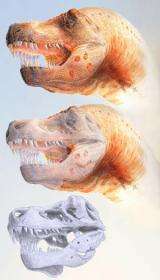
An artist’s rendering of a T. rex suffering from a trichomonosis-like disease, a parasitic infection caused by a protozoan, a single-celled organism that infects the mouth and throat and may have caused the animal to starve to death, according to a study conducted by an international team of researchers led by Ewan Wolff of UW-Madison’s School of Veterinary Medicine. The renderings show the infection and how it relates to the lesions found on the mandible of ’Peck’s Rex’ (Museum of the Rockies). Renderings by Chris Glen, University of Queensland

(PhysOrg.com) -- When pondering the demise of a famous dinosaur such as 'Sue,' the mighty Tyrannosaurus rex whose fossilized remains are a star attraction of the Field Museum in Chicago, it is hard to avoid the image of clashing Cretaceous titans engaged in bloody, mortal combat.

It is an image commonly promoted by museums and dinosaur aficionados. Sue's remains, in fact, exhibit holes in her jaw that some believed were battle scars, the result of conflict with another dinosaur, possibly another T. rex.

But a new study, published today (Sept. 29, 2009) in the online journal Public Library of Science One, provides evidence that Sue, perhaps the most famous dinosaur in the world, was felled in more mundane fashion by a lowly parasite that still afflicts modern birds. The study, conducted by an international team of researchers led by Ewan D.S. Wolff of the University of Wisconsin-Madison and Steven W. Salisbury of the University of Queensland, Australia, pins the demise of Sue and other tyrannosaurs with similar scars on an avian parasitic infection called trichomonosis, caused by a single-celled parasite that causes similar pathologies on the mandibles of modern birds, raptors in particular.

It is possible the infection in her throat and mouth may have been so acute that the 42-foot-long, 7-ton dinosaur starved to death, says Wolff, a vertebrate paleontologist and a third-year student at the UW-Madison School of Veterinary Medicine. Co-authors of the study include famed paleontologist John R. Horner of the Museum of the Rockies, which funded the study, and David J. Varricchio of Montana State University.

The focus of the new study was a survey of lesions on the jaws of Sue and nine other tyrannosaur specimens. The lesions had previously been attributed to bite wounds or, possibly, a bacterial infection.

"What drew my attention to trichomonosis as a potential candidate for these mysterious lesions on the jaws of tyrannosaurs is the manifestation of the effects of the disease in [bird] raptors," explains Wolff. "When we started looking at trichomonosis in greater depth, there was a story that matched some lines of evidence for transmission of the disease in tyrannosaurs."

In birds, trichomonosis is caused by a protozoan parasite called Trichomonas gallinae. It can be transmitted from birds such as pigeons, which commonly carry the parasite but often suffer few ill effects, to raptors such as falcons and hawks, where it causes serious lesions in the mandibles. The pattern of lesions, says Wolff, closely matches the holes in the jaws of tyrannosaurs and occurs in the same anatomical location.

The scars of combat among tyrannosaurs and other dinosaurs, Wolff notes, are not uncommon, but differ notably from the lesions that are the focus of the current study. The holes caused by trichomonosis tend to be neat and have relatively smooth edges, while bite marks are often messy, and they scar and puncture bone in ways that are not readily comparable.

Tyrannosaurs, notes Wolff, are known to have been gregarious, intermingling, fighting amongst themselves, and sometimes eating one another. Transmission of the parasite may have been through salivary contact or cannibalism, he says, noting that there is no known evidence of trichomonosis in other dinosaurs.

"This leads us to suspect that tyrannosaurs might have been the source of the disease and its transmission in its environment," Wolff says.

For the disease to manifest itself in the jaws of Sue and other tyrannosaurs, it would have had to be at an advanced stage as the parasite typically sets up housekeeping as a film in the back of the throat.

"The lesions we observe on Sue suggest a very advanced stage of the disease and may even have been the cause of her demise," says Wolff. "It is a distinct possibility as it would have made feeding incredibly difficult. You have to have a viable pharynx. Without that, you won't make it for very long, no matter how powerful you are."

Source: University of Wisconsin-Madison (news : web)

4.2 /5 (10 votes)  

Rank 4.2 /5 (10 votes)
Related Stories
Relevant PhysicsForums posts
  • Mitosis
    created6 hours ago
  • Stem cell question.
    created7 hours ago
  • Protease cleavage
    created14 hours ago
  • Pertubance in a model
    created20 hours ago
  • Cancer drugs and Alzheimer's, Oh my!
    createdFeb 09, 2012
  • Squishing cells
    createdFeb 09, 2012
  • More from Physics Forums - Biology

More news stories

A frank discussion of the power law and linking correlation to causation

(PhysOrg.com) -- Michael Stumpf a mathematics professor at Imperial College in London, and Mason Porter a lecturer at Oxford have teamed together to write and publish a perspective piece in Science regarding the in ...

Other Sciences / Mathematics

created 20 hours ago | popularity 5 / 5 (3) | comments 8 | with audio podcast report

Employers feel no love for unscrupulous practice of 'service sweethearting'

A new study led by two Florida State University marketing professors finds that some frontline service employees who are rewarded for hikes in customer loyalty and satisfaction also may engage in "service ...

Other Sciences / Economics & Business

created 14 hours ago | popularity 4 / 5 (1) | comments 7

The question of life in the ancient world

There’s a general feeling that we don’t get the Greeks – ancient or modern. Many, including heads of state like Angela Merkel, visibly shake their head in exasperation, rightly or wrongly, at ...

Other Sciences / Archaeology & Fossils

created 20 hours ago | popularity 1.3 / 5 (3) | comments 4

Sonic Cradle lands spot in TED exhibition

A Simon Fraser University graduate student project that melds music, meditation and modern technology has landed a rare spot as an exhibit at TEDActive 2012 in Palm Springs, California this month.

Other Sciences / Other

created 16 hours ago | popularity not rated yet | comments 0

Do we no longer care about the collective good?

The Transformation of Solidarity, a book co-edited by University of Queensland sociologist Dr Mara Yerkes, tackles the subject of globalisation of national economies and societies where we put a high value ...

Other Sciences / Social Sciences

created Feb 06, 2012 | popularity 3.9 / 5 (8) | comments 39


Anonymous knocks CIA website offline (Update)

The website of the Central Intelligence Agency was inaccessible on Friday after the hacker group Anonymous claimed to have knocked it offline.

New error-correcting codes guarantee the fastest possible rate of data transmission

Error-correcting codes are one of the triumphs of the digital age. They’re a way of encoding information so that it can be transmitted across a communication channel — such as an optical fiber o ...

Humans may have helped the decline of African rainforests 3000 years ago

(PhysOrg.com) -- Large areas of rainforests in Central Africa mysteriously disappeared over three thousand years ago, to be replaced by savannas. The prevailing theory has been that the cause was a change ...

New power source discovered

(PhysOrg.com) -- Researchers at the Massachusetts Institute of Technology (MIT) and RMIT University have made a breakthrough in energy storage and power generation.

Small modular reactor design could be a 'SUPERSTAR'

(PhysOrg.com) -- Though most of today's nuclear reactors are cooled by water, we've long known that there are alternatives; in fact, the world's first nuclear-powered electricity in 1951 came from a reactor ...

The power of estrogen -- male snakes attract other males

A new study has shown that boosting the estrogen levels of male garter snakes causes them to secrete the same pheromones that females use to attract suitors, and turned the males into just about the sexiest ...