Physicists create first atomic-scale map of quantum dots
September 29, 2009 Physicists create first atomic-scale map of quantum dots

Enlarge

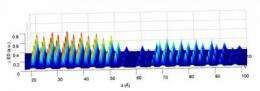
This is an atomic-scale map of the interface between an atomic dot and its substrate. Each peak represents a single atom. The map, made with high-intensity X-rays, is a slice through a vertical cross-section of the dot. Credit: Roy Clarke, University of Michigan

(PhysOrg.com) -- University of Michigan physicists have created the first atomic-scale maps of quantum dots, a major step toward the goal of producing "designer dots" that can be tailored for specific applications.

Quantum dots -- often called artificial atoms or nanoparticles -- are tiny semiconductor crystals with wide-ranging potential applications in computing, , light-emitting devices and other technologies. Each dot is a well-ordered cluster of atoms, 10 to 50 atoms in diameter.

Engineers are gaining the ability to manipulate the atoms in quantum dots to control their properties and behavior, through a process called directed assembly. But progress has been slowed, until now, by the lack of atomic-scale information about the structure and chemical makeup of quantum dots.

The new atomic-scale maps will help fill that knowledge gap, clearing the path to more rapid progress in the field of quantum-dot directed assembly, said Roy Clarke, U-M professor of physics and corresponding author of a paper on the topic published online Sept. 27 in the journal Nature Nanotechnology.

Lead author of the paper is Divine Kumah of the U-M's Program, who conducted the research for his doctoral dissertation.

"I liken it to exploration in the olden days," Clarke said of dot mapping. "You find a new continent and initially all you see is the vague outline of something through the mist. Then you land on it and go into the interior and really map it out, square inch by square inch.

"Researchers have been able to chart the outline of these quantum dots for quite a while. But this is the first time that anybody has been able to map them at the atomic level, to go in and see where the atoms are positioned, as well as their . It's a very significant breakthrough."

To create the maps, Clarke's team illuminated the dots with a brilliant X-ray photon beam at Argonne National Laboratory's Advanced Photon Source. The beam acts like an X-ray microscope to reveal details about the quantum dot's structure. Because X-rays have very short wavelengths, they can be used to create super-high-resolution maps.

"We're measuring the position and the chemical makeup of individual pieces of a quantum dot at a resolution of one-hundredth of a nanometer," Clarke said. "So it's incredibly high resolution."

The availability of atomic-scale maps will quicken progress in the field of directed assembly. That, in turn, will lead to new technologies based on quantum dots. The dots have already been used to make highly efficient lasers and sensors, and they might help make quantum computers a reality, Clarke said.

"Atomic-scale mapping provides information that is essential if you're going to have controlled fabrication of ," Clarke said. "To make dots with a specific set of characteristics or a certain behavior, you have to know where everything is, so that you can place the optimally. Knowing what you've got is the most important thing of all."

Source: University of Michigan (news : web)


print this article email this article download pdf blog this article bookmark this article     Stumble it Digg this share on Facebook retweet share on Reddit add to delicious
Rate this story - 4.7 /5 (13 votes)


September 29, 2009 all stories

Comments: 0

4.7 /5 (13 votes)
  • Stumble this up

  • Digg this

  • share this

  • hide
  • Related Stories

  • Single Atom Quantum Dots Bring Real Devices Closer (Video)
    created Jan 27, 2009 | popularity not rated yet | comments 0
  • Researchers Suggest Quantum Dots as Media for Teleportation
    created Jun 21, 2007 | popularity not rated yet | comments 0
  • Scientists find flaw in quantum dot construction
    created Feb 10, 2005 | popularity not rated yet | comments 0
  • Researchers set new record for brightness of quantum dots
    created Sep 25, 2007 | popularity not rated yet | comments 0
  • Researchers closer to mastering the 'spookiness' of quantum mechanics
    created Dec 15, 2006 | popularity not rated yet | comments 0


  • hide
  • Relevant PhysicsForums posts

  • Speed of light : missing energy
    created 4 hours ago
  • Can light produce darkness and can noise procude quiteness 4
    created 6 hours ago
  • Magnetic Oscillation Equations
    created 13 hours ago
  • US Physics Test Eligibility
    created 14 hours ago
  • More from Physics Forums - General Physics

Other News

Using superconducting probes to get a picture of what it's like inside CNTs

Nanotechnology / Nanophysics

created Nov 20, 2009 | popularity 4.9 / 5 (7) | comments 0

(PhysOrg.com) -- "Carbon nanotubes are exciting for fundamental physics, and for potential technological applications," Nadya Mason tells PhysOrg.com. "However, we are generally limited in the way that we can study them. ...


Nanoparticles used in common household items caused genetic damage in mice

Nanotechnology / Bio & Medicine

created Nov 16, 2009 | popularity 4.7 / 5 (22) | comments 11

Titanium dioxide (TiO2) nanoparticles, found in everything from cosmetics to sunscreen to paint to vitamins, caused systemic genetic damage in mice, according to a comprehensive study conducted by researchers at UCLA's Jonsson ...


Nanotube defects equal better energy and storage systems

Nanotube defects equal better energy and storage systems

Nanotechnology / Nanomaterials

created Nov 19, 2009 | popularity 4.4 / 5 (9) | comments 2

(PhysOrg.com) -- Most people would like to be able to charge their cell phones and other personal electronics quickly and not too often. A recent discovery made by UC San Diego engineers could lead to carbon ...


When It Comes to Drug Delivery, Size Matters

Nanotechnology / Bio & Medicine

created Nov 20, 2009 | popularity 5 / 5 (1) | comments 0

(PhysOrg.com) -- One of the great promises of nanotechnologies lies in its ability to create drug-containing nanoparticles decorated with targeting molecules that recognize and bind to cancer cells, providing drug delivery ...


Scientists synthesize graphene-like material: Polymer with honeycomb structure

Scientists synthesize graphene-like material: Polymer with honeycomb structure

Nanotechnology / Nanomaterials

created Nov 19, 2009 | popularity 4.5 / 5 (6) | comments 1

Two-dimensional carbon layers, so-called graphenes, are regarded as a possible substitute for silicon in the semiconductor industry. The electronic properties of these layers can be varied by "building in" ...