Why they grow? Getting to the roots of lethal metal whiskers
September 29, 2009
Getting to the roots of lethal hairs

Enlarge

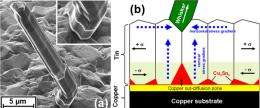
(a) This image from an ion beam microscope shows the growth morphology of a tin whisker. (b) A model of the forces that cause spontaneous whisker growth on tin-plated copper. The tin coating is a few micrometres thick. Image: Max Planck Institute for Metals Research, Stuttgart

(PhysOrg.com) -- A short circuit can be quite hairy: satellites have failed, a NASA computer centre was repeatedly paralysed and the US public heath authority recalled thousands of pacemakers - all because tin whiskers caused a short circuit in the electronic components of these devices.

A team of scientists from the Max Planck Institute for Metals Research has been working with Robert Bosch GmbH to measure the forces that trigger this metallic hair growth. Tin whiskers can be up to a few millimetres long and just a few micrometres in diameter. They sprout from the tin used to solder and plate made of copper. Understanding in detail what makes the whiskers grow is the first step on the way to preventing their growth. (Applied Physics Letters, June 2009)

The systems in a NASA computer centre failed after new data storage had been installed; at least 18 short circuits occurred in the high-performance computers before technicians found the reason: the replacement of the storage devices dislodged metal whiskers from the base construction and their subsequent distribution via air circulation caused system failure by bridging the electrical circuits of the supercomputers.

Researchers working with Eric J. Mittemeijer at the Max Planck Institute for Metals Research together with colleagues from the Robert Bosch GmbH, Argonne National Laboratory in Illinois and Oak Ridge National Laboratory in Tennessee have revealed the forces that cause these whiskers to sprout from tin-plated copper. According to their findings, the pressure of the tin atoms at the base of the film needs to be higher than at the surface. At the same time, there must be a pressure difference on the film’s surface plane: The pressure at the root of the tin whisker must be lower than it is further away. "You can compare it to a toothpaste tube," says Matthias Sobiech, who carried out the experiments. "When you press the sides, toothpaste comes out of the top." The pressure, which physicists also call stress, is created because an intermetallic tin-copper compound forms at the tin-copper interface that grows further into the tin film.

X-ray investigations provided a detailed picture of the distribution of the stress in the tin film. The researchers determined the stress differences between the base and the surface of the tin film in their laboratory in Stuttgart by measuring step by step the vertical mechanical stresses. In order to measure the distribution of stress in the surface plane around a growing whisker, the researchers had to use a method with very high spatial resolution in the sub-micron range. These micro stress measurements were taken using the synchrotron at the Advanced Photon Source at Argonne National Laboratory by means of the Micro Laue Diffraction method: A very fine beam of X-rays, around 300 nanometres in diameter, scanned the surroundings of a growing tin whisker in very small steps, and a sensitive detector very precisely recorded the local stresses at each probed position.

"We showed, for the first time, that tin whiskers are formed on tin layers which clearly exhibit mechanical stress differences," says Eric J. Mittemeijer, Director at the Max Planck Institute for Metals Research in Stuttgart. "And that these stress differences are the driving force for the growth of the whiskers." He and his colleagues demonstrated this in experiments by measuring local stress distributions in films that exhibit whisker growth and in films that do not exhibit whisker growth.

Looking closely at the state of stress in a material can be helpful in many investigations. It reveals a lot about the forces that operate in electronic or mechanical microsystems, which might have a detrimental effect on their function - in the same way as the tin whiskers cause short circuits in electronic components. "We hope that our findings will help to protect electronic components from the growth of tin whiskers," says Matthias Sobiech. "Because we now know that it is important to remove the stress differences in the film." The researchers are now setting out to investigate how that can be done successfully.

More information: Matthias Sobiech, Markus Wohlschlögel, Udo Welzel, Eric J. Mittemeijer, Werner Hügel, Andrea Seekamp, Wenjun Liu, and Gene E. Ice, Local, submicron, strain gradients as the cause of Sn whisker growth, 94 (2009), 221901

Provided by Max-Planck-Gesellschaft (news : web)

4.5 /5 (12 votes)  

Filter


Move the slider to adjust rank threshold, so that you can hide some of the comments.


Display comments: newest first

Pkunk_
Sep 29, 2009

Rank: 3.7 / 5 (3)
It would be interesting to know if this outburst of whiskering is due to the ROHS restrictions in effect for last 2 years.
Before ROHS they used to dope lead with tin to control the tin whisker problem.
PPihkala
Sep 30, 2009

Rank: 5 / 5 (1)
Before RoHS lead was added to soldering tin mix because 63% tin and 37% lead compound is the lowest melting point mixture one can make. But it also has been shown in previous research that lead is one of the best additives to tin to prevent tin whiskers from growing. It seems that 200-300 ppm of lead in solder should be enough to prevent whiskers and it would still make it RoHS compatible, as the limit for lead is 1000 ppm. So current problem might be that they make too pure (too few ppm of lead) solders for use in equipment.
Rank 4.5 /5 (12 votes)
Related Stories
Relevant PhysicsForums posts
  • Help with snow Crystals
    created10 hours ago
  • Doubts about surface plasmons
    createdFeb 11, 2012
  • excited U-236 decay time in the U235 fission chain
    createdFeb 09, 2012
  • Polar catastrophe?
    createdFeb 09, 2012
  • Large scale field sonication
    createdFeb 09, 2012
  • states and energy of paired electrons in BCS
    createdFeb 08, 2012
  • More from Physics Forums - Atomic, Solid State, Comp. Physics

More news stories

Researchers make better heat sensor based on butterfly wings

(PhysOrg.com) -- Scientists have long known that butterfly wings produce their iridescent colors by bouncing light around and between tiny ridges in structures made of chitin. More recently they’ve discovered ...

Physics / Optics & Photonics

created 57 minutes ago | popularity 5 / 5 (2) | comments 0 | with audio podcast report

Rapunzel, Leonardo and the physics of the ponytail

(PhysOrg.com) -- New research provides the first mathematical understanding of the shape of a ponytail and could have implications for the textile industry, computer animation and personal care products.

Physics / General Physics

created 3 hours ago | popularity 4.7 / 5 (3) | comments 0 | with audio podcast

Explained: Sigma

It's a question that arises with virtually every major new finding in science or medicine: What makes a result reliable enough to be taken seriously? The answer has to do with statistical significance -- but ...

Physics / General Physics

created Feb 09, 2012 | popularity 5 / 5 (21) | comments 87

Quantum physicist explains $100K offer for proof scaled-up quantum computing is impossible

(PhysOrg.com) -- MIT researcher Scott Aaronson has certainly riled the physics community with his offer this past Friday, of $100,000 to anyone who can prove that scaled-up quantum computing is impossible. ...

Physics / Quantum Physics

created Feb 08, 2012 | popularity 4.3 / 5 (15) | comments 37 | with audio podcast weblog

Hovering not hard if you're top-heavy, researchers find

Top-heavy structures are more likely to maintain their balance while hovering in the air than are those that bear a lower center of gravity, researchers at New York University's Courant Institute of Mathematical Sciences ...

Physics / General Physics

created Feb 10, 2012 | popularity 5 / 5 (4) | comments 5 | with audio podcast


Manipulating genes with hidden TALENs

(PhysOrg.com) -- A better understanding of gene function in model plant and animal systems could be used to develop useful traits in livestock and crop plants, and might someday lead to developments in stem ...

Alien matter in the solar system: A galactic mismatch

This just in: The Solar System is different from the space just outside it.

Transforming galaxies

(PhysOrg.com) -- Many of the Universe's galaxies are like our own, displaying beautiful spiral arms wrapping around a bright nucleus. Examples in this stunning image, taken with the Wide Field Camera 3 on ...

'Smart' microcapsules in a single step

(PhysOrg.com) -- A new, single-step method of fabricating microcapsules, which have potential commercial applications in industries including medicine, agriculture and diagnostics, has been developed by researchers ...

Don't ignore kids' snores

(Medical Xpress) -- Your ears aren’t playing tricks on you – that is the sound of snoring you hear from the bedroom of your preschooler. Snoring is common in children, but in some cases it can be a symptom of a ...

China's pollution puts a dent in its economy

Although China has made substantial progress in cleaning up its air pollution,a new MIT study shows that the economic impact from ozone and particulates in its air has increased dramatically. ...