'Green' research results in new geopolymer concrete technology
September 29, 2009 'Green' research results in new geopolymer concrete technology

Enlarge

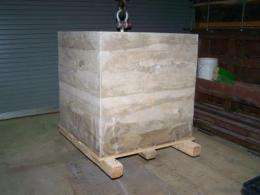
This is a 5,000 lb. geopolymer concrete block cast using fly ash. Credit: Louisiana Tech University

Dr. Erez Allouche, assistant professor of civil engineering at Louisiana Tech University and associate director of the Trenchless Technology Center, is conducting innovative research on geopolymer concrete and providing ways to use a waste byproduct from coal fired power plants and help curb carbon dioxide emissions.

Inorganic polymer (geopolymer) is an emerging class of cementitious materials that utilize "fly ash", one of the most abundant industrial by-products on earth, as a substitute for Portland cement, the most widely produced man-made material on earth.

Portland cement production is a major contributor to CO2 emissions as an estimated five to eight percent of all human-generated atmospheric CO2 worldwide comes from the concrete industry. Production of Portland cement is currently toping 2.6 billion tons per year worldwide and growing at 5 percent annually.

Geopolymer concrete has the potential to substantially curb CO2 emissions, produce a more durable infrastructure capable of design life measured in hundreds of years instead of tens, conserve hundreds of thousands of acres currently used for disposal of coal combustion products, and protect aquifers and surface bodies of fresh water via the elimination of fly ash disposal sites.

In comparison to ordinary Portland cement (OPC), geopolymer concrete (GPC) features greater , substantially higher fire resistance (up to 2400° F), high compressive and tensile strengths, a rapid strength gain, and lower shrinkage.

Perhaps Geopolymer concrete's greatest appeal is its life cycle greenhouse gas reduction potential; as much as 90% when compared with OPC.

This technology, along with other important research being conducted to meet future energy needs, will be highlighted at Louisiana Tech will feature this technology at its Energy Systems Conference on November 5 at the Technology Transfer Center in Shreveport.

Source: Louisiana Tech University


Rate this story - 4.2 /5 (15 votes)

Rank Filter

Move the slider to adjust rank threshold, so that you can hide some of the comments.


Display comments: newest first

  • Charlie_O - Oct 06, 2009
    • Rank: not rated yet
    My only concern in this otherwise great news is that fly ash often contains radioactive contaminants.
    http://pubs.usgs....-97.html
    Stuff that has seeped into the coal beds when they where forming, usually uranium.

September 29, 2009 all stories

Comments: 1

4.2 /5 (15 votes)

  • hide
  • Related Stories

  • Green Ideas: Making Concrete from Rice
    created Jul 21, 2009 | popularity not rated yet | comments 0
  • Strong, lightweight green material could replace concrete, but contains no cement
    created Nov 25, 2008 | popularity not rated yet | comments 0
  • Nanoengineered concrete could cut CO2 emissions
    created Jan 29, 2007 | popularity not rated yet | comments 0
  • Laying the foundations for a green industry
    created Jul 31, 2006 | popularity not rated yet | comments 0
  • Working on the railroad? Using concrete could help environment
    created May 07, 2009 | popularity not rated yet | comments 0


  • hide
  • Relevant PhysicsForums posts

Other News

The power of 'random'

The power of 'random': 'Seemingly loopy' technique could dramatically improve communications networks

Technology / Computer Sciences

created 19 hours ago | popularity 4.8 / 5 (9) | comments 5 | with audio podcast

A radical new approach to the design of communications networks, called "network coding," promises to make Internet file sharing faster, streaming video more reliable, and cell-phone reception better -- among ...


'Revolutionary' water treatment units on their way to Afghanistan

Technology / Engineering

created 14 hours ago | popularity 4.4 / 5 (7) | comments 5 | with audio podcast

The United States Army has taken delivery of the first two units of a "revolutionary" waste-water treatment system that will clean putrid water within 24 hours and leave no toxic by-products, according to scientists at Sam ...


Android

Google developing a translator for smartphones

Technology / Software

created 20 hours ago | popularity 4.8 / 5 (9) | comments 3 | with audio podcast report

(PhysOrg.com) -- Google is developing a translator for its Android smartphones that aims to almost instantly translate from one spoken language to another during phone calls.


Imec and Holst Centre achieve breakthrough in battery-less radios

Imec achieves breakthrough in battery-less radios

Technology / Semiconductors

created 14 hours ago | popularity 4.9 / 5 (14) | comments 1 | with audio podcast

At today's International Solid State Circuit Conference, Imec and Holst Centre report a 2.4GHz/915MHz wake-up receiver which consumes only 51µW power. This record low power achievement opens the door to battery-less ...


In Utah, company aims to store energy in air

Technology / Energy

created 23 hours ago | popularity 3.4 / 5 (10) | comments 2

A Utah company plans to dig a series of underground caverns that it hopes to one day fill with compressed air, releasing it to generate electricity by turning a turbine and solving one of the most vexing problems facing the ...