Cloudy with a chance of pebble showers: Simulation suggests rocky exoplanet has bizarre atmosphere
September 29, 2009 By Diana Lutz Cloudy with a chance of pebble showers: Simulation suggests rocky exoplanet has bizarre atmosphere

Enlarge

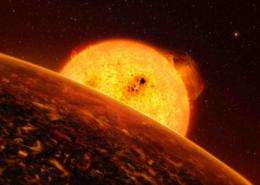
The exoplanet COROT-7b is close enough to its star that its "day-face" is hot enough to melt rock. Theoretical models suggest the planet has an atmosphere of the components of rock in gaseous form and lava or boiling oceans on its surface. Image by ESO/L. Calcada. The original file can be found at www.eso.org/gallery/v/ESOPIA/illustrations/phot-33a-09-fullres.tif.html

(PhysOrg.com) -- So accustomed are we to the sunshine, rain, fog and snow of our home planet that we find it next to impossible to imagine a different atmosphere and other forms of precipitation.

To be sure, Dr. Seuss came up with a green gluey substance called oobleck that fell from the skies and gummed up the Kingdom of Didd, but it had to be conjured up by wizards and was clearly a thing of magic.

Not so the of COROT-7b, an discovered last February by the COROT space telescope launched by the French and European space agencies.

According to models by scientists at Washington University in St. Louis, COROT-7b's atmosphere is made up of the ingredients of rocks and when "a front moves in," pebbles condense out of the air and rain into lakes of molten lava below.

The work, by Laura Schaefer, research assistant in the Planetary Chemistry Laboratory, and Bruce Fegley Jr., Ph.D., professor of earth and planetary sciences in Arts & Sciences, appears in the Oct. 1 issue of The Astrophysical Journal.

Astronomers have found nearly 400 extra-solar planets, or exoplanets, in the past 20 years. But because of the limitations of the indirect means by which they are discovered, most are Hot Jupiters, chubby gas giants orbiting close to their parent stars. (More than 1,300 Earths could be packed inside Jupiter, which has 300 times the mass of Earth.)

COROT-7b, on the other hand, is less than twice the size of Earth and only five times its mass.

It was the first planet found orbiting the star COROT-7, and orange dwarf in the constellation Monoceros, or the Unicorn. (This priority is designated by the letter b.)

Solid as a Rock

In August 2009 a consortium of European observatories led by the Swiss reported the discovery of COROT-7c, a second planet orbiting COROT-7.

Using the data from both , they were able to calculatethat COROT-7b has an average density about the same as Earth's. This means it is almost certainly a rocky planet made up of silicate rocks like those in Earth's crust, says Fegley.

Not that anyone would call it Earth-like, much less hospitable to life. The planet and its star are separated by only 1.6 million miles, 23 times less than the distance between the parboiled planet Mercury and our Sun.

Because the planet is so close to the star, it is gravitationally locked to it in the same way the Moon is locked to Earth. One side of the planet always faces its star, just as one side of the Moon always faces Earth.

This star-facing side has a temperature of about 2600 degrees Kelvin (4220 degrees Fahrenheit). That's infernally hot—hot enough to vaporize rocks. The global average temperature of Earth's surface, in contrast, is only about 288 degrees Kelvin (59 degrees Fahrenheit).

The side in perpetual shadow, on the other hand, is positively chilly at 50 degrees Kelvin (-369 degrees Fahrenheit).

Perhaps because they were cooked off, COROT-7b's atmosphere has none of the volatile elements or compounds that make up Earth's atmosphere, such as water, nitrogen and carbon dioxide.

"The only atmosphere this object has is produced from vapor arising from hot molten silicates in a lava lake or lava ocean," Fegley says.

What might that atmosphere be like? To find out Schaefer and Fegley have used thermochemical equilibrium calculations to model COROT-7b's atmosphere.

The calculations, which reveal which mineral assemblages are stable under different conditions, were carried out with MAGMA, a computer program Fegley developed in 1986 with the late A. G. W. Cameron, a professor of astrophysics at Harvard University.

Schaefer and Fegley modified the MAGMA program in 2004 in order to study high-temperature volcanism on Io, Jupiter's innermost Galilean satellite. This modified version was used in their present work.

Raining Rocks

Because the scientists didn't know the exact composition of the planet, they ran the program with four different starting compositions. "We got essentially the same result in all four cases," says Fegley.

"Sodium, potassium, silicon monoxide and then oxygen — either atomic or molecular oxygen — make up most of the atmosphere." But there are also smaller amounts of the other elements found in silicate rock, such as magnesium, aluminum, calcium and iron.

Why is there oxygen on a dead planet, when it didn't show up in Earth's atmosphere until 2.4 billion years ago, when plants started to produce it?

"Oxygen is the most abundant element in rock," says Fegley, "so when you vaporize rock what you end up doing is producing a lot of oxygen."

The peculiar atmosphere has its own singular weather. "As you go higher the atmosphere gets cooler and eventually you get saturated with different types of 'rock' the way you get saturated with water in the atmosphere of Earth," explains Fegley. "But instead of a water cloud forming and then raining water droplets, you get a 'rock cloud' forming and it starts raining out little pebbles of different types of rock."

Even more strangely, the kind of rock condensing out of the cloud depends on the altitude. The atmosphere works the same way as fractionating columns, the tall knobby columns that make petrochemical plants recognizable from afar. In a fractionating column, crude oil is boiled and its components condense out on a series of trays, with the heaviest one (with the highest boiling point) sulking at the bottom, and the lightest (and most volatile) rising to the top.

Instead of condensing out hydrocarbons such as asphalt, petroleum jelly, kerosene and gasoline, the exoplanet's atmosphere condenses out minerals such as enstatite, corundum, spinel, and wollastonite. In both cases the fractions fall out in order of boiling point.

Elemental sodium and potassium, which have very low boiling points in comparison with rocks, do not rain out but would instead stay in the atmosphere, where they would form high gas clouds buffeted by the stellar wind from COROT-7.

These large clouds may be detectable by Earth-based telescopes. The sodium, for example, should glow in the orange part of the spectrum, like a giant but very faint sodium vapor streetlamp.

Observers have recently spotted sodium in the atmospheres of two other exoplanets.

The atmosphere of COROT-7b may not be breathable, but it is certainly amusing.

Provided by Washington University in St. Louis (news : web)


print this article email this article download pdf blog this article bookmark this article     Stumble it Digg this share on Facebook retweet share on Reddit add to delicious
Rate this story - 4.7 /5 (26 votes)

Rank Filter

Move the slider to adjust rank threshold, so that you can hide some of the comments.


Display comments: newest first

  • NotAsleep - Sep 29, 2009
    • Rank: 5 / 5 (5)
    The atmosphere of COROT-7b may not be breathable, but it is certainly amusing.


    I'm definitely going to try and work that quote into casual conversation today
  • Husky - Sep 29, 2009
    • Rank: 4.5 / 5 (2)
    Because of the tidal lock there could be some sweet spots between the lavaside and the chilly side, where extremophiles are protected from the stars radiation and a temperature halfway between lava and ice
  • Graeme - Sep 29, 2009
    • Rank: 5 / 5 (1)
    Since the temperature varies so much across the planet, the subsolar point will be doing more lava vapourisation, and lava fall will occur where the sun is lower in the sky. This will mean there is a lava ocean circulation. Further near the edge of the planet, the alkali metals will be raining out possibly having a river of molten alkali oxide flowing over solid rock into the lava ocean. The solid rock shores of the ocean would gradually build up with dust fall. Has anyone produced a model of how this would look or the geology involved?
  • nuge - Sep 30, 2009
    • Rank: 5 / 5 (1)
    Now that would be an awesome planet for an interstellar probe to visit. Man this is cool.
  • physorgfan1 - Sep 30, 2009
    • Rank: 4 / 5 (1)
    Wouldn't an atmosphere imply a better heat distribution then having the other side at 50 degrees kelvin?
  • docknowledge - Sep 30, 2009
    • Rank: not rated yet
    So, with the tidal lock, would the most significant weathering factor on the dark side be pebble abrasion?
  • Adriab - Sep 30, 2009
    • Rank: not rated yet
    ...The solid rock shores of the ocean would gradually build up with dust fall. Has anyone produced a model of how this would look or the geology involved?


    That'd be a pretty involved model, generating that sucker would take a lot of computational horse-power and sufficiently powerful modeling software. Nothing I am aware of can do that right now, but it would make for a nice project.
  • omatumr - Sep 30, 2009
    • Rank: 2.5 / 5 (2)
    Congratulations!

    It sounds like Laura Schaefer and Bruce Fegley Jr. have a rocky planet!

    And their planet orbits close to the central star, like the rocky planets here.

    That means the planet is made of elements like Fe, O, Si, Ni and S that were made in the deep interior of a supernova.

    Again, congratulations!

    Oliver K. Manuel
  • johnwbales - Sep 30, 2009
    • Rank: not rated yet
    Consider this scenario. Atmospheric convection causes solid particulates to accumulate on the dark side until the center of mass shifts enough for tidal forces to shift the night side toward the sun. There the surface is melted and the cycle repeats.
  • Thecis - Oct 02, 2009
    • Rank: 5 / 5 (1)
    Congratulations!

    It sounds like Laura Schaefer and Bruce Fegley Jr. have a rocky planet!

    And their planet orbits close to the central star, like the rocky planets here.

    That means the planet is made of elements like Fe, O, Si, Ni and S that were made in the deep interior of a supernova.

    Again, congratulations!

    Oliver K. Manuel


    I agree it is an achievement. But look at the text below
    ----------------
    Using the data from both planets, they were able to calculatethat COROT-7b has an average density about the same as Earth's. This means it is almost certainly a rocky planet made up of silicate rocks like those in Earth's crust, says Fegley.
    ----------------

    They mention it is ALMOST certain, they are not entirely sure. Lets wait for the spectral data before jumping to conclusions.

    Our solar system isn't special, we just live here. I expect other system can be build up just as here with the rocky planets close to the sun.
  • yyz - Oct 04, 2009
    • Rank: not rated yet
    What level of Hell would COROT-7b occupy in Dante's Inferno?
  • physorgfan1 - Oct 04, 2009
    • Rank: not rated yet
    What level of Hell would COROT-7b occupy in Dante's Inferno?


    I'd love to see the Dante Planet Rating System being adopted.

September 29, 2009 all stories

Comments: 12

4.7 /5 (26 votes)
  • Stumble this up

  • Digg this

  • share this

  • hide
  • Related Stories

  • Field guide for confirming new earth-like planets described
    created Sep 07, 2005 | popularity not rated yet | comments 0
  • Origins of life
    created Sep 07, 2005 | popularity not rated yet | comments 0
  • Computer models suggest planetary and extrasolar planet atmospheres
    created Jun 15, 2007 | popularity not rated yet | comments 0
  • Team finds smallest transiting extrasolar planet ever
    created Feb 03, 2009 | popularity not rated yet | comments 0
  • First Solid Evidence for a Rocky Exoplanet (w/ Video)
    created Sep 16, 2009 | popularity not rated yet | comments 0


  • hide
  • Relevant PhysicsForums posts

  • basic 'our universe' question..
    created 8 hours ago
  • deriving keplers law
    created Nov 19, 2009
  • rotation of Earth
    created Nov 18, 2009
  • elliptical orbits
    created Nov 18, 2009
  • Apophis
    created Nov 18, 2009
  • Summer Research project
    created Nov 18, 2009
  • More from Physics Forums - General Astronomy

Other News

Cassini's Big Sky: The View from the Center of Our Solar System

Cassini's Big Sky: The View from the Center of Our Solar System

Space & Earth / Space Exploration

created 17 hours ago | popularity 4.7 / 5 (10) | comments 1

(PhysOrg.com) -- When NASA's Cassini spacecraft began orbiting Saturn five years ago, a dozen highly-tuned science instruments set to work surveying, sniffing, analyzing and scrutinizing the Saturnian system.


More than 18 million cubic metres of sand are set to be poured onto the new coastal band of dunes until 2011

Dutch build more dunes against rising seas

Space & Earth / Environment

created 12 hours ago | popularity 3.7 / 5 (3) | comments 0

On the beach at Monster, bulldozers painstakingly turn sand dredged from the bottom of the North Sea bed into dunes in an ambitious effort to safeguard the Netherlands from flooding.


Some 6,000 families were affected by the drought in the Chaco region of Paraguay, particularly indigenous populations

El Nino intensifies Latin America drought

Space & Earth / Earth Sciences

created 19 hours ago | popularity 5 / 5 (2) | comments 0

From a devastating food crisis in Guatemala to water cuts in Venezuela, El Nino has compounded drought damage across Latin America this year.


New Method to Measure Snow, Soil Moisture With GPS May Benefit Meteorologists, Farmers

Space & Earth / Earth Sciences

created 12 hours ago | popularity not rated yet | comments 1

(PhysOrg.com) -- A research team led by the University of Colorado at Boulder has found a clever way to use traditional GPS satellite signals to measure snow depth as well as soil and vegetation moisture, a technique expected ...


Astronauts await word of baby girl on Earth (AP)

Astronauts await word of baby girl on Earth

Space & Earth / Space Exploration

created 13 hours ago | popularity 5 / 5 (1) | comments 0

(AP) -- Atlantis' astronauts anxiously awaited word on the birth of one crewman's daughter Friday, as they moved more supplies into the International Space Station and geared up for another spacewalk.