Nero's rotating banquet hall unveiled in Rome
September 29, 2009 By MARTA FALCONI , Associated Press Writer Nero's rotating banquet hall unveiled in Rome (AP)

Enlarge

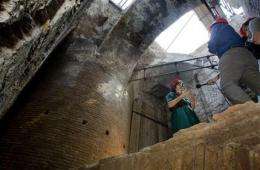
Superintendent Maria Antonietta Tomei, center, speaks to reporters in a recently unearthed brick structure, incorporating a 4-meter diameter pillar, seen at left, discovered during maintenance works in the Roman Forum in Rome, Tuesday, Sept. 29, 2009. Archaeologists believe the structure supported a rotating dining room imitating the Earth's movement and used by Roman Emperor Nero to impress his guests in his Golden Palace. The Golden Palace, also known by its Latin name Domus Aurea, rose over the ruins of a fire that destroyed much of Rome in 64 A.D. and was completed in 68 A.D. (AP Photo/Domenico Stinellis)

(AP) -- Archaeologists on Tuesday unveiled what they think are the remains of Roman emperor Nero's extravagant banquet hall, a circular space that rotated day and night to imitate the Earth's movement and impress his guests.

The room, part of Nero's Golden Palace, a sprawling residence built in the first century A.D., is thought to have been built to entertain government officials and VIPs, said lead archaeologist Francoise Villedieu.

The emperor, known for his lavish and depraved lifestyle, ruled from 37 A.D. to 68 A.D.

The dig so far has turned up the foundations of the room, the rotating mechanism underneath and part of an attached space believed to be the kitchens, she said.

"This cannot be compared to anything that we know of in ancient Roman architecture," Villedieu told reporters during a tour of the cordoned-off dig.

She said the location of the discovery atop the Palatine Hill, the rotating structure and references to it in ancient biographies of Nero make the attribution to the emperor most likely.

The partially excavated site is part of the sumptuous residence, also known by its Latin name Domus Aurea, which rose over the ruins of a fire that destroyed much of Rome in A.D. 64.

The purported main dining room, with a diameter of over 50 feet (16 meters), rested upon a 13-foot (4-meter) wide pillar and four spherical mechanisms that, likely powered by a constant flow of water, rotated the structure.

The discovery was made during routine maintenance of the fragile Palatine area, officials said.

Latin biographer and historian Suetonius, who chronicled his times and wrote the biographies of 12 Roman rulers, refers to a main dining room that revolved "day and night, in time with the sky."

Angelo Bottini, the state's top official for archaeology in Rome, said the ceiling of the rotating room might have been the one mentioned by Suetonius, who wrote of ivory panels sliding back and forth to shower flowers and perfumes on the guests below.

"The heart of every activity in ancient Rome was the banquet, together with some form of entertainment," Bottini said at the dig. "Nero was like the sun, and people were revolving around the emperor."

That part of the palace - which sprawled across nearly 200 acres (80 hectares) occupying parts of four out of Rome's seven ancient hills - offered a panoramic view over the Roman Forum and a lake, later drained by Nero's successors to build the Colosseum, Bottini said.

Described by Suetonius as one of Rome's most cruel, depraved and megalomaniac rulers, Nero often indulged in orgies and, fancying himself an artist, entertained guests with his own performances of poetry and songs.

However, Nero did not enjoy the frescoed halls and gold-encrusted ceilings of his Golden Palace for too long. It was completed in A.D. 68 - the year the unpopular emperor committed suicide amid a revolt.

©2009 The Associated Press. All rights reserved. This material may not be published, broadcast, rewritten or redistributed.


print this article email this article download pdf blog this article bookmark this article     Stumble it Digg this share on Facebook retweet share on Reddit add to delicious
Rate this story - 5 /5 (5 votes)


September 29, 2009 all stories

Comments: 0

5 /5 (5 votes)
  • Stumble this up

  • Digg this

  • share this

  • hide
  • Related Stories

  • Archaeologists unearth 'birthplace of Roman emperor' in Italy
    created Aug 06, 2009 | popularity not rated yet | comments 0
  • Dig yields shrine to Roman twins' she-wolf
    created Nov 21, 2007 | popularity not rated yet | comments 0
  • Ancient marble staircase found in Rome
    created Apr 20, 2008 | popularity not rated yet | comments 0
  • In Brief: Archaeologists find Augustan head in Italy
    created May 09, 2006 | popularity not rated yet | comments 0
  • Emperors in crisis
    created Dec 07, 2006 | popularity not rated yet | comments 0


  • hide
  • Relevant PhysicsForums posts

  • Questions about diffusion
    created 2 hours ago
  • Human Leukocyte Antigen (HLA) typing
    created 9 hours ago
  • Breeding program
    created Nov 20, 2009
  • How does a concentration gradient provide energy?
    created Nov 20, 2009
  • More from Physics Forums - Biology

Other News

Museum: Galileo's fingers, tooth are found (AP)

Museum: Galileo's fingers, tooth are found

Other Sciences / Archaeology & Fossils

created 20 hours ago | popularity 4 / 5 (1) | comments 5

(AP) -- Two fingers and a tooth removed from Galileo Galilei's corpse in a Florentine basilica in the 18th century and given up for lost have been found again and will soon be put on display, an Italian museum ...


Measure to change U. of Neb. stem-cell rule fails (AP)

Measure to change U. of Neb. stem-cell rule fails (Update 2)

Other Sciences / Other

created 20 hours ago | popularity 5 / 5 (1) | comments 0

(AP) -- The University of Nebraska's governing board on Friday voted not to place tighter restrictions on embryonic stem cell research than those outlined under federal guidelines, which were expanded after ...


Researcher: Faint writing seen on Shroud of Turin (AP)

Researcher: Faint writing seen on Shroud of Turin (Update)

Other Sciences / Archaeology & Fossils

created Nov 20, 2009 | popularity 2 / 5 (24) | comments 23

(AP) -- A Vatican researcher has rekindled the age-old debate over the Shroud of Turin, saying that faint writing on the linen proves it was the burial cloth of Jesus. Experts say the historian may be reading ...


Three of a kind

Three of a kind: Revealing language’s universal essence

Other Sciences / Social Sciences

created Nov 20, 2009 | popularity 3.9 / 5 (11) | comments 6

(PhysOrg.com) -- On the surface, English, Japanese, and Kinande, a member of the Bantu family of languages spoken in the Democratic Republic of Congo, have little in common. It is not just that the vocabularies ...


Maya

New insights into the life of the Maya

Other Sciences / Archaeology & Fossils

created Nov 16, 2009 | popularity 4.6 / 5 (15) | comments 7

(PhysOrg.com) -- Ancient artifacts are almost always concerned with rich and powerful religious and political leaders, but new excavations of an ancient Maya site have unearthed a pyramid decorated with murals ...