A step toward better brain implants using conducting polymer nanotubes
September 29, 2009
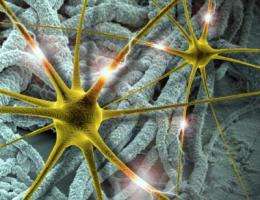
This illustration depicts neurons firing (green structures in the foreground) and communicating with nanotubes in the background. Credit: Illustration courtesy of Mohammad Reza Abidian
ANN ARBOR, Mich.---Brain implants that can more clearly record signals from surrounding neurons in rats have been created at the University of Michigan. The findings could eventually lead to more effective treatment of neurological disorders such as Parkinson's disease and paralysis.
Neural electrodes must work for time periods ranging from hours to years. When the electrodes are implanted, the brain first reacts to the acute injury with an inflammatory response. Then the brain settles into a wound-healing, or chronic, response.
It's during this secondary response that brain tissue starts to encapsulate the electrode, cutting it off from communication with surrounding neurons.
The new brain implants developed at U-M are coated with nanotubes made of poly(3,4-ethylenedioxythiophene) (PEDOT), a biocompatible and electrically conductive polymer that has been shown to record neural signals better than conventional metal electrodes.
U-M researchers found that PEDOT nanotubes enhanced high-quality unit activity (signal-to-noise ratio >4) about 30 percent more than the uncoated sites. They also found that based on in vivo impedance data, PEDOT nanotubes might be used as a novel method for biosensing to indicate the transition between acute and chronic responses in brain tissue.
The results are featured in the cover article of the Oct. 5 issue of the journal Advanced Materials. The paper is titled, "Interfacing Conducting Polymer Nanotubes with the Central Nervous System: Chronic Neural Recording using Poly(3-4-ethylenedioxythiophene) Nanotubes."
"Microelectrodes implanted in the brain are increasingly being used to treat neurological disorders," said Mohammad Reza Abidian, a post-doctoral researcher working with Professor Daryl Kipke in the Neural Engineering Laboratory at the U-M Department of Biomedical Engineering.
"Moreover, these electrodes enable neuroprosthetic devices, which hold the promise to return functionality to individuals with spinal cord injuries and neurodegenerative diseases. However, robust and reliable chronic application of neural electrodes remains a challenge."
In the experiment, the researchers implanted two neural microelectrodes in the brains of three rats. PEDOT nanotubes were fabricated on the surface of every other recording site by using a nanofiber templating method. Over the course of seven weeks, researchers monitored the electrical impedance of the recording sites and measured the quality of recording signals.
PEDOT nanotubes in the coating enable the electrodes to operate with less electrical resistance than current metal electrode sites, which means they can communicate more clearly with individual neurons.
"Conducting polymers are biocompatible and have both electronic and ionic conductivity," Abidian said. "Therefore, these materials are good candidates for biomedical applications such as neural interfaces, biosensors and drug delivery systems."
In the experiments, the Michigan researchers applied PEDOT nanotubes to microelectrodes provided by the U-M Center for Neural Communication Technology. The PEDOT nanotube coatings were developed in the laboratory of David C. Martin, now an adjunct professor of materials science and engineering, macromolecular science and engineering, and biomedical engineering. Martin is currently the Karl W. Böer Professor and Chair of the Materials Science and Engineering Department at the University of Delaware.
Martin is also co-founder and chief scientific officer for Biotectix, a U-M spinoff company located in Ann Arbor. The company is working to commercialize conducting polymer-based coatings for a variety of biomedical devices
In previous experiments, Abidian and his colleagues have shown that PEDOT nanotubes could carry with them drugs to prevent encapsulation.
"This study paves the way for smart recording electrodes that can deliver drugs to alleviate the immune response of encapsulation," Abidian said.
More information: Scientific article: http://www3.inters … 755/PDFSTART
Source: University of Michigan
-
Nanotech coating could lead to better brain implants to treat diseases
Mar 10, 2009 |
not rated yet |
0
-
Carbon Nanotube-Coated Electrodes Improve Brain Readouts
Aug 12, 2008 |
not rated yet |
0
-
New 'smart' materials for the brain
Dec 21, 2008 |
not rated yet |
0
-
Coatings to help medical implants connect with neurons
Aug 21, 2008 |
not rated yet |
0
-
Researchers engineer new polymers to change their stiffness, strength when exposed to liquids
Mar 06, 2008 |
not rated yet |
0
-
Engineers build first sub-10-nm carbon nanotube transistor
Feb 01, 2012 |
4.9 / 5 (31) |
30
-
Something old, something new: Evolution and the structural divergence of duplicate genes
Jan 31, 2012 |
4.6 / 5 (7) |
1
-
The hidden nanoworld of ice crystals: Revealing the dynamic behavior of quasi-liquid layers
Jan 30, 2012 |
5 / 5 (3) |
1
-
Stock market network reveals investor clustering
Jan 27, 2012 |
3.9 / 5 (23) |
8
-
Of microchemistry and molecules: Electronic microfluidic device synthesizes biocompatible probes
Jan 26, 2012 |
5 / 5 (1) |
0
-
polymer nanocomposites
15 hours ago
-
Corrosion Tests on Magnesium
Feb 09, 2012
-
polyethylene copper nanocomposite
Feb 09, 2012
-
Output of xrd analysis
Feb 08, 2012
-
Transport phenomena problem based on problems 18.B11 and 19B.6 from Bird, stewart, lw
Feb 06, 2012
-
Help with material selection - Car Piston
Feb 05, 2012
- More from Physics Forums - Materials & Chemical Engineering
More news stories
'Dark plasmons' transmit energy
Microscopic channels of gold nanoparticles have the ability to transmit electromagnetic energy that starts as light and propagates via "dark plasmons," according to researchers at Rice University.
23 hours ago |
5 / 5 (6) |
1
|
What lies beneath: Mapping hidden nanostructures
The ability to diagnose and predict the properties of materials is vital, particularly in the expanding field of nanotechnology. Electron and atom-probe microscopy can categorize atoms in thin sheets of material, ...
7 hours ago |
5 / 5 (1) |
1
New kind of solar cell could capture significantly more energy than current cells
New solar cells could increase the maximum efficiency of solar panels by over 25%, according to scientists from the University of Cambridge.
Feb 08, 2012 |
4.5 / 5 (12) |
14
|
Nanoshell whispering galleries improve thin solar panels
Visitors to Statuary Hall in the U.S. Capitol Building may have experienced a curious acoustic feature that allows a person to whisper softly at one side of the cavernous, half-domed room and for another on ...
Nanotechnology / Nanomaterials
Feb 07, 2012 |
4.3 / 5 (6) |
6
|
Nanotube therapy takes aim at breast cancer stem cells
Wake Forest Baptist Medical Center researchers have again proven that injecting multiwalled carbon nanotubes (MWCNTs) into tumors and heating them with a quick, 30-second laser treatment can kill them.
Nanotechnology / Bio & Medicine
Feb 09, 2012 |
5 / 5 (1) |
0
|
CIA website offline, Anonymous takes credit
The website of the Central Intelligence Agency was unresponsive on Friday after the hacker group Anonymous claimed to have knocked it offline.
Q&A: Obama and the birth control controversy
(AP) -- What birth control debate? A half-century after the introduction of the pill, acceptance of birth control by American women is virtually universal.
Complex wiring of the nervous system may rely on a just a handful of genes and proteins
Researchers at the Salk Institute have discovered a startling feature of early brain development that helps to explain how complex neuron wiring patterns are programmed using just a handful of critical genes. ...
The power of estrogen -- male snakes attract other males
A new study has shown that boosting the estrogen levels of male garter snakes causes them to secrete the same pheromones that females use to attract suitors, and turned the males into just about the sexiest ...
New error-correcting codes guarantee the fastest possible rate of data transmission
Error-correcting codes are one of the triumphs of the digital age. Theyre a way of encoding information so that it can be transmitted across a communication channel such as an optical fiber o ...
Humans may have helped the decline of African rainforests 3000 years ago
(PhysOrg.com) -- Large areas of rainforests in Central Africa mysteriously disappeared over three thousand years ago, to be replaced by savannas. The prevailing theory has been that the cause was a change ...
Oct 02, 2009
Rank: not rated yet