Fruit fly sperm makes females do housework after sex
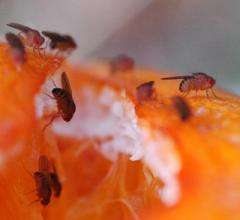
The sperm of male fruit flies are coated with a chemical 'sex peptide' which inhibits the female's usual afternoon siesta and compels her into an intense period of foraging activity.
The surprise discovery was made by Professor Elwyn Isaac from the University of Leeds' Faculty of Biological Sciences when investigating the marked differences in sleeping patterns between virgin and mated females.
Both male and female fruit flies (Drosophila melanogaster) - commonly seen hovering around rotting fruit and vegetables - are active at dawn and dusk, and have a deep sleep at night. They also exhibit a marked 'resting state' during the afternoon, which Professor Isaac likens to a siesta that conserves the fly's energy and reduces damaging exposure to the sun during hot afternoons.
"However, we noted that after mating, females still slept deeply at night, but ditched the usual siesta in favour of extra foraging and searching for places to lay her eggs," he says. "This behaviour lasts for around eight days - and our research findings suggest that this change is not by choice. Females who mated with males that produced sperm without the sex peptide continued to take their siesta. So we're certain that this change of behaviour is chemically induced by the male."
"Sleep is an ancient and essential mechanism in living creatures from worms to humans, so to inhibit this for such a long period and replace it with extra activity that exposes the female to environmental hazards and danger from predators must require a powerful mechanism," he says.
The sex peptide is produced in the males' accessory glands (the equivalent of the human prostate gland) and attaches itself to the surface of the sperm's tail. Previous research studies have shown that the sex peptide encourages females to increase egg production - a mated female will lay up to 100 eggs a day compared with 1-2 eggs laid by a virgin female. It also inhibits her from mating with other males for around a week to ten days.
"It would appear that preventing sleep and inducing extra domestic-type duties to prepare for the birth of offspring in females is a further tactic used by the male to ensure successful paternity after mating," says Professor Isaac.
Professor Isaac says that the discovery sheds further light on the role of signalling molecules in the brain. "If we can work out exactly how this natural molecular switch can disrupt sleep behaviour, we may be able to apply this knowledge to neurological disorders relating to human sleep such as narcolepsy, which we think is caused by a fault in the neuropeptide signalling pathway in the brain."
Fruit flies are a good model for looking at sleep behaviour in humans as they exhibit many of the hallmarks of mammalian sleep. For example they sleep deeply at night from which they're difficult to rouse and they have a preferred sleeping posture. If kept awake through the night, they exhibit tiredness the next day; if fed caffeine, they stay awake, and they become drowsy if given antihistamines. The fruit fly's genome has also been fully mapped, so wide ranging genetic studies are possible.
More information: The study is published online today in the Royal Society journal Proceedings of the Royal Society B.
Source: University of Leeds (news : web)


