A potential new imaging agent for early diagnosis of most serious skin cancer
September 30, 2009 A potential new imaging agent for early diagnosis of most serious skin cancer

Enlarge

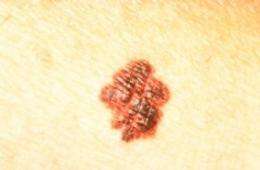
Scientists are reporting development and testing of a potential new material for diagnosing malignant melanoma, the most serious form of skin cancer. Shown is an image of melanoma on a patient’s skin. Credit: Wikimedia Commons

Scientists in Australia are reporting development and testing in laboratory animals of a potential new material for diagnosing malignant melanoma, the most serious form of skin cancer. Their study is scheduled for the September 10 issue of the ACS' Journal of the Medicinal Chemistry.

Ivan Greguric and colleagues working within the Cooperative Research Consortium for Develop, an Australian Government funded research group, note that about 130,000 new cases of malignant occur each year worldwide. Patients do best with early diagnosis and prompt treatment. The positron (PET) scans sometimes used for diagnosis sometimes miss small cancers, delaying diagnosis and treatment.

The scientists' search for better ways of diagnosis led them to a new group of radioactive imaging agents, called fluoronicotinamides, which they tested in laboratory mice that had melanoma. The most promising substance revealed melanoma cells with greater accuracy than imaging agents now in use, the scientists note. As a result, this substance could become a "superior" PET imaging agent for improving the diagnosis and monitoring the effectiveness of treatment of melanoma, they say. Clinical trials with this new agent are now scheduled for 2010.

More information: "Discovery of [18F]N-(2-(Diethylamino)ethyl)-6-fluoronicotinamide: A Melanoma Positron Emission Tomography Imaging Radiotracer with High Tumor to Body Contrast Ratio and Rapid Renal Clearance", Journal of the Medicinal Chemistry

Source: American Chemical Society (news : web)


print this article email this article download pdf blog this article bookmark this article     Stumble it Digg this share on Facebook retweet share on Reddit add to delicious
Rate this story - not rated yet


September 30, 2009 all stories

Comments: 0

not rated yet
  • Stumble this up

  • Digg this

  • share this

  • hide
  • Related Stories

  • Tiny delivery system with a big impact on cancer cells
    created Dec 15, 2008 | popularity not rated yet | comments 0
  • Unique Collaboration Funded To Develop Nanotechnology For Melanoma
    created Jan 17, 2007 | popularity not rated yet | comments 0
  • Melanoma drug revs immune cells but cancer cells ignore it
    created Sep 02, 2007 | popularity not rated yet | comments 0
  • Melanosome dynamics and sensitivity of melanoma cells to chemotherapy
    created Aug 25, 2009 | popularity not rated yet | comments 0
  • Study: Frankincense may fight some cancers
    created Jan 31, 2006 | popularity not rated yet | comments 0


  • hide
  • Relevant PhysicsForums posts

  • Putting every element in a box
    created 9 hours ago
  • a question in Lewis structure???
    created 16 hours ago
  • Paint Technology
    created Nov 24, 2009
  • About pH, Metallic electrodes
    created Nov 24, 2009
  • More from Physics Forums - Chemistry

Other News

Blocking biofilms: Alzheimer's research sheds light on potential treatments for urinary tract infections

Chemistry / Biochemistry

created 13 hours ago | popularity 5 / 5 (1) | comments 0

(PhysOrg.com) -- Research into Alzheimer's disease seems an unlikely approach to yield a better way to fight urinary tract infections (UTIs), but that's what scientists at Washington University School of Medicine in St. Louis ...


Chemists get custom-designed microscopic particles to self-assemble in liquid crystal

Chemists get custom-designed microscopic particles to self-assemble in liquid crystal

Chemistry / Materials Science

created 14 hours ago | popularity 5 / 5 (5) | comments 0

(PhysOrg.com) -- The scientists anticipate their "LithoParticles" will have significant applications in photonics, optical communications and other areas.


Sandia CR5

Machine Converts CO2 into Gasoline, Diesel, and Jet Fuel

Chemistry / Biochemistry

created Nov 23, 2009 | popularity 4.6 / 5 (30) | comments 19

(PhysOrg.com) -- Researchers at Sandia National Laboratories have built a machine that uses the sun's energy to convert carbon dioxide waste from power plants into transportation fuels such as gasoline, diesel, ...


Study shows flavanol antioxidant content of US chocolate and cocoa-containing products

Chemistry / Other

created 15 hours ago | popularity 1 / 5 (2) | comments 0

A recent study confirms that the antioxidants and other plant-based nutrients in chocolate and cocoa products are highly associated with the amount of non-fat cocoa-derived ingredients in the product. The study expands on ...


New hydrogen-storage method discovered

New hydrogen-storage method discovered

Chemistry / Materials Science

created Nov 22, 2009 | popularity 4.3 / 5 (41) | comments 15

Scientists at the Carnegie Institution have found for the first time that high pressure can be used to make a unique hydrogen-storage material. The discovery paves the way for an entirely new way to approach ...