Study in Spain and Romania confirms radon as second leading cause of lung cancer
September 30, 2009
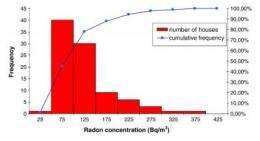
This represents the concentrations of radon in Torrelodones houses. WHO recommends no more than 100 Bq/m3. Credit: Sainz et al./ SINC
Exposure to radon gas in homes is the second leading cause of lung cancer after smoking, according to a study carried out by researchers from the University of Cantabria and the Babes-Bolyai University in Romania. The team has studied data on exposure to this element in a uranium mining area in Transylvania and in an area of granite in Torrelodones, Madrid.
Numerous studies worldwide have shown that radon, a natural radioactive gas that seeps into homes in some regions, is the second leading factor (after smoking) in causing people to develop lung cancer. This has now also been confirmed by a study carried out in Torrelodones, Madrid, and Stei, in Romania, by researchers from the University of Cantabria and the Romanian Babes-Bolyai University, and which has been published recently in the journal Science of the Total Environment.
The authors estimated the death rate due to lung cancer attributable to radon and smoking in the areas studied between 1994 and 2006, using population data from the National Statistics Institute (INE), and data on radon exposure conditions and related risks taken from European epidemiological studies. The result was double that which would have been expected based on a relative risk report produced in 2006 for the whole of Europe on cancer incidence and mortality.
"The study shows that radon is the second leading cause of lung cancer, after smoking, as has also been shown by many other studies carried out over the years in various parts of the world", Carlos Sainz, co-author of the study and a researcher for the Ionizing Radiation Group at the University of Cantabria, tells SINC.
In order to carry out their study, the authors used detectors to measure radon levels in 91 homes in the town over several months, as well as asking residents about their habits, such as whether or not they were smokers. The data were processed using a complex IT programme (European Community Radon Software), and the lung cancer death rate expectancy based estimated were made based on the INE data and various European reports.
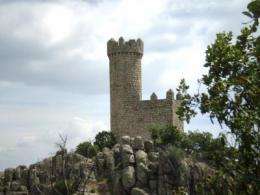
This is a Torrelodones watchtower. Credit: Jesús Sánchez Tena /SINC
WHO reduces recommended radon limitsThe World Health Organisation (WHO) had previously recommended not exceeding 1.000 becquerels (Bq - the unit used to measure radioactive activity) of radon per cubic metre inside homes. However, last week, the WHO released a guide on this subject, in which it sets a new limit of 100 Bq/m3. The Torrelodones study shows that radon in more than half of the homes there is in excess of this amount.
Sainz points out that radon is a colourless, odourless and tasteless gas generated by the decay of uranium-238 (a natural radioactive element present in all rocks and soil in varying degrees). "It is much more abundant in granite areas, such as Torrelodones and other areas in the west of the Iberian Peninsula, such as parts of Galicia, Salamanca and Cáceres", explains the expert.
The study also analysed radon levels in Stei, an area in Transylvania, Romania, where there are old uranium mines, and where the incidence of lung cancer has been shown to be 116.82% higher than estimates. Radon levels of up to 2,650 Bq/m3 have been recorded in some homes.
Ventilation and barriers against radon
Radon gas is emitted by the subsoil and seeps into houses - to a greater or lesser degree depending upon the permeability of the ground - through the pores and cracks in garages and basements. This radioactive element accumulates to a greater extent in single family homes and ground floor flats than in those located higher up in apartment blocks.
In order to address the problem, in addition to regularly checking levels of this gas, the experts suggest ventilating cellars and basements with extractor fans (opening windows alone may not be sufficient, depending on the levels of the gas). The construction of architectural barriers that are impermeable to radon is also recommended, above all in newly-built houses.
More information: C. Sainz, A. Dinu, T. Dicu, K. Szacsvai, C. Cosma, L.S. Quindós. "Comparative risk assessment of residential radon exposures in two radon-prone areas, Stei (Romania) and Torrelodones (Spain)". Science of the Total Environment 407(15): 4452-4460, 2009
Source: FECYT - Spanish Foundation for Science and Technology
-
Radon: A Silent Killer Can Lurk in Homes, MU Expert Says Test Now
Nov 08, 2007 |
not rated yet |
0
-
Deaths from lung cancer could be reduced by better policies to control indoor radon
Jan 07, 2009 |
not rated yet |
0
-
Exposure to low levels of radon appears to reduce the risk of lung cancer, new study finds
Mar 25, 2008 |
not rated yet |
0
-
Probing Question: Could your kitchen counters be radioactive?
Oct 02, 2008 |
not rated yet |
0
-
Major source of radon exposure overlooked at former Ohio uranium-processing plant
Oct 23, 2008 |
not rated yet |
0
-
Engineers build first sub-10-nm carbon nanotube transistor
Feb 01, 2012 |
4.9 / 5 (33) |
30
-
Something old, something new: Evolution and the structural divergence of duplicate genes
Jan 31, 2012 |
4.6 / 5 (7) |
1
-
The hidden nanoworld of ice crystals: Revealing the dynamic behavior of quasi-liquid layers
Jan 30, 2012 |
5 / 5 (4) |
1
-
Stock market network reveals investor clustering
Jan 27, 2012 |
3.9 / 5 (23) |
8
-
Of microchemistry and molecules: Electronic microfluidic device synthesizes biocompatible probes
Jan 26, 2012 |
5 / 5 (2) |
0
-
Is Everyday Technology Killing Us?
Feb 08, 2012
-
Exercise and weight loss
Feb 08, 2012
-
Why do we have head aches? Our brains can't feel anything.
Feb 07, 2012
-
"The end of diseases" by David Agus, interview from Daily Show with Jon Stewart
Feb 04, 2012
-
Oncolytic adenovirus
Feb 04, 2012
-
Nutrition label stuffs and diets
Feb 02, 2012
- More from Physics Forums - Medical Sciences
More news stories
Starve a virus, feed a cure? Findings show how some cells protect themselves against HIV
A protein that protects some of our immune cells from the most common and virulent form of HIV works by starving the virus of the molecular building blocks that it needs to replicate, according to research published online ...
11 hours ago |
5 / 5 (2) |
0
|
Overeating may double risk of memory loss
New research suggests that consuming between 2,100 and 6,000 calories per day may double the risk of memory loss, or mild cognitive impairment (MCI), among people age 70 and older. The study was released today and will be ...
Medicine & Health / Neuroscience
7 hours ago |
5 / 5 (2) |
0
|
Injured boomers beware: Know when to see doctor
(AP) -- It happened to nurse Jane Byron years after an in-line skating fall, business owner Haralee Weintraub while doing "men's" push-ups, and avid cyclist Gene Wilberg while lifting a heavy box.
12 hours ago |
5 / 5 (1) |
0
Declining health-care productivity in England: Who says so?
Reports that the National Health Service in England has been declining in productivity in the last decade appear to have been accepted as fact. However, a Viewpoint published Online First by The Lancet disputes this. The Vi ...
5 hours ago |
1 / 5 (1) |
0
FDA-approved drug rapidly clears amyloid from the brain, reverses Alzheimer's symptoms in mice
Neuroscientists at Case Western Reserve University School of Medicine have made a dramatic breakthrough in their efforts to find a cure for Alzheimer's disease. The researchers' findings, published in the journal Science, show t ...
Medicine & Health / Neuroscience
Feb 09, 2012 |
4.9 / 5 (58) |
17
|
Scientists discover molecular secrets of 2,000-year-old Chinese herbal remedy
For roughly two thousand years, Chinese herbalists have treated Malaria using a root extract, commonly known as Chang Shan, from a type of hydrangea that grows in Tibet and Nepal. More recent studies suggest that halofuginone, ...
New method to examine batteries -- MRI from the inside
There is an ever-increasing need for advanced batteries for portable electronics, such as phones, cameras, and music players, but also to power electric vehicles and to facilitate the distribution and storage of energy derived ...
Google might launch Drive for cloud storage soon
(PhysOrg.com) -- Google's next big move, according to the Wall Street Journal, is a cloud storage service called Drive. Hardly first to the plate, Google is simply catching up to introducing its cloud reposi ...
A mitosis mystery solved: How chromosomes align perfectly in a dividing cell
Although the process of mitotic cell division has been studied intensely for more than 50 years, Whitehead Institute researchers have only now solved the mystery of how cells correctly align their chromosomes during symmetric ...
Lab study raises questions over nano-particle impact
Tests involving chickens have raised questions about the impact on health from engineered nano-particles, the ultra-fine grains commonly used in drugs and processed foods, scientists said on Sunday.
Researchers find extensive RNA editing in human transcriptome
In a new study published online in Nature Biotechnology, researchers from BGI, the world's largest genomics organization, reported the evidence of extensive RNA editing in a human cell line by analysis of RNA-seq data, demons ...
