Major quakes can weaken seismic faults far away, scientists say
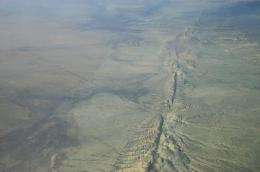
September 30, 2009 San Andreas fault

Enlarge

This is the San Andreas Fault. Credit: Wikipedia

(PhysOrg.com) -- U.S. seismologists have found evidence that the massive 2004 earthquake that triggered killer tsunamis throughout the Indian Ocean weakened at least a portion of California's famed San Andreas Fault. The results, which appear this week in the journal Nature, suggest that the Earth's largest earthquakes can weaken fault zones worldwide and may trigger periods of increased global seismic activity.

"An unusually high number of magnitude 8 earthquakes occurred worldwide in 2005 and 2006," said study co-author Fenglin Niu, associate professor of Earth science at Rice University. "There has been speculation that these were somehow triggered by the Sumatran-Andaman earthquake that occurred on Dec. 26, 2004, but this is the first direct evidence that the quake could change fault strength of a fault remotely."

Earthquakes are caused when a fault fails, either because of the buildup of stress or because of the weakening of the fault. The latter is more difficult to measure.

The magnitude 9 earthquake in 2004 occurred beneath the ocean west of Sumatra and was the second-largest quake ever measured by seismograph. The temblor spawned tsunamis as large as 100 feet that killed an estimated 230,000, mostly in Indonesia, Sri Lanka, India and Thailand.

In the new study, Niu and co-authors Taka'aki Taira and Paul Silver, both of the Carnegie Institution of Science in Washington, D.C., and Robert Nadeau of the University of California, Berkeley, examined more than 20 years of seismic records from Parkfield, Calif., which sits astride the San Andreas Fault.

The team zeroed in on a set of repeating microearthquakes that occurred near Parkfield over two decades. Each of these tiny quakes originated in almost exactly the same location. By closely comparing seismic readings from these quakes, the team was able to determine the "fault strength" -- the shear stress level required to cause the fault to slip -- at Parkfield between 1987 and 2008.

The team found fault strength changed markedly at three times during the 20-year period. The authors surmised that the 1992 Landers earthquake, a magnitude 7 quake north of Palm Springs, Calif. -- about 200 miles from Parkfield -- caused the first of these changes. The study found the Landers quake destabilized the fault near Parkfield, causing a series of magnitude 4 quakes and a notable "aseismic" event -- a movement of the fault that played out over several months -- in 1993.

The second change in fault strength occurred in conjunction with a magnitude 6 earthquake at Parkfield in September 2004. The team found another change at Parkfield later that year that could not be accounted for by the September quake alone. Eventually, they were able to narrow the onset of this third shift to a five-day window in late December during which the Sumatran quake occurred.

"The long-range influence of the 2004 Sumatran-Andaman earthquake on this patch of the San Andreas suggests that the quake may have affected other faults, bringing a significant fraction of them closer to failure," said Taira. "This hypothesis appears to be borne out by the unusually high number of large earthquakes that occurred in the three years after the Sumatran-Andaman quake."

Source: Rice University


print this article email this article download pdf blog this article bookmark this article     Stumble it Digg this share on Facebook retweet share on Reddit add to delicious
Rate this story - 4.9 /5 (8 votes)


September 30, 2009 all stories

Comments: 0

4.9 /5 (8 votes)
  • Stumble this up

  • Digg this

  • share this

  • hide
  • Related Stories

  • Great Indian Ocean earthquake of 2004 set off tremors in San Andreas fault
    created Dec 10, 2008 | popularity not rated yet | comments 0
  • Geologists study China earthquake for glimpse into future
    created Jul 06, 2008 | popularity not rated yet | comments 0
  • Why do earthquakes stop?
    created Feb 06, 2008 | popularity not rated yet | comments 0
  • Discovery sheds new light on cause of earthquakes
    created Dec 14, 2006 | popularity not rated yet | comments 0
  • Tremors on southern San Andreas Fault may mean increased quake risk
    created Jul 09, 2009 | popularity not rated yet | comments 0


  • hide
  • Relevant PhysicsForums posts

  • Which countries around the world cause the most destruction to the rain forest
    created 13 hours ago
  • HadleyCru data hacked
    created Nov 20, 2009
  • Younger Dryas Caused by Ice Dam Collapse?
    created Nov 17, 2009
  • Modeling rainfall and flooding
    created Nov 15, 2009
  • More from Physics Forums - Earth

Other News

Baby can wait as expectant dad finishes spacewalk (AP)

Baby can wait as expectant dad finishes spacewalk

Space & Earth / Space Exploration

created 13 hours ago | popularity 3 / 5 (2) | comments 0

(AP) -- A spacewalking astronaut put aside the impending birth of his daughter and blazed through his first-ever venture outside the International Space Station on Saturday.


Unseasonably hot and dry weather combined with strong winds to fan scores of blazes in the country's southeastern states

Australia issues 'catastrophic' alerts as fires rage

Space & Earth / Environment

created 19 hours ago | popularity 4 / 5 (3) | comments 0

Australia has issued "catastrophic" alerts after record-breaking temperatures and wild lightning storms sparked more than 100 fires across the country, officials said Saturday.


Commuters wait on the platform shrouded by fog in London

Climate change not man-made, say majority of Britons: poll

Space & Earth / Environment

created Nov 15, 2009 | popularity 3.3 / 5 (15) | comments 46

Less than half of Britons believes that human activity is to blame for global warming, according to a poll carried out for The Times newspaper and published on Saturday.


Mysteriously warm times in Antarctica

Mysteriously warm times in Antarctica

Space & Earth / Earth Sciences

created Nov 18, 2009 | popularity 4.2 / 5 (21) | comments 28

(PhysOrg.com) -- A new study of Antarctica's past climate reveals that temperatures during the warm periods between ice ages (interglacials) may have been higher than previously thought. The latest analysis ...


UN: Fight climate change with free condoms (AP)

UN: Fight climate change with free condoms

Space & Earth / Environment

created Nov 18, 2009 | popularity 3.1 / 5 (11) | comments 24

(AP) -- The battle against global warming could be helped if the world slowed population growth by making free condoms and family planning advice more widely available, the U.N. Population Fund said Wednesday.