Research puts a 'Fas' to the cause of programmed cell death
September 30, 2009
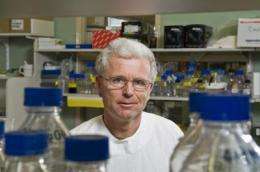
Professor Andreas Strasser's team at the Walter and Eliza Hall Institute of Medical Research in Melbourne, Australia, has put an end to a 10-year debate over which form of a molecular messenger called Fas ligand is responsible for killing cells during programmed cell death. Credit: Cameron Wells, Walter and Eliza Hall Institute
Walter and Eliza Hall Institute researchers have put an end to a 10-year debate over which form of a molecular messenger called Fas ligand is responsible for killing cells during programmed cell death (also called apoptosis).
Apoptosis is an important process in human biology as it removes unwanted and dangerous cells from our bodies, protecting us against cancer development and diseases where the immune system attacks the body's own tissues, such as in lupus or insulin-dependent diabetes.
This cell death process can be activated by proteins on the surface of cells. The most prominent of these cell surface proteins is Fas ligand, which exists in two forms - membrane-bound or secreted - and binds to a surface receptor called Fas. Professor Andreas Strasser, co-head of the institute's Molecular Genetics of Cancer division (with Professor Jerry Adams), has been looking to settle a decade-long scientific debate by investigating whether membrane-bound Fas ligand, secreted Fas ligand, or both, cause cell death.
"There has been a lot of debate among the scientific community over which of the forms causes cell death but also which of the forms may induce an inflammatory response," Professor Strasser said. "What we have shown is that it is the membrane-bound Fas ligand that is essential for cell death and is therefore the body's guardian against lymphadenopathy (the swelling of lymph nodes), autoimmunity and cancer."
Professor Strasser's research, done in collaboration with Dr Lorraine O'Reilly and Ms Lin Tai from the Molecular Genetics of Cancer division and Dr Lorraine Robb from the Cancer and Haematology division, has been published in today's issue of the international journal Nature.
The research also demonstrated that although secreted Fas ligand does not have a role in cell killing, too much secreted Fas can promote tumour development and autoimmunity.
"In certain autoimmune conditions and types of lymphoma/leukaemia there is massive over-production of secreted Fas ligand. Since our research shows that secreted Fas is pro-inflammatory, and therefore detrimental, and since the aforementioned disease states are characterised by inflammatory tissue destruction, it may be possible to alleviate some of the manifestations of these diseases by neutralising the secreted Fas ligand with antibodies or soluble receptors," Professor Strasser said.
Now the roles of membrane-bound and secreted Fas ligand have been clearly defined, Professor Strasser's team is investigating the molecular pathways that are activated by a surplus of secreted Fas ligand and their role in autoimmune conditions and lymphomas/leukaemias.
Source: Walter and Eliza Hall Institute
-
Critical link in cell death pathway revealed
Jul 22, 2009 |
not rated yet |
0
-
Researchers discover 'on switch' for cell death signaling mechanism
Jan 05, 2009 |
not rated yet |
0
-
Hepatitis C virus may need enzyme's help to cause liver disease
Jul 09, 2008 |
not rated yet |
0
-
Gene's novel role may provide key to treating liver and neurodegenerative diseases
Jul 03, 2009 |
not rated yet |
0
-
Researchers find targeted therapy combination overcomes treatment resistance in liver cancer
Apr 13, 2008 |
not rated yet |
0
-
Engineers build first sub-10-nm carbon nanotube transistor
Feb 01, 2012 |
4.9 / 5 (33) |
30
-
Something old, something new: Evolution and the structural divergence of duplicate genes
Jan 31, 2012 |
4.6 / 5 (7) |
1
-
The hidden nanoworld of ice crystals: Revealing the dynamic behavior of quasi-liquid layers
Jan 30, 2012 |
5 / 5 (5) |
1
-
Stock market network reveals investor clustering
Jan 27, 2012 |
3.9 / 5 (23) |
8
-
Of microchemistry and molecules: Electronic microfluidic device synthesizes biocompatible probes
Jan 26, 2012 |
5 / 5 (2) |
0
-
Is Everyday Technology Killing Us?
Feb 08, 2012
-
Exercise and weight loss
Feb 08, 2012
-
Why do we have head aches? Our brains can't feel anything.
Feb 07, 2012
-
"The end of diseases" by David Agus, interview from Daily Show with Jon Stewart
Feb 04, 2012
-
Oncolytic adenovirus
Feb 04, 2012
-
Nutrition label stuffs and diets
Feb 02, 2012
- More from Physics Forums - Medical Sciences
More news stories
Social psychologist: Lust makes you smarter and evidence that seven deadly sins are good for you
(Medical Xpress) -- Good news for lovers on Valentine’s Day - the seven deadly sins, including Lust, are good for you. University of Melbourne social psychologist Dr Simon Laham uses modern research to make a compelling ...
Medicine & Health / Psychology & Psychiatry
12 minutes ago |
not rated yet |
0
Research finds injuries to professional athletes from routine play or practice often reported as 'freak accidents' in me
(Medical Xpress) -- A new report from the Johns Hopkins Center for Injury Research and Policy finds injuries to professional athletes from routine play or practice are often characterized as freak accidents in ...
7 minutes ago |
not rated yet |
0
Researchers find rate of follow-up surgeries after partial mastectomy varies greatly
(Medical Xpress) -- A study conducted at the University of Vermont/Fletcher Allen Health Care and three other sites and published in the February 1 issue of the Journal of the American Medical Association found significant ...
21 minutes ago |
not rated yet |
0
Cognitive impairment in older adults often unrecognized in the primary care setting
A new study published in the Journal of the American Geriatrics Society reveals that brief cognitive screenings combined with offering further evaluation increased new diagnoses of cognitive impairment in older veterans two to ...
2 hours ago |
not rated yet |
0
Botox developer rues missing out on billions
Botox developer Alan Scott says he rues the day he handed over rights to the best-selling wrinkle-smoothing drug to a US company for just $4.5 million, saying he might have become a billionaire.
Medicine & Health / Medications
3 hours ago |
not rated yet |
0
New molecule has potential to help treat genetic diseases and HIV
(PhysOrg.com) -- Chemists at The University of Texas at Austin have created a molecule that's so good at tangling itself inside the double helix of a DNA sequence that it can stay there for up to 16 days before ...
Researchers' paper wins Best Paper Award for 2011
A paper written by Dr. Paul Gratz and his graduate student, Reena Panda, from the Department of Electrical and Computer Engineering at Texas A&M University was selected as one of the best papers from IEEE Computer Architecture ...
New European rocket lifts off on maiden flight
A new lightweight rocket, Vega, lifted off from Europe's space base Monday carrying nine satellites on its inaugural flight, mission control said.
Ordered planar polymers created for the first time
(PhysOrg.com) -- Scientists under the direction of ETH Zurich have created a minor sensation in synthetic chemistry. They succeeded for the first time in producing regularly ordered planar polymers that form ...
Microsoft India retail site down after 'cyber attack'
Microsoft India's retail website was down on Monday after reportedly being hacked by a Chinese group calling itself Evil Shadow Team.
Chinese city seizes Apple iPads in name dispute
(AP) -- Authorities have seized Apple iPads from retailers in a city in northern China due to a dispute with a domestic company that says it owns the iPad name, an official said Monday. The Chinese company said it is asking ...