Monkeys' grooming habits provide clues to how we socialise
September 30, 2009 Monkeys' grooming habits provide clues to how we socialise

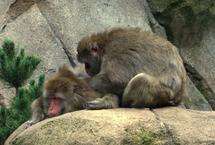
Two Japanese macaques engaged in social grooming.

(PhysOrg.com) -- A study of female monkeys' grooming habits provides new clues about the way humans socialise. New research reveals a link between the size of the neocortex in the brain, responsible for higher-level thinking, and the size of grooming clusters that monkeys belong to.

A study of female monkeys' grooming habits provides new clues about the way we humans socialise. New research, published today in , reveals there is a link between the size of the brain, in particular the neocortex which is responsible for higher-level thinking, and the size and number of grooming clusters that monkeys belong to.

The researchers, from the University of Oxford and Roehampton University, have shown that bigger brained female monkeys invest more time grooming a smaller group of monkeys but still manage to maintain contact with other members of their group, even though they have much weaker social bonds with them. In contrast, monkeys of species with smaller neocortices, and therefore less cognitive ability, live in groups with a less complicated social structure.

An analysis of data on the grooming patterns of 11 species of Old World monkeys suggests the relative size of the neocortex is the key factor, rather than overall brain size. The neocortex is connected with cognitive functions, such as learning, memory and more complex thought. In monkeys, species with large neocortices typically live in groups of 25-50 animals, whereas species with small neocortices live in groups of 10-20 individuals.

Species with larger neocortices are able to maintain larger social groups because they can balance a few very intimate friendships against many less close acquaintances. In contrast, species with smaller neocortices cannot manage this, and so have groups that fragment more easily.

The study therefore suggests that, while bigger brained female monkeys concentrate their social effort on core partners in smaller cliques in order to minimize the costs of harassment from other members of the group, their enhanced social skills allow them to exploit weak social links with others in the wider network and maintain good social relations outside their own close-knit groups.

Professor Robin Dunbar, from the Institute of Cognitive and Evolutionary at Oxford University, said: 'These findings give us glimpses into how humans manage the complex business of maintaining coherence in social groups that are much larger than those found in any other primate species. Our is three times larger than that of other and apes, and this allows us to manage larger, more dispersed social groups as a result. '

The ICEA is a degree-granting component of the School of Anthropology and Museum Ethnography. The School is part of the Division of Social Sciences at the University of Oxford.

Provided by Oxford University (news : web)


print this article email this article download pdf blog this article bookmark this article     Stumble it Digg this share on Facebook retweet share on Reddit add to delicious
Rate this story - 3 /5 (2 votes)


September 30, 2009 all stories

Comments: 0

3 /5 (2 votes)
  • Stumble this up

  • Digg this

  • share this

  • hide
  • Related Stories

  • Female monkeys more dominant in groups with relatively more males
    created Jul 16, 2008 | popularity not rated yet | comments 0
  • Monkey economy works
    created Jul 13, 2009 | popularity not rated yet | comments 0
  • Researchers find monkeys enjoy giving to others
    created Aug 25, 2008 | popularity not rated yet | comments 0
  • Animals and Human Experience the Same Emotions
    created Sep 06, 2005 | popularity not rated yet | comments 0
  • Monkey Math Machinery is Like Humans'
    created Nov 01, 2005 | popularity not rated yet | comments 0


  • hide
  • Relevant PhysicsForums posts

  • Questions about diffusion
    created 5 hours ago
  • Human Leukocyte Antigen (HLA) typing
    created 11 hours ago
  • Breeding program
    created Nov 20, 2009
  • How does a concentration gradient provide energy?
    created Nov 20, 2009
  • More from Physics Forums - Biology

Other News

The Monarchs' annual migration ritual has yet to be scientifically explained

Tree-eating bugs threaten Monarch butterfly in Mexico

Biology / Ecology

created 13 hours ago | popularity 4 / 5 (1) | comments 0

The mysterious Monarch butterfly, which migrates en masse annually between Canada and Mexico, is now facing a new peril: another insect thriving in Western Mexican forests.


Bigger not necessarily better, when it comes to brains

Bigger not necessarily better, when it comes to brains

Biology / Plants & Animals

created Nov 17, 2009 | popularity 4.5 / 5 (18) | comments 11

(PhysOrg.com) -- Tiny insects could be as intelligent as much bigger animals, despite only having a brain the size of a pinhead, say scientists at Queen Mary, University of London.


Extinct goat Myotragus balearicus

Extinct goat was cold-blooded

Biology / Plants & Animals

created Nov 18, 2009 | popularity 4.9 / 5 (33) | comments 10

(PhysOrg.com) -- An extinct goat that lived on a barren Mediterranean island survived for millions of years by reducing in size and by becoming cold-blooded, which has never before been discovered in mammals.


Right-handed chimpanzees provide clues to the origin of human language

Biology / Plants & Animals

created Nov 16, 2009 | popularity 3 / 5 (1) | comments 7

Most of the linguistic functions in humans are controlled by the left cerebral hemisphere. A study of captive chimpanzees at the Yerkes National Primate Research Center (Atlanta, Georgia), reported in the January 2010 issue ...


The creature was found at a depth of 161 metres

Japanese researchers film rare baby fish 'fossil'

Biology / Plants & Animals

created Nov 17, 2009 | popularity 4.7 / 5 (7) | comments 4

Japanese marine researchers said Tuesday they had found and successfully filmed a young coelacanth -- a rare type of fish known as "a living fossil" -- in deep water off Indonesia.