Biodiversity loss weakens global development
September 30, 2009 Biodiversity loss weakens global development

Enlarge

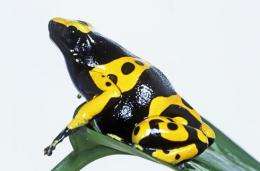
Yellow banded dart frog. Amphibians are facing some of the worst threats to their biodiversity. A report in the journal Science highlights how biodiversity loss is weakening efforts to tackle global poverty.

Biodiversity loss is undermining global development, leading scientists warn. The paper brings together a broad group of scientists and policy makers, including Natural History Museum plant expert Dr Sandra Knapp.

Biodiversity loss is undermining global development, leading scientists warn in a paper published in the journal Science this month.

Goals set to alleviate extreme will not be met unless we address the accelerating rate of biodiversity loss, they say, and new achievable targets are needed urgently.

Led by Professor Jeffrey Sachs of ZSL (Zoological Society of London), the paper brings together a broad group of scientists and policy makers, including Natural History Museum plant expert Dr Sandra Knapp.

Poverty and environmental degradation have many of the same fundamental causes, such as the pressures of unsustainable human population growth.

More research is needed into the links between biodiversity and poverty, the team says, so that better decisions can be made about how the environment is used in future. The outcomes should benefit both poverty alleviation and conservation.

‘Degradation of the natural diversity of our planet will inevitably bring problems for our own species,’ says Dr Knapp.

Dr Knapp explains, ‘The integration of conservation and development goals will be difficult, and will require new interactions between scientific communities and with the public at large’.

‘We hope the newly opened Darwin Centre at the Natural History Museum can be a focal point for discussion of issues that confront all of us as we integrate the Millennium Development Goals with our concern for the natural world.’

The 8 Millennium Development Goals were agreed by all the world’s countries and one of the goals is to halve extreme poverty by 2015. The Convention on , signed by 150 governments at the 1992 Rio Earth Summit, is dedicated to promoting sustainable development. However, the goals of both of these will not be met unless humans begin living in a more sustainable way.

Dr Kate Jones, Senior Research Fellow at ZSL concludes: ‘The global issues are now so intense we will only succeed if we have an integrated environment and development agenda - our children’s environment is an essential part of their welfare.’

Provided by American Museum of Natural History (news : web)


print this article email this article download pdf blog this article bookmark this article     Stumble it Digg this share on Facebook retweet share on Reddit add to delicious
Rate this story - not rated yet


September 30, 2009 all stories

Comments: 0

not rated yet
  • Stumble this up

  • Digg this

  • share this

  • hide
  • Related Stories


  • hide
  • Relevant PhysicsForums posts

  • What is transpulmonary pressure?
    created Nov 24, 2009
  • Is there a gay gene?
    created Nov 23, 2009
  • Super quick question about Starling forces?
    created Nov 22, 2009
  • Questions about diffusion
    created Nov 22, 2009
  • More from Physics Forums - Biology

Other News

Variable Temperatures Leave Insects wtih a Frosty Reception

Biology / Plants & Animals

created 6 hours ago | popularity not rated yet | comments 0

(PhysOrg.com) -- For the first time, scientists at The University of Western Ontario have shown that insects exposed to repeated periods of cold will trade reproduction for immediate survival.


When camouflage is a plant's best protection

Rare woodland plant uses 'cryptic coloration' to hide from predators

Biology / Plants & Animals

created 8 hours ago | popularity 4.3 / 5 (3) | comments 0

It is well known that some animal species use camouflage to hide from predators. Individuals that are able to blend in to their surroundings and avoid being eaten are able to survive longer, reproduce, and ...


Cells defend themselves from viruses, bacteria with armor of protein errors

Biology / Cell & Microbiology

created 10 hours ago | popularity 5 / 5 (7) | comments 0

When cells are confronted with an invading virus or bacteria or exposed to an irritating chemical, they protect themselves by going off their DNA recipe and inserting the wrong amino acid into new proteins to defend them ...


'Safety valve' protects photosynthesis from too much light

Biology / Cell & Microbiology

created 10 hours ago | popularity 5 / 5 (2) | comments 0

Photosynthetic organisms need to cope with a wide range of light intensities, which can change over timescales of seconds to minutes. Too much light can damage the photosynthetic machinery and cause cell death. Scientists ...


Researchers discover biological basis of 'bacterial immune system'

Biology / Cell & Microbiology

created 10 hours ago | popularity 4.7 / 5 (3) | comments 0

Bacteria don't have easy lives. In addition to mammalian immune systems that besiege the bugs, they have natural enemies called bacteriophages, viruses that kill half the bacteria on Earth every two days.