Consciousness is the brain's Wi-Fi, resolving competing requests, study suggests

September 30, 2009
During the Stroop Task (pictured), which involves having to say the name of the color that the word is written in (blue for the top word) rather than reading the word (red), we feel conflicting urges as we fight the urge to read the word. New research by San Francisco State University Professor Ezequiel Morsella suggests it is our consciousness that resolves this kind of dilemma, acting as the brain's Wi-Fi network that mediates competing requests from different parts of the body. Credit: San Francisco State University
Your fingers start to burn after picking up a hot plate. Should you drop the plate or save your meal? New research suggests that it is your consciousness that resolves these dilemmas by serving as the brain's Wi-Fi network, mediating competing requests from different parts of the body. Published today in the journal Emotion, the study also explains why we are consciously aware of some conflicting urges but not others.
"If the brain is like a set of computers that control different tasks, consciousness is the Wi-Fi network that allows different parts of the brain to talk to each other and decide which action 'wins' and is carried out," said San Francisco State University Assistant Professor of Psychology Ezequiel Morsella, lead author of the study. The study finds that we are only aware of competing actions that involve skeletal muscles that voluntarily move parts of the body, the bicep for example, rather than the muscles in the digestive tract or the iris of the eye.
In lab experiments, participants were trained to identify and report changes in their awareness, or the feeling of being about to make a mistake, while in a state of readiness to perform simple exercises.
The results demonstrated that merely preparing to perform an incompatible action, for example preparing to move simultaneously left and right, triggered stronger changes in awareness than preparing to perform a compatible action or experiencing a conflict that does not engage the muscles that move our bodies. Participants rated changes in their awareness on an eight-point scale and reported an average rating of 4.5 when mentally preparing to perform an incompatible action and an average rating of two for compatible actions.
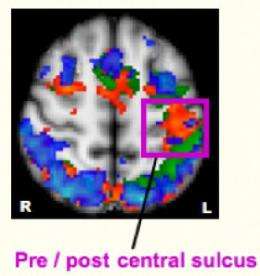
This is an fMRI image of the brain, viewed from above. New research shows that the changes in awareness we feel when preparing to do two incompatible actions are uniquely associated with increased activity in areas of the brain used for working memory, including the pre and post central sulcus. These areas are responsible for consciousness and selecting the right action at the right time. This finding supports San Francisco State University Professor Ezequiel Morsella's new theory that it is consciousness that resolves the dilemma of conflicting urges. The findings were presented at the Proceedings of the Cognitive Neuroscience Society Annual Meeting in April 2008. Credit: Morsella, Kang, Shamosh, Bargh and Gray
The findings support a new theory developed by Morsella which predicts that the primary role of consciousness is to bring together competing demands on skeletal muscle. Morsella's theory also proposes that consciousness allows individuals to adapt their actions in the future, for example wearing an oven mitt to hold a hot dish.The results give credence to an interesting idea that 'thinking is for doing,' a framework psychologists are using to explore the link among consciousness, perception and action. "Our findings add to the growing body of evidence that when you prepare to perform two competing actions you prime the same areas of the brain associated with carrying out that same action," Morsella said.
In a related, but separate study, Morsella and colleagues used fMRI scans to identify the regions of the brain that produce the changes in awareness associated with conflicting urges. The findings were presented at the Proceedings of the Cognitive Neuroscience Society Annual Meeting in April 2008.
"What's interesting is that the changes in awareness that participants felt when preparing to perform conflicting actions was uniquely associated with increased activation of areas of the brain associated with action and perception, as we would expect, and also with working memory, including the pre- and post-central sulcus," Morsella said. "This is consistent with our theory because these brain regions are responsible for consciousness and selecting the right action at the right time."
The authors suggest that both studies identify the common elements underlying all conflicting urges and that the findings shed light on managing addiction and failures of self control.


Oh yes, we know how accurate brain scan images are... they are easy to misinterpret, unreliable, etc... I am dead tired of seeing them used in practically every neurology study. It's almost a pseudoscience, the way it's used most of the time.
Plus I love the concept that consciousness "allows individuals to adapt their actions in the future". That's like saying that something unphysical can effect physical things. It doesn't even make logical sense. A better way to say it (and hopefully what they meant), is to say that consciousness comes about because of neurological systems that "allow individuals to adapt their actions in the future". Not the other way around.
-Axemaster
If consciousness is defined as physical, then our current understanding of physics is severely flawed, I think.
What is absurd, is to deny the existence of your own consciousness.
the answer is that as the layperson, you accept your ignorance and then either shun the article or shun the research it is describing, as meaningless. i'm inclined to blame it on the former because it's tantamount to avoiding the process of laying blame altogether while respecting the fact the research might actually be above your head , and, as such, is also beyond explanation within the confines of a short descriptive piece.
That can be demonstrated with a much easier test. Give a person four buttons of different colors and show him colors on the screen. Tell him to quickly press the correct button.
But, have the computer randomly show only three of the colors for some time, after which it includes the fourth color.
The time it takes to press the fourth color button for the first time, is significantly longer.
This follows from the brain areas of the fourth color action "losing" their preparedness as the color is not shown. The subject feels "I was not prepared", if asked about the delay.
PS: some of the above commentators have a problem understanding the word consciousness in scientific context, as opposed to its religious meaning. Blame the church and creationists.
Consciousness is outside the ability of biomedical science to quantify, as can be seen by this rather poor attempt to pigeon hole it into mechanistic terms. The Computational Theory of the Mind, of which the proposed model is a version, has been known for quite some time to be a logically untenable position. It is vulnerable to, among other things, the Homunculus fallacy.
Methinks that a consistent theory of consciousness will require some sort of paraconsistent logic to overcome the inevitable contradictions inherent to a self-referential system. To begin, one would need to first reject the notion that unphysical consciousness cannot cause physical changes.