In 16 states, drug deaths overtake traffic fatals
September 30, 2009 By MIKE STOBBE , AP Medical Writer
In 16 states, drug deaths overtake traffic fatals (AP)

Enlarge

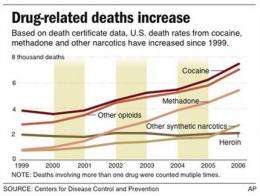
Graphic shows number of drug related deaths from 1999 to 2006 by various drugs

(AP) -- In 16 states and counting, drugs now kill more people than auto accidents do, the government said Wednesday.

Experts said the startling shift reflects two opposite trends: Driving is becoming safer, and the legal and illegal use of powerful prescription painkillers is on the rise.

For decades, traffic accidents have been the biggest cause of injury-related death in the U.S., and they are still No. 1. But drug overdoses are pulling ahead in one state after another.

"People see a car accident as something that might happen to them," said Margaret Warner, an epidemiologist with the Centers for Disease Control and Prevention. But as for death from a drug overdose, "maybe they see it as something that's not going happen to them."

The drug-related death rate roughly doubled from the late 1990s to 2006, according to the most recent CDC data.

The number of states in which drug-related deaths have overtaken traffic fatalities has gone from eight in 2003 to 12 in 2005, and 16 in 2006. They are: Massachusetts, New Hampshire, Rhode Island, Connecticut, New York, New Jersey, Maryland, Pennsylvania, Ohio, Michigan, Illinois, Colorado, Utah, Nevada, Oregon and Washington.

It's not clear why those states have seen such a shift, but experts said certain drugs may be more of a problem in some states than in others.

While cocaine and heroin continue to be significant killers, most of the increase is attributed to prescription opiates such as the painkillers methadone, Oxycontin and Vicodin.

From 1999 to 2006, for such medications climbed for every age group. Deaths from methadone alone increased sevenfold, according to the CDC.

It's not all black market stuff, either.

About half of the opiate medication deaths in King County, Wash., which includes Seattle, involved people who got their drugs through legal prescriptions, said Caleb Banta-Green, a University of Washington research scientist.

"There has been a dramatic change in how doctors prescribe opiates," Banta-Green said.

In the 1990s, he said, doctors began recognizing that chronic pain was undertreated. The prescribing of painkillers escalated after that. Today, about one in five U.S. adults and one in 10 adolescents are prescribed an opiate each year, he said.

"The pendulum swung in the other direction," he said.

Using death certificate data, CDC researchers counted more than 45,000 U.S. deaths nationwide from traffic accidents in 2006, and about 39,000 from drug-induced causes.

About 90 percent of those drug fatalities are sudden deaths from overdoses, but the count includes people who died from organ damage from long-term drug use or abuse.

In Massachusetts, there were more than 1,000 drug-related deaths in 2006, double the number of traffic deaths, according to the CDC. Michigan had about 500 more drug deaths than vehicle fatalities, and New York had 350 more.

Nationally, the death rate from traffic accidents fell by about 6.5 percent from 1999 through 2006 - from 15.3 deaths per 100,000 people to 14.3 per 100,000, according to the National Highway Traffic Safety Administration.

The decline in road fatalities is "considered one of the great public health triumphs" of the past few decades, the CDC's Warner said.

--

On the Net:

CDC report: http://www.cdc.gov/NCHS

©2009 The Associated Press. All rights reserved. This material may not be published, broadcast, rewritten or redistributed.

3.3 /5 (3 votes)  

Rank 3.3 /5 (3 votes)
Related Stories
Relevant PhysicsForums posts

More news stories

Researchers illuminate link between sodium, calcium and heartbeat

Using the Canadian Light Source synchrotron, researchers from the University of British Columbia have revealed, for the first time, one of the molecular mechanisms that regulates the beating of heart cells by controlling ...

Medicine & Health / Research

created 56 minutes ago | popularity 4.5 / 5 (2) | comments 0 | with audio podcast

Oxygen-deprived baby rats fare worse if kept warm

New study suggests that baby rats deprived of oxygen, but kept warm, had bigger swings in glucose and insulin, metabolic and physiologic effects that could increase the chances of brain damage. Findings could have implications ...

Medicine & Health / Research

created 58 minutes ago | popularity not rated yet | comments 0

Fetal exposure to radiation increases risk of testicular cancer

Male fetuses of mothers that are exposed to radiation during early pregnancy may have an increased chance of developing testicular cancer, according to a study in mice at The University of Texas MD Anderson Cancer Center. ...

Medicine & Health / Cancer

created 17 minutes ago | popularity not rated yet | comments 0

Prolonged fructose intake not linked to rise in blood pressure

Eating fructose over an extended period of time does not lead to an increase in blood pressure, according to researchers at St. Michael's Hospital.

Medicine & Health / Health

created 47 minutes ago | popularity not rated yet | comments 0

Challenges of identifying cognitive abilities in severely brain-injured patients

Only by employing complex machine-learning techniques to decipher repeated advanced brain scans were researchers at NewYork-Presbyterian/Weill Cornell able to provide evidence that a patient with a severe brain injury could, ...

Medicine & Health / Neuroscience

created 37 minutes ago | popularity not rated yet | comments 0


Music service gives Myspace second wind

Faded online social network Myspace said Monday it was getting a second wind due to the popularity of a freshly launched online music player.

Computer programs that think like humans

Intelligence – what does it really mean? In the 1800s, it meant that you were good at memorising things, and today intelligence is measured through IQ tests where the average score for humans is 100. ...

Study shows children with IBD have difficulty in school, mostly due to absences

Children with inflammatory bowel disease (IBD) may have difficulty functioning in school, particularly because their tendency to internalize problems can impact attendance. These are the findings from a Nationwide Children's ...

Fast photon control brings quantum photonic technologies closer

(PhysOrg.com) -- Using photons instead of electrons to transmit information could lead to faster and more secure ways to communicate, among other advantages. Now a team of physicists has taken another step toward realizing ...

Brain-imaging technique predicts who will suffer cognitive decline over time

Cognitive loss and brain degeneration currently affect millions of adults, and the number will increase, given the population of aging baby boomers. Today, nearly 20 percent of people age 65 or older suffer ...

Neuron memory key to taming chronic pain

For some, the pain is so great that they can't even bear to have clothes touch their skin. For others, it means that every step is a deliberate and agonizing choice. Whether the pain is caused by arthritic joints, an injury ...