MESSENGER Spacecraft Flies by Mercury
September 30, 2009 MESSENGER at Mercury

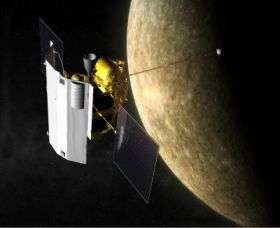
Artist's concept of the NASA's MESSENGER spaceraft at Mercury. Credit: NASA

Shortly before 5:55 p.m. EDT, MESSENGER skimmed 228 kilometers (141 miles) above the surface of Mercury in its third and final flyby of the planet.

Radio signals received after the spacecraft emerged from behind the planet indicate that the spacecraft is operating nominally. Its instruments are now collecting images and other scientific measurements from the planet as it departs Mercury.

Tonight at 9:34 p.m., the spacecraft will turn its high-gain antenna back toward Earth to start down linking real-time telemetry. Downlink of the data stored onboard will start two hours later. The first images from the will be released around 10:00 a.m. on September 30, 2009.

MESSENGER (MErcury Surface, Space ENvironment, GEochemistry, and Ranging) is a NASA-sponsored scientific investigation of the and the first space mission designed to orbit the planet closest to the Sun.

The MESSENGER launched on August 3, 2004, and after flybys of Earth, Venus, and Mercury will start a yearlong study of its target planet in March 2011.

Provided by JPL/NASA (news : web)


print this article email this article download pdf blog this article bookmark this article     Stumble it Digg this share on Facebook retweet share on Reddit add to delicious
Rate this story - 4.7 /5 (3 votes)


September 30, 2009 all stories

Comments: 0

4.7 /5 (3 votes)
  • Stumble this up

  • Digg this

  • share this

  • hide
  • Related Stories

  • NASA rescheduled MESSENGER start to Mercury to August 3
    created Aug 02, 2004 | popularity not rated yet | comments 0
  • MESSENGER flyby of Mercury
    created Jan 15, 2008 | popularity not rated yet | comments 0
  • MESSENGER Returns Images from Oct. 6 Mercury Fly-By
    created Oct 07, 2008 | popularity not rated yet | comments 0
  • Spacecraft Tandem Provide New Views of Venus
    created Jul 19, 2007 | popularity not rated yet | comments 0
  • MESSENGER On Its Way
    created Aug 04, 2004 | popularity not rated yet | comments 0


  • hide
  • Relevant PhysicsForums posts

  • Question about 2-body gravity
    created 6 hours ago
  • life on Mars
    created 9 hours ago
  • Semi-major axis from cartesian co-ordinates
    created 21 hours ago
  • Primary Mirror grinding
    created 23 hours ago
  • More from Physics Forums - General Astronomy

Other News

Global study of salmon shows: 'Sustainable' food isn't so sustainable

Space & Earth / Environment

created 46 minutes ago | popularity not rated yet | comments 0

Popular thinking about how to improve food systems for the better often misses the point, according to the results of a three-year global study of salmon production systems. Rather than pushing for organic or land-based ...


Icebergs head from Antarctica for New Zealand (AP)

Icebergs head from Antarctica for New Zealand

Space & Earth / Earth Sciences

created 33 minutes ago | popularity not rated yet | comments 0

(AP) -- Ships in the south Pacific Ocean have been alerted that hundreds of icebergs believed to have split off Antarctic ice shelves are drifting north toward New Zealand, officials said Tuesday.


Does carbon labelling give developing countries a bad deal?

Space & Earth / Environment

created 13 minutes ago | popularity not rated yet | comments 0

Carbon labelling could unfairly disadvantage economies in the developing world, and mislead consumers, according to an interdisciplinary project carried out by the UK Research Councils' Rural Economy and Land Use Programme. ...


First black holes may have incubated in giant, starlike cocoons, says CU-Boulder study

First black holes may have incubated in giant, starlike cocoons

Space & Earth / Astronomy

created 2 hours ago | popularity 5 / 5 (3) | comments 6

(PhysOrg.com) -- The first large black holes in the universe likely formed and grew deep inside gigantic, starlike cocoons that smothered their powerful x-ray radiation and prevented surrounding gases from ...


The drying shores of the Dead Sea

Dead Sea needs world help to stay alive

Space & Earth / Environment

created 1hour ago | popularity 5 / 5 (1) | comments 0

The Dead Sea may soon shrink to a lifeless pond as Middle East political strife blocks vital measures needed to halt the decay of the world's lowest and saltiest body of water, experts say.