Cars may one day mimic fish to avoid collisions
October 1, 2009
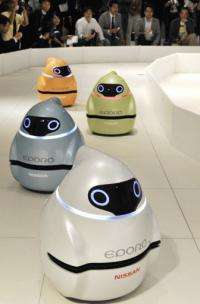
Robot cars designed by Nissan travel in group and move to avoid obstacles at a press preview at the company's headquarters in Yokohama, suburban Tokyo. With these robots, engineers in Japan say they are a step closer to developing technology they hope will cut the risk of car crashes -- by mimicking the behaviour of fish.
Engineers in Japan say they are a step closer to developing technology they hope will cut the risk of car crashes -- by mimicking the behaviour of fish.
The experts at Nissan Motor have been studying fish and the way they are able to swim in schools and avoid colliding with each other.
The result is a robot that can travel in a group of up to seven, avoiding bumps by sharing information with its peers.
The firm hopes to use the technology in its vehicles in future.
The three-wheeled robot uses a laser range finder, which measures the distance to an obstacle, and radio communications to recreate the behaviour of fish, which can change direction and travel side by side without colliding.
Last year Nissan unveiled a similar robot inspired by the bumblebee, which is also highly adept at avoiding collisions but travels solo.
"We, in a motorised world, have a lot to learn from the behaviour of a school of fish in terms of each fish's degree of freedom and safety," said Toshiyuki Andou, the principal engineer in the project.
By sharing information, the group can travel safely, changing its shape as needed, Andou said.
Nissan will demonstrate the technology at the CEATEC electronics trade fair in Japan next week.
(c) 2009 AFP
-
Nissan rolls out electric car at new headquarters
Aug 02, 2009 |
not rated yet |
0
-
Social relationships affect personality of fish, say experts
Nov 22, 2006 |
not rated yet |
0
-
Nissan Cuts In Half Amount of Precious Metals Required in Catalysts
Nov 17, 2008 |
not rated yet |
0
-
Fish robot as an alternative marine propulsion system of the future (w/Video)
Jun 09, 2009 |
not rated yet |
0
-
Fish-shaped robot for underwater research
Dec 16, 2004 |
not rated yet |
0
-
Engineers build first sub-10-nm carbon nanotube transistor
Feb 01, 2012 |
4.9 / 5 (30) |
30
-
Something old, something new: Evolution and the structural divergence of duplicate genes
Jan 31, 2012 |
4.6 / 5 (7) |
1
-
The hidden nanoworld of ice crystals: Revealing the dynamic behavior of quasi-liquid layers
Jan 30, 2012 |
5 / 5 (3) |
1
-
Stock market network reveals investor clustering
Jan 27, 2012 |
3.9 / 5 (23) |
8
-
Of microchemistry and molecules: Electronic microfluidic device synthesizes biocompatible probes
Jan 26, 2012 |
5 / 5 (1) |
0
-
feed hold button on CNC lathe
13 hours ago
-
Mechanics of Solids ( Final exam question) please help!
15 hours ago
-
RFAC in Fortran
18 hours ago
-
dynamics 2/32
23 hours ago
-
dynamics
Feb 08, 2012
-
Vibration Absorbtion Problem
Feb 08, 2012
- More from Physics Forums - General Engineering
More news stories
First Google hire leaving for online academy
The first person hired by Google's founders is leaving the Internet giant to devote himself to an innovative online education website called Khan Academy.
1 hour ago |
not rated yet |
0
NY attorney general ends lawsuit against Intel
(AP) -- Intel Corp. is paying $6.5 million as part of a deal to terminate an antitrust lawsuit filed against the chip maker by the New York attorney general's office.
1 hour ago |
not rated yet |
0
FBI file: Steve Jobs was considered for govt post
(AP) -- FBI background interviews of some people who knew Apple co-founder Steve Jobs reveal a man driven by power and alienating some of the people who worked with him.
1 hour ago |
2.3 / 5 (3) |
0
LinkedIn's 4Q earnings strong, revenue doubles
(AP) -- LinkedIn reported a strong fourth quarter as the online professional-networking service added 14 million members. Its net income and revenue beat Wall Street's expectations.
1 hour ago |
not rated yet |
0
New integrated building model may improve fish farming operations
Today's "locavore" movement with its emphasis on eating more locally-produced food is a natural fit for fruits and vegetables in nearly every region, but few entrepreneurs have dared to apply the concept to ...
2 hours ago |
not rated yet |
0
'Dark plasmons' transmit energy
Microscopic channels of gold nanoparticles have the ability to transmit electromagnetic energy that starts as light and propagates via "dark plasmons," according to researchers at Rice University.
Anyone can learn to be more inventive, cognitive researcher says
There will always be a wild and unpredictable quality to creativity and invention, says Anthony McCaffrey, a cognitive psychology researcher at the University of Massachusetts Amherst, because an "Aha moment" is rare and ...
New method makes culture of complex tissue possible in any lab
Scientists at the University of California, San Diego have developed a new method for making scaffolds for culturing tissue in three-dimensional arrangements that mimic those in the body. This advance, published online in ...
Cell biologists describes mechanism by which some people may be more susceptible to colon cancer
An international research team led by cell biologists at the University of California, Riverside has uncovered a new insight into colon cancer, the third leading cause of cancer-related deaths in the United ...
Ultraviolet protection molecule in plants yields its secrets
Lying around in the sun all day is hazardous not just for humans but also for plants, which have no means of escape. Ultraviolet (UV) radiation from the sun can damage proteins and DNA inside cells, leading ...
Hydrogen from acidic water: Researchers develop potential low cost alternative to platinum for splitting water
A technique for creating a new molecule that structurally and chemically replicates the active part of the widely used industrial catalyst molybdenite has been developed by researchers with the Lawrence Berkeley ...
Oct 01, 2009
Rank: not rated yet
i notice that we are now reinventing a lot because people in different domains dont step out of them to even find in other areas the work done.