It's in the bank: Human cord blood reprogrammed into embryonic-like stem cells
October 1, 2009
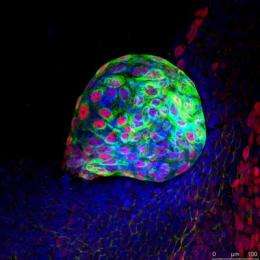
The endodermal layer, identified by markers AFP and FoxA2, will give rise to the digestive tract, lungs and bladder. Credit: Courtesy of Juan-Carlos Izpisúa Belmonte, from Cell Stem Cell, Oct. 1, 2009
Human umbilical cord blood cells may be far more versatile than previous research has indicated. Two independent studies, published by Cell Press in the October 2nd issue of the journal Cell Stem Cell, report that they have successfully reprogrammed human umbilical cord blood cells into cells with properties similar to human embryonic stem cells. The results are significant as they identify cord blood as a convenient source for generating cells with a theoretically limitless potential.
Recent research has shown that adult cells can be reprogrammed into cells with characteristics similar to embryonic stem cells by turning on a select set of genes. The cells, called induced pluripotent stem (iPS) cells, have tremendous potential for regenerative medicine. However, issues related to difficulty harvesting adult cells, inefficient reprogramming and the accumulation of genetic errors (mutations) that may contribute to an increased risk for cancer and diminished cellular functionality have presented formidable challenges. Human umbilical cord blood cells have been suggested as an attractive alternative to adult cells for reprogramming.
"Cord blood-derived cells can be collected without any risk for the donor, are young cells expected to carry minimal mutations and possess the immunological immaturity of newborn cells. We believe that cord blood cells could represent, rather than just another cell type that can be reprogrammed, a real alternative for a safer source of iPS cells," explains senior study author Dr. Izpisua Belmonte from the Center of Regenerative Medicine in Barcelona, Spain and The Salk Institute in La Jolla, California.
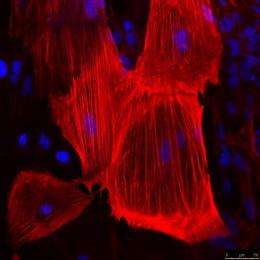
The mesodermal layer, identified by ASM, will form bones, muscles, connective tissue and the middle layer of the skin. Credit: Courtesy of Juan-Carlos Izpisúa Belmonte , from Cell Stem Cell, Oct. 1, 2009
Dr. Izpisua Belmonte and colleagues described a specific process that converted human cord blood cells into embryonic-like stem cells using only two factors. "From a mechanistic point of view, the fact that cord blood-derived iPS cells could be generated by activating only two genes is a crucial point that offers new possibilities for investigating the molecular basis of the reprogramming process," concludes Dr. Izpisua Belmonte.In a separate study, led by Dr. Ulrich Martin from Hannover Medical School in Hannover, Germany, cord blood cells were also used to generate cells that exhibited characteristics typical of embryonic stem cells. Dr. Martin and colleagues demonstrated that the iPS cells had the potential to differentiate into multiple mature cell types, including functional heart muscle cells. "Our study provides a feasible strategy for the reproducible generation of iPS cells from human cord blood" offers Dr. Martin. "Importantly, public and commercial cord blood banks may provide a superior and almost unlimited source of for the production of clinically useful iPS cells."
Both research groups highlight the substantial clinical convenience of the existing networks for banking human cord blood and the theoretical advantage of these "young" cells in that they may have a decreased risk of having accumulated damaging genetic mutations associated with adult cells. The successful reprogramming of human cord blood cells into pluripotent stem cells is an important step towards future regenerative therapies. "Our findings should facilitate the clinical translation of iPS cell-based therapies," says Dr. Izpisua Belmonte.
-
What's good for the mouse is good for the monkey: Skin cells reprogrammed into stem cells
Dec 03, 2008 |
not rated yet |
0
-
Researchers create heart and blood cells from reprogrammed skin cells
Apr 30, 2008 |
not rated yet |
0
-
Researchers develop human stem cell line containing sickle cell anemia mutation
May 29, 2008 |
not rated yet |
0
-
Researchers generate functional neurons from somatic cells
Feb 24, 2009 |
not rated yet |
0
-
Stem cells used to reverse paralysis in animals
Jan 28, 2009 |
not rated yet |
0
-
Engineers build first sub-10-nm carbon nanotube transistor
Feb 01, 2012 |
4.9 / 5 (30) |
30
-
Something old, something new: Evolution and the structural divergence of duplicate genes
Jan 31, 2012 |
4.6 / 5 (7) |
1
-
The hidden nanoworld of ice crystals: Revealing the dynamic behavior of quasi-liquid layers
Jan 30, 2012 |
5 / 5 (3) |
1
-
Stock market network reveals investor clustering
Jan 27, 2012 |
3.9 / 5 (23) |
8
-
Of microchemistry and molecules: Electronic microfluidic device synthesizes biocompatible probes
Jan 26, 2012 |
5 / 5 (1) |
0
-
Cancer drugs and Alzheimer's, Oh my!
5 hours ago
-
Squishing cells
5 hours ago
-
Any books/articles for evolutionary stable strategy models in humans?
17 hours ago
-
Science behind the bore feeling?
23 hours ago
-
Homo Sapien vs. Chimpanzee - Divergence Timeline
Feb 09, 2012
-
a single mRNA strand is attached to sevaral ribosomes?
Feb 08, 2012
- More from Physics Forums - Biology
More news stories
Fighting crimes against biodiversity: How to catch a killer weed
Invasive species which have the potential to destroy biodiversity and influence global change could be tracked and controlled in the same way as wanted criminals, according to new research from Queen Mary, University of London.
10 minutes ago |
not rated yet |
0
Ultraviolet protection molecule in plants yields its secrets
Lying around in the sun all day is hazardous not just for humans but also for plants, which have no means of escape. Ultraviolet (UV) radiation from the sun can damage proteins and DNA inside cells, leading ...
13 hours ago |
5 / 5 (5) |
0
|
Deadly bird parasite evolves at exceptionally fast rate
A new study of a devastating bird disease that spread from poultry to house finches in the mid-1990s reveals that the bacteria responsible for the disease evolves at an exceptionally fast rate. What's more, ...
12 hours ago |
5 / 5 (2) |
0
|
Decoding the molecular machine behind E. coli and cholera
Scientists from Queen Mary, University of London have discovered the workings behind some of the bacteria that kill hundreds of thousands every year, possibly paving the way for new antibiotics that could treat infections ...
12 hours ago |
not rated yet |
0
|
Deciding to go left or right: Researchers use device to determine that lower animals can navigate too
For decades, scientists have associated binary decision making opting to go left or right with higher-ranking animals, including humans. A team of Harvard researchers, however, is rewriting that ...
20 hours ago |
not rated yet |
2
|
A novel method for simultaneously measuring blood pressure and arterial stiffness
Arterial stiffness due to is a major contributor to cardiovascular disease but is very difficult to measure. It also can influence blood pressure readings since these rely on the time taken for arteries to return to normal ...
Study finds that red blood cell transfusion decreases fatigue in women with acute postpartum anemia
In a study to be presented today at the Society for Maternal-Fetal Medicine's annual meeting, The Pregnancy Meeting , in Dallas, Texas, researchers will report findings that show that in women with acute postpartum ...
Study weighs risks and benefits of birthing facilities
In a study to be presented today at the Society for Maternal-Fetal Medicine's annual meeting, The Pregnancy Meeting , in Dallas, Texas, researchers will report findings that indicate that the risk of obstetric intervention ...
Study finds in women with prior cesarean, optimal gestational age for elective delivery is week 39
In a study to be presented today at the Society for Maternal-Fetal Medicine's annual meeting, The Pregnancy Meeting, in Dallas, Texas, researchers will report findings that indicate that for women with prior delivery via ...
4.5 million Americans living with total knee replacement
New research presented at the 2012 Annual Meeting of the American Academy of Orthopaedic Surgeons (AAOS) found that more than 4.5 million Americans are living with a total knee replacement (TKR), as the number of TKR surgeries ...
FDA-approved drug rapidly clears amyloid from the brain, reverses Alzheimer's symptoms in mice
Neuroscientists at Case Western Reserve University School of Medicine have made a dramatic breakthrough in their efforts to find a cure for Alzheimer's disease. The researchers' findings, published in the journal Science, show t ...
