No texting at dinner! Parenting in the digital era
October 1, 2009 By KARYN D. COLLINS , For The Associated Press
No texting at dinner! Parenting in the digital era (AP)

Enlarge

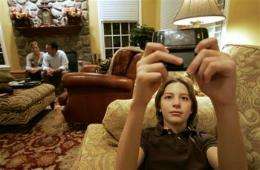
Dylan Herina 13, uses his cell phone to text as his mother and father, Beth and Peter sit in another part of their family room in their home in Ringwood N.J., Wednesday, Sept. 30, 2009. Dylan has strict rules as to when and where he can text. (AP Photo/Rich Schultz)

(AP) -- Holly Kopczynski always prided herself on raising her kids the right way, teaching them etiquette basics like saying "please" and "thank you." Then it happened.

"We were at a restaurant for my mom's birthday. I looked over and there are my daughter and my oldest son , holding their phones under the table," said the mom of four in Lewiston, Idaho. "I just came unglued. I was like, `Are you kidding? You're at your grandma's birthday party. Put those phones away now!'"

We all know teens love their gadgets - more for texting than talking. But the devices are posing some new challenges for parents. How can they teach their tech-savvy kids some electronic etiquette?

So far, parents are learning on the fly, imposing new rules for their young offenders such as "no texting at dinner."

Beth Herina of Ringwood, N.J., made that rule two years ago because her 13-year-old son was texting friends at the dinner table. She has another rule, too: No texting on family outings.

"He can text en route but not when it is family time," she said. "And I ask questions about who he is texting."

Her son Dylan may not like mom's rules, but she considers them mild. Her brother-in-law goes into his children's accounts to read their texts.

When it comes to like cell phones and computers, some kids and even some adults don't seem to consider their gadget behavior rude, said P.M. Forni, co-founder of Johns Hopkins University's Civility Initiative.

"We're seeing behavior that you never would have seen before," he said. "Students getting up in the middle of class to answer their phones, texting during class, students on their laptops during lectures."

Kopczynski said she told her 20-year-old son and 16-year-old daughter to shut their phones off and put them away, which they did, but it was their reaction to her order that still bothers her.

"That was a sad moment for me," she said. "I grew up with rules, the `no elbows on the table' kind of things. And I've raised my kids with that. But they didn't even realize what they were doing."

It's not only cell phones that parents are restricting.

Many are establishing control over their children's computer use - setting themselves up as administrators for Internet accounts, asking kids questions about who they are communicating with online, and at times looking directly over their shoulders at the screen.

Some even go so far as to put the computer in a common area of the house so they can monitor the sites their children are visiting.

Laura Lambert, a Chicago mom of four, tries not to implement time limits and other rules. Her 16-year-old son has his own laptop now after years of using the family computer.

"What I've found is if you say you only get 90 minutes, they obsess about it all day and they rush through everything else and it almost elevates the importance of it," she said.

"I find they regulate (their usage) better if I just say 'I want you to balance your time better so you can get everything else done.'"
For kids, the rules and parent checks can seem intrusive and a bit extreme.

Kopczynski's daughter Kaitlyn had her phone taken away recently because she was texting after her mother told her to turn it off.
"I guess I understand why there are rules," Kaitlyn said. "But I don't think I'm that bad. I have a lot of friends who don't have rules at all."

Joy Weaver, whose Dallas-based Protocol Enterprises offers etiquette classes for all ages, said parents should begin establishing rules and expectations early on about cell phones and computer use. Monitor usage closely with the help of available applications and programs, she said.

Sending a consistent message to children is also crucial.

"You can't have two sets of rules," she said. "If you don't want your children to text at the dinner table you need to ignore your own phone or excuse yourself from the table, too."

©2009 The Associated Press. All rights reserved. This material may not be published, broadcast, rewritten or redistributed.

Filter


Move the slider to adjust rank threshold, so that you can hide some of the comments.


Display comments: newest first

Mauricio
Oct 01, 2009

Rank: not rated yet
hilarious....

people tend to maintain the traditions, but the question arises? do those traditions raised nice, happy people?

Oh.... we did not think of that.

My wife tried to enforced some rules that her family had, until I asked the question? do you think the way your parents raised you and your brothers was a way to raised well balanced people?

Another thing is the resistance of people to technology, just because is new. It is important to remember than centuries ago (and maybe recently in some parts of the world) present strong resistance to reading, they created all sorts of excuses about it. That it makes you blind! Today, few people would even encourage reading. Yes, only few. Most people seem to be unfortunately enforcing the repetition of their unhappy histories (e.g., disciplining the children).

Computers are replacing all the media, just accept that. We are getting "wired".
Rank 1 /5 (1 vote)
Related Stories
Relevant PhysicsForums posts
  • How to tilt a object
    created3 hours ago
  • How to calculate total compressibility in liquid porous solid system
    created8 hours ago
  • Need help reading 3-D
    createdFeb 11, 2012
  • A way to send and receive wireless data
    createdFeb 11, 2012
  • Calling function with no input argument
    createdFeb 10, 2012
  • Force free body diagram problem on gym equipment
    createdFeb 10, 2012
  • More from Physics Forums - General Engineering

More news stories

Google might launch Drive for cloud storage soon

(PhysOrg.com) -- Google's next big move, according to the Wall Street Journal, is a cloud storage service called Drive. Hardly first to the plate, Google is simply catching up to introducing its cloud reposi ...

Technology / Internet

created 17 hours ago | popularity 4.8 / 5 (5) | comments 5 | with audio podcast report

Iran blocks email, restricts net access: reports

Iran has further restricted access to the Internet and blocked popular email services for the past few days, in a move a top lawmaker said could "cost the regime dearly," media reports said on Sunday.

Technology / Internet

created 10 hours ago | popularity 5 / 5 (2) | comments 5

Walney offshore wind farm is world's biggest (for now)

(PhysOrg.com) -- The Walney wind farm on the Irish Sea--characterized by high tides, waves and windy weather--officially opened this week. The farm is treated in the press as a very big deal as the Walney ...

Technology / Energy & Green Tech

created Feb 11, 2012 | popularity 4.1 / 5 (14) | comments 56 | with audio podcast weblog

Love a click away in Indonesia's Twitter Republic

He was a geeky kid from Yogyakarta, she a glamorous city girl in Jakarta. In a country with one of the world's most vibrant social networking scenes they fell in love on Twitter.

Technology / Internet

created 18 hours ago | popularity 4 / 5 (1) | comments 0

Navy to begin tests on electromagnetic railgun prototype launcher

The Office of Naval Research (ONR)'s Electromagnetic (EM) Railgun program will take an important step forward in the coming weeks when the first industry railgun prototype launcher is tested at a facility ...

Technology / Engineering

created Feb 06, 2012 | popularity 4.6 / 5 (20) | comments 95 | with audio podcast


Scientists discover molecular secrets of 2,000-year-old Chinese herbal remedy

For roughly two thousand years, Chinese herbalists have treated Malaria using a root extract, commonly known as Chang Shan, from a type of hydrangea that grows in Tibet and Nepal. More recent studies suggest that halofuginone, ...

New method to examine batteries -- MRI from the inside

There is an ever-increasing need for advanced batteries for portable electronics, such as phones, cameras, and music players, but also to power electric vehicles and to facilitate the distribution and storage of energy derived ...

A mitosis mystery solved: How chromosomes align perfectly in a dividing cell

Although the process of mitotic cell division has been studied intensely for more than 50 years, Whitehead Institute researchers have only now solved the mystery of how cells correctly align their chromosomes during symmetric ...

Lab study raises questions over nano-particle impact

Tests involving chickens have raised questions about the impact on health from engineered nano-particles, the ultra-fine grains commonly used in drugs and processed foods, scientists said on Sunday.

Starve a virus, feed a cure? Findings show how some cells protect themselves against HIV

A protein that protects some of our immune cells from the most common and virulent form of HIV works by starving the virus of the molecular building blocks that it needs to replicate, according to research published online ...

Researchers find extensive RNA editing in human transcriptome

In a new study published online in Nature Biotechnology, researchers from BGI, the world's largest genomics organization, reported the evidence of extensive RNA editing in a human cell line by analysis of RNA-seq data, demons ...