Loss of top predators causing surge in smaller predators, ecosystem collapse
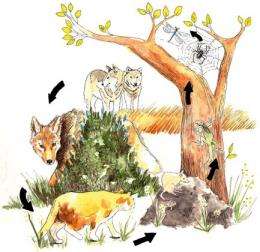
The catastrophic decline around the world of "apex" predators such as wolves, cougars, lions or sharks has led to a huge increase in smaller "mesopredators" that are causing major economic and ecological disruptions, a new study concludes.
The findings, published today in the journal Bioscience, found that in North America all of the largest terrestrial predators have been in decline during the past 200 years while the ranges of 60 percent of mesopredators have expanded. The problem is global, growing and severe, scientists say, with few solutions in sight.
An example: in parts of Sub-Saharan Africa, lion and leopard populations have been decimated, allowing a surge in the "mesopredator" population next down the line, baboons. In some cases children are now being kept home from school to guard family gardens from brazen packs of crop-raiding baboons.
"This issue is very complex, and a lot of the consequences are not known," said William Ripple, a professor of forest ecosystems and society at Oregon State University. "But there's evidence that the explosion of mesopredator populations is very severe and has both ecological and economic repercussions."
In case after case around the world, the researchers said, primary predators such as wolves, lions or sharks have been dramatically reduced if not eliminated, usually on purpose and sometimes by forces such as habitat disruption, hunting or fishing. Many times this has been viewed positively by humans, fearful of personal attack, loss of livestock or other concerns. But the new picture that's emerging is a range of problems, including ecosystem and economic disruption that may dwarf any problems presented by the original primary predators.
"I've done a lot of work on wildlife in Africa, and people everywhere are asking some of the same questions, what do we do?" said Clinton Epps, an assistant professor at OSU who is studying the interactions between humans and wildlife. "Most important to understand is that these issues are complex, the issue is not as simple as getting rid of wolves or lions and thinking you've solved some problem. We have to be more careful about taking what appears to be the easy solution."
The elimination of wolves is often favored by ranchers, for instance, who fear attacks on their livestock. However, that has led to a huge surge in the number of coyotes, a "mesopredator" once kept in check by the wolves. The coyotes attack pronghorn antelope and domestic sheep, and attempts to control them have been hugely expensive, costing hundreds of millions of dollars.
"The economic impacts of mesopredators should be expected to exceed those of apex predators in any scenario in which mesopredators contribute to the same or to new conflict with humans," the researchers wrote in their report. "Mesopredators occur at higher densities than apex predators and exhibit greater resiliency to control efforts."
The problems are not confined to terrestrial ecosystems. Sharks, for instance, are in serious decline due to overfishing. In some places that has led to an explosion in the populations of rays, which in turn caused the collapse of a bay scallop fishery and both ecological an economic losses.
Among the findings of the study:
• Primary or apex predators can actually benefit prey populations by suppressing smaller predators, and failure to consider this mechanism has triggered collapses of entire ecosystems.
• Cascading negative effects of surging mesopredator populations have been documented for birds, sea turtles, lizards, rodents, marsupials, rabbits, fish, scallops, insects and ungulates.
• The economic cost of controlling mesopredators may be very high, and sometimes could be accomplished more effectively at less cost by returning apex predators to the ecosystem.
• Human intervention cannot easily replace the role of apex predators, in part because the constant fear of predation alters not only populations but behavior of mesopredators.
• Large predators are usually carnivores, but mesopredators are often omnivores and can cause significant plant and crop damage.
• The effects of exploding mesopredator populations can be found in oceans, rivers, forests and grasslands around the world.
• Reversing and preventing mesopredator release is becoming increasingly difficult and expensive as the world's top predators continue to edge toward obliteration.
"These problems resist simple solutions," Ripple said. "I've read that when Gen. George Armstrong Custer came into the Black Hills in 1874, he noticed a scarcity of coyotes and the abundance of wolves. Now the wolves are gone in many places and coyotes are killing thousands of sheep all over the West."
"We are just barely beginning to appreciate the impact of losing our top predators," he said.
At OSU, Ripple and colleague Robert Beschta have done extensive research and multiple publications on the effect that loss of predators such as wolves and cougars have on ecosystem disruption, not only by allowing increased numbers of grazing animals such as deer and elk, but also losing the fear of predation that changes the behavior of these animals. They have documented ecosystem recovery in Yellowstone National Park after wolves were reintroduced there.
Source: Oregon State University (news : web)


