Sony Develops High Frame Rate Single Lens 3D Camera Technology

October 1, 2009 Sony Develops High Frame Rate Single Lens 3D Camera Technology

Enlarge

Sony today announced the development of a single lens 3D camera technology capable of recording natural and smooth 3D images of even fast-moving subject matter such as sports, at 240fps (frames per second).

This technology combines a newly developed optical system for single lens which captures the left and right images simultaneously, together with existing high frame rate (HFR) recording technology to realize 240fps 3D filming. will demonstrate a prototype model incorporating this technology at "CEATEC JAPAN 2009", to be held at Makuhari Messe convention center in Chiba city, Japan, from October 6th.

In existing half mirror 3D camera systems with separate lenses for the left and right eyes, the parallax range is adjustable, enabling the depth of the 3D images to be modified. However, when operating the zoom and focus functions of such systems, the sensitivity of the human eye, in particular to differences in the size and rotational movement of dual images, as well as any vertical misalignment or difference in image quality has meant that complex technology has been required to ensure that each camera lens is closely coordinated, and there are no discrepancies in the optical axis, image size, and focus. The introduction of a single lens system resolves any issues that may occur as a result of having different optical characteristics for each eye.
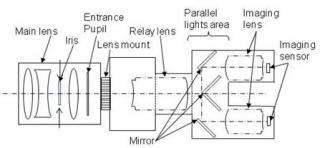
Optical system for single lens 3D camera
Enlarge

Optical system for single lens 3D camera

Furthermore, by using mirrors in place of shutters, incoming light can now be simultaneously separated into left and right images and recorded as it reaches the parallel light area (the area where diverging light from the point of focus on the subject matter becomes parallel) of the relay lens. The separated left and right images are then processed and recorded with the respective left and right image sensors. As there is no difference in time between when the left and right eye images are captured, it is possible for natural and smooth 3D images to be captured, even of scenes involving rapid movement.

Optical tests have shown that a frame rate 240fps represents the limit of human visual perception, and beyond that it becomes difficult to detect differences in terms of blur and "jerkiness" of moving images (where images that were continuous are now seen as a series of distinct snapshots). By developing a 240fps frame rate CMOS with properties close to the human eye, which is capable of capture natural images of even fast moving subject matter, Sony has succeeded in enhancing the quality of 3D video images.

The combination of Sony's new single lens 3D system and its 240fps high frame rate technology has realized a single lens 3D camera system, based on universal properties of the human eye, which enables natural and smooth 3D images with no accommodation-vergence conflict to be recorded.

Technological Features:

1. New single lens optical system

- Captures left and right images simultaneously to deliver natural and smooth 3D images with no accommodation-vergence conflict.
- Eliminates the need for lens synchronization, ensuring easily accurate control of 3D zoom and focus functions.
- When polarized glasses are not used, viewers with still be able to see natural 2D images, as the disparity of the images for left and right eyes are within the range that human eyes can recognize as a blur.

2. 240fps image capture to realize high quality motion images

- Realizes high quality capture of 3D content including fast-moving subject matter such as sports.

Source: Sony


print this article email this article download pdf blog this article bookmark this article     Stumble it Digg this share on Facebook retweet share on Reddit add to delicious
Rate this story - 4.1 /5 (8 votes)

Rank Filter

Move the slider to adjust rank threshold, so that you can hide some of the comments.


Display comments: newest first

  • YawningDog - Oct 01, 2009
    • Rank: 5 / 5 (1)
    I read the whole thing (and thought about it) and still don't see how you can get a 3D image from one lens position. 3D perception results from merging two images separated by a few inches. I don't get it. They're splitting one image into two and calling it 3D. I'm going to have to see it to believe it.
  • Nartoon - Oct 02, 2009
    • Rank: not rated yet
    I'm with YawningDog. There is a single image that is divided in two, how is that a 3D image? Maybe this is a 'faked' 3D when processed?
  • Dhanne - Oct 02, 2009
    • Rank: not rated yet
    Just look at the long dashed line to see that there are actually two parts inside the camera. The mirrors on parellel lights area divide the image in half - just like if you have two cameras on side by side. In the end you'll get two videos that have slightly different from each other thus showing the videos in 3DTV let's you see it like 3D. Or this is how I understand the image above. Correct me if I'm wrong.
  • YawningDog - Oct 03, 2009
    • Rank: not rated yet
    The key in what you say is "slightly different". I fail to see how that slight difference in field position could result in what our eyes call 3D. We have become accustomed to about 2.5" separation. It may all be done with mirrors but I detect a whiff of smoke in Sony's announcement.

October 1, 2009 all stories

Comments: 4

4.1 /5 (8 votes)
  • Stumble this up

  • Digg this

  • share this

  • hide
  • Related Stories

  • Panasonic Develops World's First 3D Full HD Plasma Theater System
    created Sep 24, 2008 | popularity not rated yet | comments 0
  • Japanese Researchers Develop Portable 3D Display System
    created Sep 29, 2006 | popularity not rated yet | comments 0
  • Epson Develops New High-Resolution 3D LCD Display
    created Aug 11, 2008 | popularity not rated yet | comments 0
  • KDDI's First 3D Mobile Phone LCD Screen
    created Oct 09, 2008 | popularity not rated yet | comments 0
  • Fujifilm unveils 3D digital camera
    created Jul 22, 2009 | popularity not rated yet | comments 0


  • hide
  • Relevant PhysicsForums posts

  • Base Isolation Systems in Skyscrapers?
    created 10 hours ago
  • Need to interview a Computer Hardware Engineer for school project
    created 12 hours ago
  • transient heat transfer
    created 18 hours ago
  • Trying to adapt a fuel gage circuit
    created Nov 22, 2009
  • Pushing the piston.
    created Nov 22, 2009
  • Do Camcorders/ Video camera have Sensors in them?
    created Nov 22, 2009
  • More from Physics Forums - General Engineering

Other News

NREL Uncovers Clean Energy Leaders State by State

NREL Uncovers Clean Energy Leaders State by State

Technology / Energy

created 11 minutes ago | popularity not rated yet | comments 0

(PhysOrg.com) -- That California and Texas still lead the United States in generating renewable energy probably is no surprise. But, NREL's 2009 State of the States report shows that several smaller states ...


Opera logo

Stable Opera 10.10 browser with Unite now available

Technology / Software

created 1hour ago | popularity 5 / 5 (2) | comments 0

(PhysOrg.com) -- The web browser Opera 10.10 has been released as a stable version, and it has a number of new features to enhance the browsing experience, including "Unite", which is a group of applications ...


Key scientist says politics behind stolen e-mails

Technology / Other

created 1hour ago | popularity not rated yet | comments 3

(AP) -- A leading climate change scientist said hackers breaking into a university's computer server and then posting documents online show the nasty politics of global warming.


Just in time for Black Friday: students turn iPhone into barcode scanner

Just in time for Black Friday: students turn iPhone into barcode scanner

Technology / Software

created 12 hours ago | popularity 4.7 / 5 (3) | comments 0

(PhysOrg.com) -- Comparing prices over the Internet has become a common practice for consumers. Now, just in time for Black Friday, a group of Missouri University of Science and Technology students is putting ...


IBM Researchers Lower Language Barrier With Text Translator

Technology / Computer Sciences

created 14 hours ago | popularity 4.5 / 5 (4) | comments 0

IBM Researchers are helping to break the language barrier with the advent of technology dubbed "n.Fluent" -- smart software that translates text between English and 11 other languages. IBM employees use it to instantaneously ...