Panasonic Develops High Energy Lithium-ion Battery Module with High Reliability
October 1, 2009
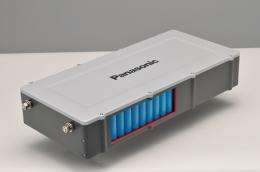
Panasonic Corp. has developed a 1.5 kWh battery module from 18650-type (18 mm in diameter x 65 mm in length) lithium-ion battery cells, which are widely used in laptop computers, to provide energy storage solutions for a wide range of environmentally friendly energy technologies. For example, multiple units can be connected in series and/or parallel to store energy generated by home-use photovoltaic (PV) systems and fuel cells, and power electric vehicles (EV).
A prototype of the new module will be shown at CEATEC JAPAN 2009 (Makuhari Messe, October 6-10, 2009) and New Energy Industry Fair Osaka (Intex Osaka, October 7-9, 2009).
Amid rising environmental concerns such as CO2 emissions, great expectations are placed on widespread use of renewable energy technologies such as photovoltaics and commercialization of electric vehicles to alleviate the concerns. However, these technologies require storage systems to become commonplace in daily life. Among a number of energy storage technologies, storage systems using lithium-ion batteries in particular are considered promising and practical, because such systems are lighter and have greater capacity than those using other types of rechargeable batteries.
As applications of the storage systems using lithium-ion batteries increase, there will arise demand for such systems with higher capacity, output, reliability and safety as well as improved cost performance. Flexibility in voltage and capacity will also be required according to the application.
Panasonic's compact and high-energy battery module meets such demands. The module having a volume of approximately 7 L and weighing 8 kg has a voltage of 25.2 V and a capacity of 58 Ah. By connecting a plurality of this module, users can construct battery packs for a variety of applications such as home electricity storage and electric vehicles.
The high-energy module is constructed from 140 pieces of 18650-type lithium-ion battery cells - seven serially connected rows with each row made of 20 parallel connected battery cells. This structure allows for avoiding serious loss in the system performance such as system shutdown even if some individual cells fail.
Panasonic has a proven record in the production of the 18650-type lithium-ion batteries which are highly reliable and safe, and offer good cost performance. The company has already developed and commercialized a 18650-type lithium-ion battery which has the industry's highest level of capacity.
To achieve the innovative module, Panasonic employed a high-capacity and high-durability cell technology using its proprietary nickel-based positive electrode material. Other technologies used include its cell safety technology that uses a heat-resistant insulating layer between the positive and negative electrodes to prevent short circuits and thermal runaway (overheating) which can be caused when foreign particles get mixed into the battery cell. The new module also uses Panasonic's design technology to ensure reliability by minimizing the effects on power supply if a trouble occurs in some of the cells contained in the module.
On the new battery module, Panasonic holds 38 patents in Japan and 22 in other countries including pending applications.
Source: Panasonic
-
Argonne's lithium-ion battery technology to be commercialized by Japan's Toda Kogyo
Mar 13, 2008 |
not rated yet |
0
-
New 'layered-layered' materials for rechargeable lithium batteries
May 07, 2007 |
not rated yet |
0
-
Toshiba's 'NanoBattery' Recharges In Only One Minute
Mar 29, 2005 |
not rated yet |
0
-
New Lithium Ion Batteries With Industry's Highest Level of Energy Density
Dec 09, 2004 |
not rated yet |
0
-
Industry's First Tin-Based Anode Battery With 30 Percent More Capacity
Feb 15, 2005 |
not rated yet |
0
-
Engineers build first sub-10-nm carbon nanotube transistor
Feb 01, 2012 |
4.9 / 5 (31) |
30
-
Something old, something new: Evolution and the structural divergence of duplicate genes
Jan 31, 2012 |
4.6 / 5 (7) |
1
-
The hidden nanoworld of ice crystals: Revealing the dynamic behavior of quasi-liquid layers
Jan 30, 2012 |
5 / 5 (3) |
1
-
Stock market network reveals investor clustering
Jan 27, 2012 |
3.9 / 5 (23) |
8
-
Of microchemistry and molecules: Electronic microfluidic device synthesizes biocompatible probes
Jan 26, 2012 |
5 / 5 (1) |
0
-
Calling function with no input argument
6 hours ago
-
Force free body diagram problem on gym equipment
7 hours ago
-
Empirical data regarding shower heads and water
15 hours ago
-
feed hold button on CNC lathe
Feb 09, 2012
-
RFAC in Fortran
Feb 09, 2012
-
dynamics 2/32
Feb 08, 2012
- More from Physics Forums - General Engineering
More news stories
CIA website offline, Anonymous takes credit
The website of the Central Intelligence Agency was unresponsive on Friday after the hacker group Anonymous claimed to have knocked it offline.
1 hour ago |
5 / 5 (1) |
6
New error-correcting codes guarantee the fastest possible rate of data transmission
Error-correcting codes are one of the triumphs of the digital age. Theyre a way of encoding information so that it can be transmitted across a communication channel such as an optical fiber o ...
Technology / Computer Sciences
9 hours ago |
5 / 5 (3) |
5
|
Small modular reactor design could be a 'SUPERSTAR'
(PhysOrg.com) -- Though most of today's nuclear reactors are cooled by water, we've long known that there are alternatives; in fact, the world's first nuclear-powered electricity in 1951 came from a reactor ...
Technology / Energy & Green Tech
9 hours ago |
4.2 / 5 (10) |
18
|
Advanced power-grid model finds low-cost, low-carbon future in West
(PhysOrg.com) -- The least expensive way for the Western U.S. to reduce greenhouse gas emissions enough to help prevent the worst consequences of global warming is to replace coal with renewable and other ...
Technology / Energy & Green Tech
9 hours ago |
3.7 / 5 (3) |
7
|
New power source discovered
(PhysOrg.com) -- Researchers at the Massachusetts Institute of Technology (MIT) and RMIT University have made a breakthrough in energy storage and power generation.
Technology / Energy & Green Tech
8 hours ago |
4.9 / 5 (12) |
3
|
NASA sees wide-eyed cyclone Jasmine
Cyclone Jasmine's eye has opened wider on NASA satellite imagery, as it moves through the Southern Pacific Ocean.
NASA sees Giovanna reach cyclone strength, threaten Madagascar
Tropical Storm 12S built up steam and became a cyclone on February 10, 2012 as NASA's Terra satellite passed overhead. Residents of east-central Madagascar should prepare for this cyclone to make landfall ...
Complex wiring of the nervous system may rely on a just a handful of genes and proteins
Researchers at the Salk Institute have discovered a startling feature of early brain development that helps to explain how complex neuron wiring patterns are programmed using just a handful of critical genes. ...
The power of estrogen -- male snakes attract other males
A new study has shown that boosting the estrogen levels of male garter snakes causes them to secrete the same pheromones that females use to attract suitors, and turned the males into just about the sexiest ...
Humans may have helped the decline of African rainforests 3000 years ago
(PhysOrg.com) -- Large areas of rainforests in Central Africa mysteriously disappeared over three thousand years ago, to be replaced by savannas. The prevailing theory has been that the cause was a change ...
Could Venus be shifting gear?
(PhysOrg.com) -- ESAs Venus Express spacecraft has discovered that our cloud-covered neighbour spins a little slower than previously measured. Peering through the dense atmosphere in the infrared, the ...
Oct 02, 2009
Rank: not rated yet
"Japan's Panasonic Corp (6752.T) said on Thursday it has developed a technology that binds together standard lithium-ion battery cells used in laptop PCs to power electric vehicles, taking aim at growing demand for green cars.
The new technology will likely enable Panasonic to make electric car batteries at half the cost of lithium-ion batteries that are developed solely for electric cars, since it can use existing battery plants and production expertise, the company said."
Half the cost.
http://www.reuter...20091001