New White House Fellows survey: Leaders are less trusting, less cynical
October 2, 2009
This is the logo for the White House Fellow Project. Credit: Rice University's Baker Institute
Contemporary leaders are less trusting, but also less cynical, than those in top positions nearly four decades ago, according to a new comprehensive survey of White House Fellows -- a group that includes more than 600 prominent leaders in nearly every sector of American society.
On the eve of the 45th anniversary of the executive order establishing the President's Commission on White House Fellowships, D. Michael Lindsay, Rice University sociology professor and Baker Institute for Public Policy scholar, today released the results from a yearlong study, which resembled the last major survey of America's leadership cohort (the American Leadership Study of 1971-72). Leaders represented in the study include corporate CEOs (of such companies as Levi Strauss & Co. and JCPenney), political leaders (such as presidential cabinet secretaries as well as U.S. senators and representatives), along with top leaders in higher education, nonprofit life and the media.
The report, "Surveying America's Leadership: A Study of White House Fellows," reveals striking differences between America's leadership cohort and the general public as well as differences between leaders today and those of the 1970s. America's leadership cohort has greater confidence than the general public in certain institutions — such as the Supreme Court and the scientific community — and less confidence in others — such as education or organized labor. The study reveals significant differences on hot-button topics such as executive income and political representativeness.
"This study shows some important ways that the federal government is recruiting not only future political leaders, but also training leaders for the private and nonprofit sectors," said Lindsay.
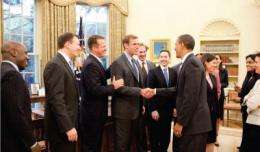
The nonpartisan White House Fellows program is 45 years old this week. Credit: White House
The study was co-sponsored by the James A. Baker III Institute for Public Policy and the Carnegie Corp. of New York. Through its grantmaking, the Carnegie Corporation funded the first few years of the White House Fellowship."Leadership has always been one of the highest values at Carnegie Corp. of New York because leaders make a difference in institutions, in peoples' lives and in society," said Vartan Gregorian, president of the Carnegie Corp. and a current member of the commission that annually selects White House Fellows. "When John Gardner, the former president of the Corporation, worked to create the White House Fellowship program he believed the men and women who won these competitive slots in government could make a difference.
"For the first time in 45 years, however, we now have hard data [from Rice University] on how important a role the White House Fellowship can be, not just in the lives of our nation's leaders but also in American society. We are proud the corporation, present at the creation of the fellowship program, could support this important research. Anyone who cares about developing leaders can learn from these findings."
-
Psychologist reveals the secrets of leadership
Aug 20, 2007 |
not rated yet |
0
-
Harvard seeks to tap soul of leadership
Nov 13, 2006 |
not rated yet |
0
-
Study: Americans Expect Business Leaders to Be White
Jul 15, 2008 |
not rated yet |
0
-
Report warns of challenges to U.S. leadership in space
Jun 24, 2005 |
not rated yet |
0
-
No such thing as a 'born leader,' study in fish finds
Jan 29, 2009 |
not rated yet |
0
-
Engineers build first sub-10-nm carbon nanotube transistor
Feb 01, 2012 |
4.9 / 5 (31) |
30
-
Something old, something new: Evolution and the structural divergence of duplicate genes
Jan 31, 2012 |
4.6 / 5 (7) |
1
-
The hidden nanoworld of ice crystals: Revealing the dynamic behavior of quasi-liquid layers
Jan 30, 2012 |
5 / 5 (3) |
1
-
Stock market network reveals investor clustering
Jan 27, 2012 |
3.9 / 5 (23) |
8
-
Of microchemistry and molecules: Electronic microfluidic device synthesizes biocompatible probes
Jan 26, 2012 |
5 / 5 (1) |
0
-
Bohr-Einstein debate: why did Bohr not simply say...
Feb 06, 2012
-
Best/Worst U.S. Presidents
Jan 31, 2012
- More from Physics Forums - History & Humanities
More news stories
A frank discussion of the power law and linking correlation to causation
(PhysOrg.com) -- Michael Stumpf a mathematics professor at Imperial College in London, and Mason Porter a lecturer at Oxford have teamed together to write and publish a perspective piece in Science regarding the in ...
Employers feel no love for unscrupulous practice of 'service sweethearting'
A new study led by two Florida State University marketing professors finds that some frontline service employees who are rewarded for hikes in customer loyalty and satisfaction also may engage in "service ...
Other Sciences / Economics & Business
Feb 10, 2012 |
3.3 / 5 (3) |
11
US workers are 'giving away the store,' costing firms billions
Nearly 70 percent of the nation's service employees give away free goods and services from hamburgers to cable TV costing companies billions of dollars a year, according to a groundbreaking study.
Other Sciences / Economics & Business
Feb 09, 2012 |
3.5 / 5 (4) |
10
New insights into how to correct false knowledge
The abundance of false information available on the Internet, in movies and on TV has created a big challenge for educators.
Other Sciences / Social Sciences
Feb 07, 2012 |
4.9 / 5 (7) |
9
|
Neanderthal demise due to many influences, including cultural changes: study
As an ice age crept upon them thousands of years ago, Neanderthals and modern human ancestors expanded their territory ranges across Asia and Europe to adapt to the changing environment.
Other Sciences / Archaeology & Fossils
Feb 07, 2012 |
4.4 / 5 (5) |
8
|
Scientists discover molecular secrets of 2,000-year-old Chinese herbal remedy
For roughly two thousand years, Chinese herbalists have treated Malaria using a root extract, commonly known as Chang Shan, from a type of hydrangea that grows in Tibet and Nepal. More recent studies suggest that halofuginone, ...
New method to examine batteries -- MRI from the inside
There is an ever-increasing need for advanced batteries for portable electronics, such as phones, cameras, and music players, but also to power electric vehicles and to facilitate the distribution and storage of energy derived ...
A mitosis mystery solved: How chromosomes align perfectly in a dividing cell
Although the process of mitotic cell division has been studied intensely for more than 50 years, Whitehead Institute researchers have only now solved the mystery of how cells correctly align their chromosomes during symmetric ...
Starve a virus, feed a cure? Findings show how some cells protect themselves against HIV
A protein that protects some of our immune cells from the most common and virulent form of HIV works by starving the virus of the molecular building blocks that it needs to replicate, according to research published online ...
Researchers find extensive RNA editing in human transcriptome
In a new study published online in Nature Biotechnology, researchers from BGI, the world's largest genomics organization, reported the evidence of extensive RNA editing in a human cell line by analysis of RNA-seq data, demons ...
The proteins ensuring genome protection
Researchers from the University of Geneva (UNIGE), Switzerland, have discovered the crucial role of two proteins in developing a cell 'anti-enzyme shield'. This protection system, which operates at the level of molecular ...

Oct 02, 2009
Rank: 1 / 5 (1)