Heart of a galaxy emits gamma rays
October 2, 2009 Heart of a galaxy emits gamma rays

Enlarge

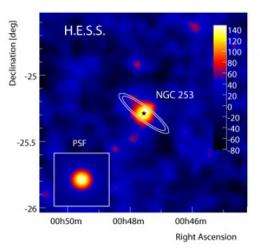
Heart of a galaxy emitting gamma rays: This image taken with H.E.S.S. shows the heart of the NGC 253 galactic system. The black star marks the optical centre and the white contours indicate the shape of the galaxy. The H.E.S.S. telescope system perceives the centre of the galaxy as a point - as the comparison with a simulated artificial point source in the inset ("PSF") shows. Credit: Image: H.E.S.S. Collaboration

(PhysOrg.com) -- Quite a few distant galaxies turn out to be cosmic delivery rooms. Large numbers of massive stars are born in the hearts of these starburst galaxies, and later explode as supernovae. In the remnants they leave behind, particles are accelerated to very high energies. Astrophysicists have now used the H.E.S.S. telescopes to make detailed measurements of the gamma rays from the NGC 253 galaxy. As predicted, these high-energy rays originate from the region of maximum supernova activity close to the centre. (Science Express, September 2009)

At a distance of some twelve million light years away, NGC 253 is one our closest spiral galaxies outside the so-called local group of our Milky Way and its companions. Observations in the visible light as well as in the infrared and radio frequency ranges had already shown there was a small region at the centre of NGC 253 which gave birth to a very high number of stars. This region exhibits a very high density of interstellar dust and gas.

The high-mass born in this region use up their nuclear fuel relatively quickly and stagger into an energy crisis at the end of their life. The nucleus collapses while the star destroys itself in one final explosion. Such a supernova suddenly flares up a million or even a billion times brighter than before. The charged particles accelerated to very high energies in the remnants of such explosions react with the surrounding medium or with electromagnetic fields to generate extremely high-energy gamma quanta.

Between 2005 and 2008, astrophysicists used the H.E.S.S. telescope system in Namibia over a total observation period of 119 hours to detect the expected at energies exceeding 220 GeV (billion electronvolts). The source of these rays lies precisely at the optical centre of NGC 253 and appears as a point to H.E.S.S. This makes it the weakest source discovered to date in the very high-energy gamma radiation range.

The flux of radiation from the starburst region of NGC 253 measured by H.E.S.S. implies an enormous cosmic ray density - more than 1,000 times higher than at the centre of the Milky Way. Moreover, the high gas density makes the conversion of cosmic rays into gamma rays around one order of magnitude more efficient. Accordingly, the central region of NGC 253 shines around five times as brightly in the light of gamma rays as all the rest of the galaxy together.

H.E.S.S. Telescopes

The four H.E.S.S. telescopes, each with a mirror area of 108 square metres, observe weak bluish and extremely short flashes of light. This so called Cherenkov radiation is emitted by showers of particles created when high-energy gamma quanta collide with molecules in Earth's atmosphere. H.E.S.S. stands for High Energy Stereoscopic System and has been in operation since the beginning of 2004. Since this time it has made many important discoveries, such as the first astronomical image of a supernova remnant in the high-energy gamma radiation range, or the detection of galaxies with active nuclei in the light of gamma rays. The fifth, much larger telescope that is currently under construction will significantly improve the sensitivity of the system and extend the observable energy range. The H.E.S.S. collaboration under the overall lead management of the Max Planck Institute for Nuclear Physics involves more than 150 researchers from Germany, France, Great Britain, Poland, Czech Republic, Ireland, Austria, Sweden, Armenia, South Africa and Namibia.

More information:

• F. Acero, F. Aharonian et al. Detection of Gamma Rays From a Starburst Galaxy , , September 24, 2009

The H.E.S.S. Homepage at the MPI for Nuclear Physics

Source: Max-Planck-Gesellschaft (news : web)


print this article email this article download pdf blog this article bookmark this article     Stumble it Digg this share on Facebook retweet share on Reddit add to delicious
Rate this story - 4.5 /5 (6 votes)

Rank Filter

Move the slider to adjust rank threshold, so that you can hide some of the comments.


Display comments: newest first

  • omatumr - Oct 02, 2009
    • Rank: 1 / 5 (2)
    Neutron repulsion probably causes gamma-ray emission from the heart of a galaxy.

    See: ""Attraction and repulsion of nucleons: Sources of stellar energy", Journal of Fusion Energy 19 (2001) 93-98.

    With kind regards,
    Oliver K. Manuel
  • Truth - Oct 02, 2009
    • Rank: not rated yet
    I understand that at the center of most galaxies there is a black hole. How then do these centers act as cosmic delivery rooms? How can they create new stars if they can actively devour anything that comes within their Schwarzchild radius?
  • E_L_Earnhardt - Oct 03, 2009
    • Rank: not rated yet
    Black holes are rejecting "rejects"! Cosmic construction is still going on! I'm surprised OURS got a passing grade!
  • yyz - Oct 03, 2009
    • Rank: 5 / 5 (1)
    The paper referenced above can be found here: http://arxiv.org/...51v1.pdf . The researchers at H.E.S.S. stress that this >220 Gev radiation is coming from a small area at the nucleus of NGC 253 and not from an extended region of gamma ray emission from the inner regions of the galaxy. Must be something quite compact and energetic at NGC 253s core!(See Fig 1 in the paper I linked to above).
  • omatumr - Oct 04, 2009
    • Rank: 1 / 5 (2)
    Must be something quite compact and energetic at NGC 253s core!(See Fig 1 in the paper I linked to above).


    Thanks, yyz.

    Yes, indeed, "compact and energetic" matter is the primary source of energy in atoms, in stars, and in galaxies.

    There are no massive, compact "dead nuclear embers." NONE ! That concept is falsified almost daily by observations of neutron stars and imaginary "black holes."

    Why? Repulsive interactions between neutrons - recorded for all to see in the rest masses of the 3,000 different types of atoms that comprise the entire visible universe.

    With kind regards,
    Oliver K. Manuel

  • Truth - Oct 05, 2009
    • Rank: not rated yet
    Excuse me, but neutrons are neutral particles (they have no charge at all)...therefore, how can they have any repulsive interactions with anything, much less themselves? Dr. Manuel, please answer this question with specific, documented information. No sweeping, abstract or nebulous answers, please!

October 2, 2009 all stories

Comments: 6

4.5 /5 (6 votes)
  • Stumble this up

  • Digg this

  • share this

  • hide
  • Related Stories


  • hide
  • Relevant PhysicsForums posts

  • Sideral question
    created 10 hours ago
  • Doppler shifted blackbody spectrum
    created 12 hours ago
  • Earth v. Moon
    created 15 hours ago
  • help me with coordinates and orbits
    created 15 hours ago
  • More from Physics Forums - General Astronomy

Other News

Astronauts finish another spacewalk, still no baby (AP)

Astronauts finish another spacewalk, still no baby

Space & Earth / Space Exploration

created 1hour ago | popularity 5 / 5 (1) | comments 0

(AP) -- A spacewalking astronaut put aside the impending birth of his daughter and blazed through his first-ever venture outside the International Space Station on Saturday.


Unseasonably hot and dry weather combined with strong winds to fan scores of blazes in the country's southeastern states

Australia issues 'catastrophic' alerts as fires rage

Space & Earth / Environment

created 7 hours ago | popularity 4 / 5 (1) | comments 0

Australia has issued "catastrophic" alerts after record-breaking temperatures and wild lightning storms sparked more than 100 fires across the country, officials said Saturday.


Commuters wait on the platform shrouded by fog in London

Climate change not man-made, say majority of Britons: poll

Space & Earth / Environment

created Nov 15, 2009 | popularity 3.3 / 5 (15) | comments 45

Less than half of Britons believes that human activity is to blame for global warming, according to a poll carried out for The Times newspaper and published on Saturday.


Mysteriously warm times in Antarctica

Mysteriously warm times in Antarctica

Space & Earth / Earth Sciences

created Nov 18, 2009 | popularity 4.3 / 5 (20) | comments 27

(PhysOrg.com) -- A new study of Antarctica's past climate reveals that temperatures during the warm periods between ice ages (interglacials) may have been higher than previously thought. The latest analysis ...


UN: Fight climate change with free condoms (AP)

UN: Fight climate change with free condoms

Space & Earth / Environment

created Nov 18, 2009 | popularity 3.1 / 5 (11) | comments 22

(AP) -- The battle against global warming could be helped if the world slowed population growth by making free condoms and family planning advice more widely available, the U.N. Population Fund said Wednesday.