Femtoseconds lasers help formation flying in space
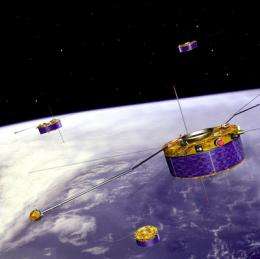
The National Physical Laboratory (NPL) has helped to establish that femtosecond comb lasers can provide accurate measurement of absolute distance in formation flying space missions.
NPL, along with collaborators, produced technical reports for the European Space Agency. The conclusions demonstrated that the lasers were a suitable method for measurement in such missions.
Formation flying missions involve multiple spacecrafts flying between tens and hundreds of metres apart, which autonomously control their position relative to each other. The benefit of such missions is they can gather data in a completely different way to a standard spacecraft - the formation can effectively act as one large sensor.
Measuring absolute distance between the formation spacecraft is critical to mission success. Femtosecond comb lasers are an accurate way of making such measurements. The lasers emit light with very short pulses - each lasting just a few femtoseconds. A femtosecond is one billionth of one millionth of a second. The short pulses allow time of flight measurements to be used to determine distance to a few microns.
For example, in the proposed International X-ray Observatory mission, due to launch after 2020, it is thought that the 25 metre spacecraft will require highly accurate measurement of the absolute distance between the front and back of the spacecraft because the craft's body will be flexible.
For the x-ray images to stay in focus, the position and orientation of the mirror at one end will have to be known, and controlled, to roughly 300 microns in length and 10 arc seconds in angle. Otherwise the telescope will not be able to resolve an image and the mission would fail.
Achieving this accuracy is enormously challenging on board a spacecraft. Instrumentation requires such accuracy, but must also be robust enough to survive launch and the ravages of space.
The other challenge in formation flying is achieving the formation itself, which is done once the spacecrafts reach the appropriate region of space. The spacecraft orient themselves in relation to each other by plotting their positions relative to known stars, and then establish their lateral positions via laser pointers. Once the formation is established, it can be maintained via highly accurate absolute length measurements between the spacecrafts.
These kinds of missions could answer a lot of the 'big questions' in astronomy and cosmology - like 'is general relativity correct?', 'how did the universe develop following the Big Bang?', and 'where do all the magnetic fields in the universe come from?'.
Another mission, called LISA (Laser Interferometer Space Antenna) is being planned to look for gravity waves. This will involve three craft flying approximately 5 million km apart. In this case it is not necessary to know the absolute distance between the crafts, extremely small changes in their separation on timescales of 10 seconds to 10,000 seconds could be a sign that gravity waves have been detected.
Such missions stand to benefit from this project and the use of femtosecond combs, and a number of groups worldwide are developing other systems using such technology as distance measuring instruments.
Prototype systems will need to have uncertainty claims verified by a national standards laboratory, such as NPL. They will also need to fulfil strict specifications on size, weight and power consumption and undergo other tests (for example the system's ability to withstand strong gravitational fields or radiation) so that they can become fully 'space qualified'.
Source: National Physical Laboratory


