The Hot Saturn Exoplanet
October 2, 2009 The Hot Saturn Exoplanet

Enlarge

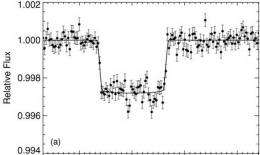
The flux from the star HD149026 and its Saturn-like planet versus time in 4.3 minute intervals, as seen by the Infrared Array Camera as the planet passes in front of the star ("transits"). Credit: Knutson et al. 2009

(PhysOrg.com) -- Of the roughly 350 known exoplanets (i.e., extrasolar planets), the one orbiting the star HD149026 is unique.

It has a mass comparable to that of Saturn but is much smaller in size, indicating that it is made up of a denser material such as ice or rocks. It is therefore quite unlike the large class of "hot Jupiters," giant exoplanets that are primarily composed of and (and that are hot because they orbit close to their parent ).

The comparatively unusual composition of this exoplanet may reflect the chemistry of the original stellar nebula, or perhaps something in the way it formed, or a combination of factors. Whatever the reasons, astronomers suspect that the atmosphere of this planet could also be comparatively unusual. As scientists explore the incredible, new field of exoplanet astronomy, these and other basic questions help to illuminate how our own earth was formed and how it is influenced by the sun.

A team of seven astronomers led by CfA scientists Heather Knutson and David Charbonneau used the IRAC camera on the (the IRAC team is led by CfA astronomer Giovanni Fazio) to measure the daytime and nighttime temperatures of the Saturn-sized exoplanet around HD149026. It happens that this is one of a few that transit its star, which is to say that its directly crosses the line-of-sight of our view of the star.

As the planet passes behind the star, beginning its so-called secondary eclipse, the daylight side of the planet becomes visible for a short time. Using the IRAC camera, the scientists were able to measure the daytime brightness by watching the brightness of the planet change during this phase, with an amazing precision of about 0.04%. They calculate the daytime temperature to be about 1440 kelvin, a value significantly smaller than previous estimates; they also find the average nighttime temperature for the first time, and report that it is about 900 kelvin.

The temperature difference between the day and night side is largely a result of the exoplanet's atmosphere. The scientists argue that the atmosphere shows evidence for some combination of atmospheric circulation, water absorption, and reflectivity. Furthermore, they are able to estimate the energy budget of the planet, and find that, like other that reflect some of the incident starlight (often due to clouds), it appears to emit less flux than it receives from its parent star, although this conclusion is tentative pending observations at other wavelengths. The new paper is a dramatic illustration of the power of the new generation of astronomical instruments whose effectiveness comes not only from their being sensitive, but also from their ability to make extremely precise measurements.

Provided by Harvard-Smithsonian Center for Astrophysics (news : web)


print this article email this article download pdf blog this article bookmark this article     Stumble it Digg this share on Facebook retweet share on Reddit add to delicious
Rate this story - 4.4 /5 (11 votes)

Rank Filter

Move the slider to adjust rank threshold, so that you can hide some of the comments.


Display comments: newest first

  • srikkanth_kn - Oct 03, 2009
    • Rank: 3 / 5 (1)
    They usually attach so called 'artistic renditions' This paper illustrates the power of new class of instruments.
  • smiffy - Oct 04, 2009
    • Rank: 3 / 5 (1)
    It's peculiar that this is both a rare kind of large rocky exoplanet (1 in 350) and that it's also rare in that it's one of the 'few' exoplanets that are in a direct line-of-sight with its star.
    I don't know how many 'few' means but if you take it to mean 3 or so that gives a chance of 1 in 100. Taking together that gives a probability of 1 in 350,000 of this being down to chance alone. You've just got to suspect an observational selection effect (over and above the usual selection effect for big planets).

    Just how solid is the evidence that the planets found so far are gas giants? Can they be sure of the radius of an object from non-line-of-sight observations? Maybe some of them also have large rocky cores? After all, it's what you might expect with them orbiting so close to their star.
  • Hungry4info2 - Oct 06, 2009
    • Rank: 4 / 5 (1)
    Sniffy, although this is indeed the only planet like this known out of 350 exoplanets, only 62 planets are known to transit. So it could easily be that some of the other 200 non-transiting planets are similar to HD 149026 b, but since we cannot determine their radii, it's impossible to know at this time.

    The evidence that these planets are gaseous is a simple density measurement which is made possible through measurements of their mass and radius. Atmospheres have been detected and chemically identified for both HD 189733 b and HD 209458 b.

    Three planets, Gliese 436 b, HAT-P-11 b, and CoRoT-7 b, are known to not be Jovian planets. Gliese 436 b and HAT-P-11 b are Neptunes, and CoRoT-7 b is a super-Earth.

    No, the radius of a planet cannot yet be determined if the planet does not transit.

    And yes, the new-born field of extrasolar planetology has many observational biases, many of which are limitations of technology. Gargantuan planets tend to stick out over little ones.

October 2, 2009 all stories

Comments: 3

4.4 /5 (11 votes)
  • Stumble this up

  • Digg this

  • share this

  • hide
  • Related Stories

  • Exoplanet atmospheres detected from Earth for the first time
    created Jan 14, 2009 | popularity not rated yet | comments 0
  • Hubble Finds Carbon Dioxide on an Extrasolar Planet
    created Dec 09, 2008 | popularity not rated yet | comments 0
  • Hazy red sunset on extrasolar planet
    created Dec 11, 2007 | popularity not rated yet | comments 0
  • Extreme winds rule exoplanet's weather
    created May 09, 2007 | popularity not rated yet | comments 0
  • Astronomer finds that hottest measured extrasolar planet is 3700 degrees
    created May 09, 2007 | popularity not rated yet | comments 0


  • hide
  • Relevant PhysicsForums posts

  • Sideral question
    created 11 hours ago
  • Doppler shifted blackbody spectrum
    created 14 hours ago
  • Earth v. Moon
    created 16 hours ago
  • help me with coordinates and orbits
    created 16 hours ago
  • More from Physics Forums - General Astronomy

Other News

Astronauts finish another spacewalk, still no baby (AP)

Astronauts finish another spacewalk, still no baby

Space & Earth / Space Exploration

created 3 hours ago | popularity 5 / 5 (1) | comments 0

(AP) -- A spacewalking astronaut put aside the impending birth of his daughter and blazed through his first-ever venture outside the International Space Station on Saturday.


Unseasonably hot and dry weather combined with strong winds to fan scores of blazes in the country's southeastern states

Australia issues 'catastrophic' alerts as fires rage

Space & Earth / Environment

created 9 hours ago | popularity 4 / 5 (1) | comments 0

Australia has issued "catastrophic" alerts after record-breaking temperatures and wild lightning storms sparked more than 100 fires across the country, officials said Saturday.


Commuters wait on the platform shrouded by fog in London

Climate change not man-made, say majority of Britons: poll

Space & Earth / Environment

created Nov 15, 2009 | popularity 3.3 / 5 (15) | comments 45

Less than half of Britons believes that human activity is to blame for global warming, according to a poll carried out for The Times newspaper and published on Saturday.


Mysteriously warm times in Antarctica

Mysteriously warm times in Antarctica

Space & Earth / Earth Sciences

created Nov 18, 2009 | popularity 4.3 / 5 (20) | comments 28

(PhysOrg.com) -- A new study of Antarctica's past climate reveals that temperatures during the warm periods between ice ages (interglacials) may have been higher than previously thought. The latest analysis ...


UN: Fight climate change with free condoms (AP)

UN: Fight climate change with free condoms

Space & Earth / Environment

created Nov 18, 2009 | popularity 3.1 / 5 (11) | comments 22

(AP) -- The battle against global warming could be helped if the world slowed population growth by making free condoms and family planning advice more widely available, the U.N. Population Fund said Wednesday.