How to limit risk of climate catastrophe
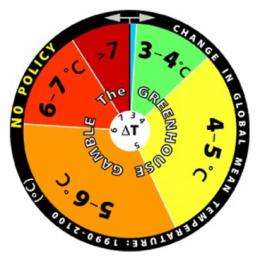
(PhysOrg.com) -- A new analysis of climate risk, published by researchers at MIT and elsewhere, shows that even moderate carbon-reduction policies now can substantially lower the risk of future climate change. It also shows that quick, global emissions reductions would be required in order to provide a good chance of avoiding a temperature increase of more than 2 degrees Celsius above the pre-industrial level — a widely discussed target. But without prompt action, they found, extreme changes could soon become much more difficult, if not impossible, to control.
Ron Prinn, co-director of MIT's Joint Program on the Science and Policy of Global Change and a co-author of the new study, says that "our results show we still have around a 50-50 chance of stabilizing the climate" at a level of no more than a few tenths above the 2 degree target. However, that will require global emissions, which are now growing, to start downward almost immediately. That result could be achieved if the aggressive emissions targets in current U.S. climate bills were met, and matched by other wealthy countries, and if China and other large developing countries followed suit with only a decade or two delay. That 2 degree C increase is a level that is considered likely to prevent some of the most catastrophic potential effects of climate change, such as major increases in global sea level and disruption of agriculture and natural ecosystems.
"The nature of the problem is one of minimizing risk," explains Mort Webster, assistant professor of engineering systems, who was the lead author of the new report. That's why looking at the probabilities of various outcomes, rather than focusing on the average outcome in a given climate model, "is both more scientifically correct, and a more useful way to think about it."
Too often, he says, the public discussion over climate change policies gets framed as a debate between the most extreme views on each side, as "the world is ending tomorrow, versus it's all a myth," he says. "Neither of those is scientifically correct or socially useful."
"It's a tradeoff between risks," he says. "There's the risk of extreme climate change but there's also a risk of higher costs. As scientists, we don't choose what's the right level of risk for society, but we show what the risks are either way."
The new study, published online by the Joint Program in September, builds on one released earlier this year that looked at the probabilities of various climate outcomes in the event that no emissions-control policies at all were implemented — and found high odds of extreme temperature increases that could devastate human societies. This one examined the difference that would be made to those odds, under four different versions of possible emissions-reduction policies.
Both studies used the MIT Integrated Global Systems Model, a detailed computer simulation of global economic activity and climate processes that has been developed and refined by the Joint Program on the Science and Policy of Global Change since the early 1990s. The new research involved hundreds of runs of the model with each run using slight variations in input parameters, selected so that each run has about an equal probability of being correct based on present observations and knowledge. Other research groups have estimated the probabilities of various outcomes, based on variations in the physical response of the climate system itself. But the MIT model is the only one that interactively includes detailed treatment of possible changes in human activities as well — such as the degree of economic growth, with its associated energy use, in different countries.
Quantifying the odds
By taking a probabilistic approach, using many different runs of the climate model, this approach gives a more realistic assessment of the range of possible outcomes, Webster says. "One of the common mistakes in the [scientific] literature," he says, "is to take several different climate models, each of which gives a 'best guess' of temperature outcomes, and take that as the uncertainty range. But that's not right. The range of uncertainty is actually much wider."
Because this study produced a direct estimate of probabilities by running 400 different probability-weighted simulations for each policy case, looking at the actual range of uncertainty for each of the many factors that go into the model, and how they interact. By doing so, it produced more realistic estimates of the likelihood of various outcomes than other procedures — and the resulting odds are often significantly worse. For example, an earlier study by Tom Wigley of the National Center for Atmospheric Research estimated that the Level 1 emissions control policy — the least-restrictive of the standards studied -would reduce by 50 percent the odds of a temperature increase of more than 2 degrees C, but the more detailed analysis in the new study finds only a 20 percent chance of avoiding such an increase.
One interesting finding the team made is that even relatively modest emissions-control policies can have a big impact on the odds of the most damaging climate outcomes. For any given climate model scenario, there is always a probability distribution of possible outcomes, and it turns out that in all the scenarios, the policy options have a much greater impact in reducing the most extreme outcomes than they do on the most likely outcomes.
For example, under the strongest of the four policy options, the average projected outcome was a 1.7 degrees C reduction of the expected temperature increase in 2100, but for the most extreme projected increase (with 5 percent probability of occurring) there was a 3.2 degree C reduction. And that's especially significant, the authors say, because the most damaging effects of climate change increase drastically with higher temperature, in a very non-linear way.
"These results illustrate that even relatively loose constraints on emissions reduce greatly the chance of an extreme temperature increase, which is associated with the greatest damage," the report concludes.
Webster emphasizes that "this is a problem of risk management," and says that while the technical aspects of the models are complex, the results provide information that's not much different from decisions that people face every day. People understand that by using their seat belts and having a car with airbags they are reducing the risks of driving, but that doesn't mean they can't still be injured or killed. "No, but the risk goes down. That's the return on your decision. It's not something that's so unfamiliar to people. We may make sure to buy a car with airbags, but we don't refuse to leave the house. That's the nature of the kind of tradeoffs we have to make as a society."
Provided by Massachusetts Institute of Technology (news : web)


