Could stressed out sharks save more fish? (w/ Video)
October 2, 2009 Could stressed out sharks save more fish?

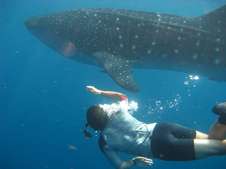
Austin Gallagher free diving with whale sharks in Mexico.

(PhysOrg.com) -- Marine biology graduate student Austin Gallagher has studied the dwindling shark population around the world—from the waters of the South Pacific to those off Southern California.

Now, as a research assistant at the New England Aquarium, the 23-year-old is focused on tracking the stress levels of . He’s working on a portable way to measure stress in the giant fish when they’re accidentally captured and thrown back during expeditions. It turns out that the stress alone causes some of these species—including the hammerhead shark—to die.

The goal is to make it easier to collect information that illuminates for fishermen and conservationists the connection between fishing practices and the overall health and sustainability of fish populations.

“This is just a small piece of the larger puzzle about the of marine life,” cautions Gallagher about the big-picture applications of his work. “But if these portable analyzers can help us better gauge the physiology of threatened sharks, then we may be able to make more informed conservation decisions.”


Video: A trailer of Gallagher’s underwater documentary on marine protected areas inside a Marine Reserve on California’s Catalina Island.

Over the past 50 years, global shark catch increased nearly three-fold, peaking at roughly 900,000 in 2003. And as of last year, nearly 17 percent of shark and ray species landed on the Nature’s Red List of Threatened Species compiled by the Switzerland-based International Union of Conservation, the world’s largest environmental network. As shark species continue to show up on endangered lists, research such as Gallagher’s could become increasingly important in protecting these commercially exploited marine animals.

Gallagher is conducting his research as part of the Three Seas graduate program at Northeastern, a 15-month master’s program during which students study in three different aquatic environments—in Massachusetts, the French Polynesia, and off the coast of Southern California.

Working with Aquarium research scientist Dr. John Mandelman, Gallagher is testing the reliability of a small blood analyzer that could be used right on the boat, rather than previous methods that were too cumbersome to accompany fishermen at sea. To assess the tool’s accuracy, Gallagher draws blood from a caudal vein in the shark’s tail immediately after the is taken from the water, tests the sample using a remote blood analyzer, and compares the value against conventional analyses.

The blood-sampling process resembles the one a physician uses drawing human blood. “What I do with sharks is actually quite similar,” says Gallagher, “but my patients have sharper teeth and are more difficult to calm down.”

Gallagher credits Northeastern’s Three Seas program for giving him the jumpstart he’ll need for a career in shark research. “The program is teaching me how to do sound science, collect my own data, and interact with the scientific community,” he says.

He hopes eventually to combine his passion for science with that of filmmaking in order to more effectively communicate conservation messages. Right now, he’s awaiting the green light on a project documenting sharks and humans interacting.

Provided by Northeastern University (news : web)


print this article email this article download pdf blog this article bookmark this article     Stumble it Digg this share on Facebook retweet share on Reddit add to delicious
Rate this story - 5 /5 (2 votes)


October 2, 2009 all stories

Comments: 0

5 /5 (2 votes)
  • Stumble this up

  • Digg this

  • share this

  • hide
  • Related Stories

  • Video: Swine flu health tips
    created Apr 30, 2009 | popularity not rated yet | comments 0
  • Fish robot as an alternative marine propulsion system of the future (w/Video)
    created Jun 09, 2009 | popularity not rated yet | comments 0
  • Security Alert: Beware of SMS Messages That Can Take Control of Your Phone
    created Apr 20, 2009 | popularity not rated yet | comments 0
  • Foldable phone opens into large OLED screen
    created Nov 24, 2008 | popularity not rated yet | comments 0
  • Dell Talking About 80-Core Chip Processor
    created Nov 20, 2008 | popularity not rated yet | comments 0


  • hide
  • Relevant PhysicsForums posts

  • Questions about diffusion
    created 6 hours ago
  • Human Leukocyte Antigen (HLA) typing
    created 12 hours ago
  • Breeding program
    created Nov 20, 2009
  • How does a concentration gradient provide energy?
    created Nov 20, 2009
  • Eyesight and Neural Damage from Electronics
    created Nov 19, 2009
  • Quick question about the Golgi Apparatus?
    created Nov 19, 2009
  • More from Physics Forums - Biology

Other News

The Monarchs' annual migration ritual has yet to be scientifically explained

Tree-eating bugs threaten Monarch butterfly in Mexico

Biology / Ecology

created 14 hours ago | popularity 4 / 5 (1) | comments 0

The mysterious Monarch butterfly, which migrates en masse annually between Canada and Mexico, is now facing a new peril: another insect thriving in Western Mexican forests.


Bigger not necessarily better, when it comes to brains

Bigger not necessarily better, when it comes to brains

Biology / Plants & Animals

created Nov 17, 2009 | popularity 4.5 / 5 (18) | comments 11

(PhysOrg.com) -- Tiny insects could be as intelligent as much bigger animals, despite only having a brain the size of a pinhead, say scientists at Queen Mary, University of London.


Extinct goat Myotragus balearicus

Extinct goat was cold-blooded

Biology / Plants & Animals

created Nov 18, 2009 | popularity 4.9 / 5 (33) | comments 10

(PhysOrg.com) -- An extinct goat that lived on a barren Mediterranean island survived for millions of years by reducing in size and by becoming cold-blooded, which has never before been discovered in mammals.


Right-handed chimpanzees provide clues to the origin of human language

Biology / Plants & Animals

created Nov 16, 2009 | popularity 3 / 5 (1) | comments 7

Most of the linguistic functions in humans are controlled by the left cerebral hemisphere. A study of captive chimpanzees at the Yerkes National Primate Research Center (Atlanta, Georgia), reported in the January 2010 issue ...


The creature was found at a depth of 161 metres

Japanese researchers film rare baby fish 'fossil'

Biology / Plants & Animals

created Nov 17, 2009 | popularity 4.7 / 5 (7) | comments 4

Japanese marine researchers said Tuesday they had found and successfully filmed a young coelacanth -- a rare type of fish known as "a living fossil" -- in deep water off Indonesia.