Mysterious sailor unearthed by Cranfield archaeologists
October 2, 2009
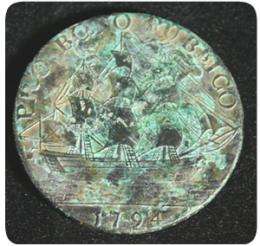
The 'Made in Gosport, 1794 halfpenny. More photos are available on request.
(PhysOrg.com) -- Mystery surrounds a sailor who was unearthed as part of Cranfield University's dig at Royal Hospital Haslar this summer.
Dr Andrew Shortland and his team from Cranfield’s Centre for Archaeological and Forensic Analysis have been working at the Gosport site for three years.
Two metal discs that were probably placed over his eyes before burial were found near the skeleton; one was a medal that featured a kneeling slave engraved with the phrase 'Am I not a man and a brother?' and the other was a halfpenny with the picture of a ship and the words 'Made in Gosport, 1794'. Unlike the rest of the burials that were set out all aligned one way, this particular sailor was placed at the far end of the grave yard and out of alignment.
The area to the south-west of the building was used to bury sailors and marines that died in the hospital from 1753. It is thought the grounds could have up to 15,000 burials.
Dr Shortland said: "We believe the kneeling slave coin was bought by people to show their support for the abolition of slavery so we think we have found a very earlier abolitionist sailor.
"Some people believe coins were put on the eyelids to keep them closed but the most interesting reason involves a belief that seems to stem from Greek mythology. The Greeks used the coins to pay to get over the River Styx on their journey to the underworld."
The team started excavating the site owned by the MOD in 2007. Dr Shortland said: “The site is extremely interesting and we wanted to find out more about the many young men who died in active duty for the Royal Navy and were buried here.
"We have found several amputated limbs buried with different sailors, but this is the most mysterious find we have come across so far."
Provided by Cranfield University
-
2 Viking finds in Norway, Sweden
Oct 31, 2006 |
not rated yet |
0
-
Father-son team find Roman Briton remains
Nov 23, 2007 |
not rated yet |
0
-
Skeleton of 12,000-year-old shaman discovered buried with leopard, 50 tortoises and human foot
Nov 05, 2008 |
not rated yet |
0
-
Young archaeologists dig up a mystery
Jul 05, 2007 |
not rated yet |
0
-
Roman York skeleton could be early TB victim
Sep 16, 2008 |
not rated yet |
0
-
Engineers build first sub-10-nm carbon nanotube transistor
Feb 01, 2012 |
4.9 / 5 (33) |
30
-
Something old, something new: Evolution and the structural divergence of duplicate genes
Jan 31, 2012 |
4.6 / 5 (7) |
1
-
The hidden nanoworld of ice crystals: Revealing the dynamic behavior of quasi-liquid layers
Jan 30, 2012 |
5 / 5 (5) |
1
-
Stock market network reveals investor clustering
Jan 27, 2012 |
3.9 / 5 (23) |
8
-
Of microchemistry and molecules: Electronic microfluidic device synthesizes biocompatible probes
Jan 26, 2012 |
5 / 5 (2) |
0
-
Factors affecting beet root cell membrane
19 hours ago
-
Stem cell question.
Feb 10, 2012
-
Protease cleavage
Feb 10, 2012
-
Pertubance in a model
Feb 10, 2012
-
Cancer drugs and Alzheimer's, Oh my!
Feb 09, 2012
-
Squishing cells
Feb 09, 2012
- More from Physics Forums - Biology
More news stories
Australian women reject 'I love u' texts
Australian women may have embraced the digital era, but they prefer a face-to-face declaration of affection to an "I love u" text and find men addicted to their mobile phones a major turnoff.
Other Sciences / Social Sciences
1 hour ago |
not rated yet |
0
A frank discussion of the power law and linking correlation to causation
(PhysOrg.com) -- Michael Stumpf a mathematics professor at Imperial College in London, and Mason Porter a lecturer at Oxford have teamed together to write and publish a perspective piece in Science regarding the in ...
US workers are 'giving away the store,' costing firms billions
Nearly 70 percent of the nation's service employees give away free goods and services from hamburgers to cable TV costing companies billions of dollars a year, according to a groundbreaking study.
Other Sciences / Economics & Business
Feb 09, 2012 |
3 / 5 (5) |
11
Employers feel no love for unscrupulous practice of 'service sweethearting'
A new study led by two Florida State University marketing professors finds that some frontline service employees who are rewarded for hikes in customer loyalty and satisfaction also may engage in "service ...
Other Sciences / Economics & Business
Feb 10, 2012 |
3.3 / 5 (3) |
10
New insights into how to correct false knowledge
The abundance of false information available on the Internet, in movies and on TV has created a big challenge for educators.
Other Sciences / Social Sciences
Feb 07, 2012 |
4.9 / 5 (7) |
9
|
Rapunzel, Leonardo and the physics of the ponytail
(PhysOrg.com) -- New research provides the first mathematical understanding of the shape of a ponytail and could have implications for the textile industry, computer animation and personal care products.
Cognitive impairment in older adults often unrecognized in the primary care setting
A new study published in the Journal of the American Geriatrics Society reveals that brief cognitive screenings combined with offering further evaluation increased new diagnoses of cognitive impairment in older veterans two to ...
AT&T customers surprised by 'unlimited data' limit
(AP) -- Mike Trang likes to use his iPhone 4 as a GPS device, helping him get around in his job. Now and then, his younger cousins get ahold of it, and play some YouTube videos and games.
Climate change causes harmful algal blooms in North Atlantic: study
Warming oceans and increases in windiness could be causing of an abundance of harmful algal blooms in the North Atlantic Ocean and North Sea, according to new research.
Hacker claims porn site users compromised
A hacker claims to have compromised the personal information of more than 350,000 users after breaking into a disused website operated by pornography provider Brazzers.
Primary care program helps obese teen girls manage weight, improve body image and behavior
Teenage girls gained less weight, improved their body image, ate less fast food, and had more family meals after participating in a 6- month program that involved weekly peer meetings, consultations with primary care providers ...