Nanotechnology gets a new light touch
October 2, 2009 By Bob Beale Nanotechnology gets a new light touch

Enlarge

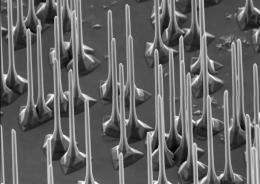
Scanning electron microscope of nanowires ready for device assembly using optical tweezers. Image courtesy of Dr H. Tan at ANU

(PhysOrg.com) -- Building the super-fast computers of the future has just become much easier thanks to an advance by Australian researchers that lets them grab hold of tiny electronics components and probe their inner structure using only a beam of light.

The discovery moves researchers a step closer to utilising semiconductor nano-wires that will be key components of future integrated devices and circuits.

In a paper published in the journal , a team led by Dr Peter Reece, from the UNSW School of Physics, and colleagues from the Australian National University, report for the first time that such tiny objects can not only be held by "" but simultaneously studied in detail using a second laser beam.

"Optical tweezers work by focussing very intense laser beams that can impart forces onto very small objects and let you physically push them around," says Dr Reece, a UNSW Vice-Chancellor's Postdoctoral Research Fellow.

"Using one laser beam you can grab an object, turn it around and look at it from all angles and put it into an orientation you're interested in. What we've done is bring in a second laser beam to probe the internal structure of the object itself, using photo-luminescence spectroscopy.

"Every nano-wire - and, indeed any nano-scale object - is different and you need to understand these nuances to make practical use of them. This gives us a new tool that we can use to pre-select the components we want.

"The novel part of our work is to look at the light emitted from the nano-wire when it is excited with the second as the ; it can tell us so much more about the nature and structure of the material. No-one's done this before.

"I'm very interested in building nano-sized devices - it's a big new area of application in science. While our demand for information processing grows unabated, our ability to meet these demands is beginning to waiver.

"The microelectronics industry has reached its limits for providing further levels of large-scale integration of components and, without a change in technology, future computer processor performances will stagnate.

"The optical technologies that revolutionised long-haul communications and brought us high-speed internet may be the key to the future of on-chip information processing. Working with researchers in the UK, we hope we can harness the 'forces of light' to build and test prototype nano-scale optical devices which may one day power your personal computer."

More information: Applied Physics Letters, http://apl.aip.org/

Provided by University of New South Wales (news : web)


print this article email this article download pdf blog this article bookmark this article     Stumble it Digg this share on Facebook retweet share on Reddit add to delicious
Rate this story - 4.9 /5 (8 votes)


October 2, 2009 all stories

Comments: 0

4.9 /5 (8 votes)
  • Stumble this up

  • Digg this

  • share this

  • hide
  • Related Stories

  • 'The photon force is with us': Harnessing light to drive nanomachines
    created Nov 26, 2008 | popularity not rated yet | comments 0
  • White-light laser is basis of new optical tweezers and microscope
    created May 27, 2005 | popularity not rated yet | comments 0
  • A sonic boom in the world of lasers
    created Jun 17, 2009 | popularity not rated yet | comments 0
  • Team 'tractor beam' for manipulation of cells on silicon
    created Oct 30, 2007 | popularity not rated yet | comments 0
  • Quantum dots self-tune their color for ultra-efficient nano lasers
    created Apr 14, 2006 | popularity not rated yet | comments 0


  • hide
  • Relevant PhysicsForums posts

Other News

Nanoparticles used in common household items caused genetic damage in mice

Nanotechnology / Bio & Medicine

created Nov 16, 2009 | popularity 4.7 / 5 (22) | comments 11

Titanium dioxide (TiO2) nanoparticles, found in everything from cosmetics to sunscreen to paint to vitamins, caused systemic genetic damage in mice, according to a comprehensive study conducted by researchers at UCLA's Jonsson ...


Using superconducting probes to get a picture of what it's like inside CNTs

Nanotechnology / Nanophysics

created Nov 20, 2009 | popularity 4.9 / 5 (7) | comments 0

(PhysOrg.com) -- "Carbon nanotubes are exciting for fundamental physics, and for potential technological applications," Nadya Mason tells PhysOrg.com. "However, we are generally limited in the way that we can study them. ...


Nanotube defects equal better energy and storage systems

Nanotube defects equal better energy and storage systems

Nanotechnology / Nanomaterials

created Nov 19, 2009 | popularity 4.4 / 5 (9) | comments 2

(PhysOrg.com) -- Most people would like to be able to charge their cell phones and other personal electronics quickly and not too often. A recent discovery made by UC San Diego engineers could lead to carbon ...


When It Comes to Drug Delivery, Size Matters

Nanotechnology / Bio & Medicine

created Nov 20, 2009 | popularity 5 / 5 (1) | comments 0

(PhysOrg.com) -- One of the great promises of nanotechnologies lies in its ability to create drug-containing nanoparticles decorated with targeting molecules that recognize and bind to cancer cells, providing drug delivery ...


New study confirms exotic electric properties of graphene

New study confirms exotic electric properties of graphene

Nanotechnology / Nanomaterials

created Nov 17, 2009 | popularity 4.8 / 5 (23) | comments 1

(PhysOrg.com) -- First, it was the soccer-ball-shaped molecules dubbed buckyballs. Then it was the cylindrically shaped nanotubes. Now, the hottest new material in physics and nanotechnology is graphene: ...