Ruins of ancient arena discovered outside Rome
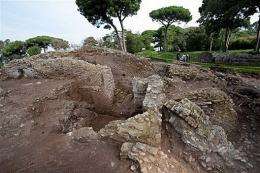
October 2, 2009 British archaeologists work at the discovered ruins outside Ostia

Enlarge

British archaeologists work at the discovered ruins of an arena built early in the third century BC outside Ostia, the ancient imperial port 25 kilometres (16 miles) from Rome.

British archaeologists have discovered the ruins of an arena built early in the third century BC outside Ostia, the ancient imperial port 25 kilometres (16 miles) from Rome, the team leader said Friday.

"Gladiators and wild animals may have fought in this place, but it also may have been used for important meetings, or, because of its proximity to the sea, to stage historical naval battle scenes," Simon Keay told AFP.

Since the small arena, measuring some 1,600 square metres (17,000 square feet), was next to the imperial procurator's palace, "we think it was intended mainly for private use," Keay said.

"More research will be needed to determine its use and the height of the amphitheatre -- which will give us a better understanding of the functioning of the entire port," he added.

The ruins were uncovered in three years of digging by the British team from Southampton and Cambridge Universities in cooperation with the British School at , an archaeological academy.

Italian archaeologist Rodolfo Lanciani determined the approximate location of the site in 1868, but more systematic research finally led to its discovery 140 years later.

(c) 2009 AFP


print this article email this article download pdf blog this article bookmark this article     Stumble it Digg this share on Facebook retweet share on Reddit add to delicious
Rate this story - 5 /5 (1 vote)


October 2, 2009 all stories

Comments: 0

5 /5 (1 vote)
  • Stumble this up

  • Digg this

  • share this

  • hide
  • Related Stories

  • Archaeologists unearth 'birthplace of Roman emperor' in Italy
    created Aug 06, 2009 | popularity not rated yet | comments 0
  • Ancient seaside villa found near Rome
    created Apr 16, 2006 | popularity not rated yet | comments 0
  • Remains of 3,500-year-old palace are found
    created Mar 28, 2006 | popularity not rated yet | comments 0
  • Ancient ashes found buried in Rome
    created Feb 09, 2006 | popularity not rated yet | comments 0
  • 3,000-year-old skeleton found in Rome
    created May 31, 2006 | popularity not rated yet | comments 0


  • hide
  • Relevant PhysicsForums posts

Other News

Ancient Greek Temple

Houses of the rising sun: Research sheds new light on Ancient Greeks

Other Sciences / Archaeology & Fossils

created 21 hours ago | popularity 5 / 5 (2) | comments 3

New research at the University of Leicester has identified scores of Sicilian temples built to face the rising Sun, shedding light on the practices of the Ancient Greeks.


Study: Race, class and gender shape religion's effect on American voters

Other Sciences / Social Sciences

created 17 hours ago | popularity not rated yet | comments 0

(PhysOrg.com) -- How Americans vote is strongly linked to their religious identities, but it is not an independent influence that transcends race, socio-economic class and gender, reports a new Cornell study.


Researcher: Faint writing seen on Shroud of Turin (AP)

Researcher: Faint writing seen on Shroud of Turin (Update)

Other Sciences / Archaeology & Fossils

created Nov 20, 2009 | popularity 2.4 / 5 (30) | comments 40

(AP) -- A Vatican researcher has rekindled the age-old debate over the Shroud of Turin, saying that faint writing on the linen proves it was the burial cloth of Jesus. Experts say the historian may be reading ...


UQ archaeology digs into the life behind Pompeii

Other Sciences / Archaeology & Fossils

created 16 hours ago | popularity 3.3 / 5 (3) | comments 0

(PhysOrg.com) -- Brisbane may be 2000 years and half-a-world away from Pompeii, but it hasn’t stopped a UQ archaeologist from digging up some hidden treasures.


Explained: The Discrete Fourier Transform

Explained: The Discrete Fourier Transform

Other Sciences / Mathematics

created Nov 25, 2009 | popularity 4.3 / 5 (24) | comments 8

(PhysOrg.com) -- In 1811, Joseph Fourier, the 43-year-old prefect of the French district of Isčre, entered a competition in heat research sponsored by the French Academy of Sciences. The paper he submitted ...