Invisible matters: How dwarf galaxies may lose their light
(PhysOrg.com) -- A new study seeking to answer the question of why some galaxies are extremely dark compared with others may eventually help to explain the formation of all galaxies, according to researchers at the Harvard-Smithsonian Center for Astrophysics (CfA).
While the inner structure of most galaxies is dominated by their visible components, the small, spheroid-shaped galaxies scientists refer to as dwarf spheroidals are dominated by an invisible component that scientists refer to as dark matter.
“The mass in these dwarf spheroidal systems is mostly dark matter,” says Elena D’Onghia, a Research Associate at the CfA and author of the study that was published in the journal Nature. “We want to know why these systems are so dark-matter dominated compared to normal, bigger galaxies like our own Milky Way or Andromeda, which have less dark matter relative to stars and gas.”
Stars, gas, and dust make up about 10 percent of the mass of the average galaxy. “But these spheroidal dwarf systems have an even smaller percentage of this visible matter,” D’Onghia says. "There must be some physical process that has removed the gas and the stars very efficiently, leaving these systems as mostly dark matter” and consequently extremely faint to the astronomer’s eye, she adds.
Mainstream astrophysics holds that structure in the Universe in small systems is probably similar to that in larger systems. “We think that galaxies build up their mass hierarchically — smaller systems combining to make bigger things,” explains co-author of the study Gurtina Besla, a graduate student in Harvard’s Department of Astronomy.
“In large galaxies like our Milky Way, stars, gas, and dust form a disk structure and rotate at a certain speed around its center — the galaxy's core — depending on their distance from it,'' Besla says. Perhaps smaller, spheroidal galaxies, satellites to larger galaxies (much like the moon to the Earth), originally shared the same characteristic.
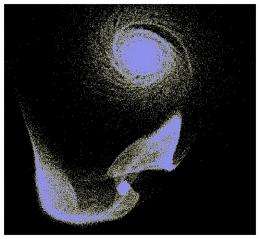
D’Onghia and collaborators simulated “encounters” between such dwarf galaxies. “We found that when a small dwarf (the victim) felt the attraction of the gravitational potential of a larger dwarf, the frequency of rotation of the material at some position in the victim's disk matches the frequency at which the victim orbited around the bigger object,” says D’Onghia. “This is referred to as a ‘resonance,’ and provides an additional kick that strips the stars and the gas off of the victim dwarf."
The team believes that resonance stripping explains how these dwarf spheroidals lost most of their stars, dust, and gas material, while keeping all of their dark matter.
“The dark matter remained because it is not rotating. It doesn't feel the additional kick the gas and stars do,” says D’Onghia. Stripping the disk of most of its stars and gas leaves behind a very faint nucleus, or core. “Those are the dwarf spheroidal galaxies we observe.”
So far, researchers have seen these old and faint spheroidals in both the neighborhood of our galaxy and that of nearby Andromeda. “There are around 20 or 30 of these systems,” D’Onghia says. Understanding how these systems formed may give researchers a better idea of how the universe looked at an earlier age.
According to the cold dark matter theory in astrophysics, the universe today should contain a greater number of dwarfs — but it doesn’t appear to.
"In the Milky Way alone, theory predicts about 200 of these galaxies near the center of ours,” says D’Onghia. “So there are still a lot of ‘missing’ dwarfs. The ones we see haven't been stripped of all their gas yet, and the ‘missing’ ones may actually be there but we can’t see them because all they have is dark matter,” she says, adding, "Resonance stripping might explain this, but we haven’t pushed the theory to this extreme yet because we are trying to determine the efficiency of our model.”
Although other models have been proposed to explain the origin of dwarf spheroidals, they require Milky Way-sized galaxies in the vicinity of dwarfs-to-be. As such, they fail to explain the existence of dwarf spheroidals in the outskirts of our galactic neighborhood — the so-called Local Group — that have never been close to a large galaxy. “So the next step is to see if this process can explain many different scenarios,” D'Onghia says.
More information: www.nature.com/nature/journal/ … ull/nature08215.html
Provided by Harvard University (news : web)


