Lone llama rescued after month on Pikes Peak
October 3, 2009
Lone llama rescued after month on Pikes Peak (AP)

Enlarge

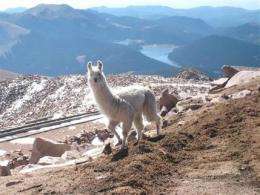
In this Sept. 20, 2009 photo provided by Southwest Llama Rescue a llama walks near the cog railway tracks near the summit of Pike's Peak near Colorado Springs, Colo. Southwest Llama Rescue is coordinating efforts to capture the llama before it falls prey to mountain lions, coyotes or the coming winter. (AP Photo/Southwest Llama Rescue, Rachel Javorsek)

(AP) -- A lone llama wandering near the summit of Pikes Peak for a month has been captured and is heading to a new home.

Tracy Ducharme and Mike Shealy, both of Black Forest, Colo., trekked up the 14,110-foot mountain Friday to find the little white beast of burden.

They took two llamas with them, hoping Homer's herd instincts would lure him to them. The two split up and Ducharme spotted the llama, which bounded after her llama, Dancer. She then slipped a rope around his neck.

"I dubbed him 'Homer' because of his little odyssey," she said, referring to the classic Greek novel "Odyssey" by the poet Homer.

Ducharme said the llama might lose its ears to frostbite, but is otherwise fine.

"He's going home," said Ducharme, adding that she doesn't expect to have any trouble finding him a permanent home.

The Southwest Llama Rescue group coordinated efforts to capture Homer before he fell prey to mountain lions, coyotes or the coming winter. The group says llamas are domesticated animals and don't have the instincts to survive in the wild.

Rescuers speculate that the llama might have escaped from a stock trailer on the plains below or from hikers who were using it as a pack animal. But no one has reporting a missing llama.

Riders on a cog railway on the mountain first reported seeing the llama about a month ago. It roamed the mountain's south slope, living off alpine vegetation and trying to unsuccessfully to make friends with a herd of bighorn sheep.

©2009 The Associated Press. All rights reserved. This material may not be published, broadcast, rewritten or redistributed.

Filter


Move the slider to adjust rank threshold, so that you can hide some of the comments.


Display comments: newest first

ruebi
Oct 03, 2009

Rank: not rated yet
"It roamed the mountain's south slope, living off alpine vegetation and trying to unsuccessfully to make friends with a herd of bighorn sheep."

i hope the wolves and mountain lions dont starve.
Crossrip
Oct 04, 2009

Rank: not rated yet
Too bad humans are always interfering with natural selection.
zevkirsh
Oct 04, 2009

Rank: not rated yet
"she doesn't expect to have any trouble finding him a permanent home". ....for the right price of course. this white llama must be worth quite a penny.
Rank 2 /5 (1 vote)
Related Stories
Relevant PhysicsForums posts
  • Protease cleavage
    created6 hours ago
  • Pertubance in a model
    created12 hours ago
  • Cancer drugs and Alzheimer's, Oh my!
    created20 hours ago
  • Squishing cells
    created21 hours ago
  • Any books/articles for evolutionary stable strategy models in humans?
    createdFeb 09, 2012
  • Science behind the bore feeling?
    createdFeb 09, 2012
  • More from Physics Forums - Biology

More news stories

The power of estrogen -- male snakes attract other males

A new study has shown that boosting the estrogen levels of male garter snakes causes them to secrete the same pheromones that females use to attract suitors, and turned the males into just about the sexiest ...

Biology / Plants & Animals

created 10 hours ago | popularity 4.8 / 5 (5) | comments 0 | with audio podcast

Grass to gas: Researchers' genome map speeds biofuel development

Researchers at the University of Georgia have taken a major step in the ongoing effort to find sources of cleaner, renewable energy by mapping the genomes of two originator cells of Miscanthus x giganteus, a large perenn ...

Biology / Biotechnology

created 7 hours ago | popularity 3.7 / 5 (3) | comments 0 | with audio podcast

Experts reveal how plants don't get sunburn

(PhysOrg.com) -- Experts at the University of Glasgow have discovered how plants survive the harmful rays of the sun.

Biology / Cell & Microbiology

created 10 hours ago | popularity 5 / 5 (2) | comments 0 | with audio podcast

Protein libraries in a snap

(PhysOrg.com) -- A Rice University undergraduate will depart with not only a degree but also a possible patent for his invention of an efficient way to create protein libraries, an important component of biomolecular ...

Biology / Cell & Microbiology

created 14 hours ago | popularity 5 / 5 (3) | comments 0 | with audio podcast

Miami battling invasion of giant African snails

No one knows how they got there. But an invasion of African giant snails has southern Florida in a panic over potential crop damage, disease and general yuckiness surrounding the slimy gastropods.

Biology / Ecology

created 14 hours ago | popularity 4 / 5 (1) | comments 4


Google users warned of threat to smartphone wallets

Users of Google smartphone wallets were being warned on Friday that there is a way to crack pass codes intended to thwart thieves from going on illicit shopping sprees.

Anonymous knocks CIA website offline (Update)

The website of the Central Intelligence Agency was inaccessible on Friday after the hacker group Anonymous claimed to have knocked it offline.

Complex wiring of the nervous system may rely on a just a handful of genes and proteins

Researchers at the Salk Institute have discovered a startling feature of early brain development that helps to explain how complex neuron wiring patterns are programmed using just a handful of critical genes. ...

New error-correcting codes guarantee the fastest possible rate of data transmission

Error-correcting codes are one of the triumphs of the digital age. They’re a way of encoding information so that it can be transmitted across a communication channel — such as an optical fiber o ...

Putting the squeeze on planets outside our solar system

(PhysOrg.com) -- Using high-powered lasers, scientists at Lawrence Livermore National Laboratory and collaborators discovered that molten magnesium silicate undergoes a phase change in the liquid state, abruptly ...

NASA sees wide-eyed cyclone Jasmine

Cyclone Jasmine's eye has opened wider on NASA satellite imagery, as it moves through the Southern Pacific Ocean.