Baby mammoth preserved in frozen soil heads to Chicago
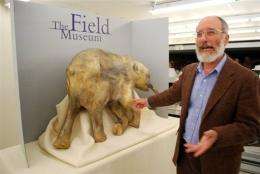
October 4, 2009 Replica of the world's best preserved wooly mammoth - a 40,000 year old baby named Lyuba

Enlarge

A replica of the world's best preserved wooly mammoth - a 40,000 year old baby named Lyuba who was discovered in Siberia in 2007 - is described by curator and geologist Daniel Fisher at Chicago's Field Museum on September 30. The Field Museum will be the first in North America to display Lyuba's body, which is currently undergoing analysis in Russia, in an exhibit which opens on March 5.

Sucked to her death in a muddy river bed, a baby woolly mammoth spent 40,000 years frozen in the Siberian permafrost where her body was so perfectly preserved traces of her mother's milk remained in her belly.

Three years after her discovery by nomadic reindeer herders, Lyuba will head to Chicago as the star of a mammoths and mastodons exhibit at the world-famous Field Museum.

The exhibition, announced at mid-week, opens March 5 and will run through September 6. The Field Museum is the first US museum to display the prehistoric specimen.

"There's a visceral awe that takes hold of you in looking at a specimen like Lyuba, and the exhibition as a whole demonstrates how close we can come to knowing what these animals were like," said lead curator Daniel Fisher, a professor of geological sciences at the University of Michigan who is part of the international team studying the remains.

Lyuba -- who was about a month old when she died -- has already taught researchers much about mammoths that they had been unable to glean from fossils and other less well preserved finds.

"We had no idea from preserved skeletons and preserved carcasses that young mammoths had a discrete structure on the back of the head of brown ," Fisher told reporters.

The hump acted as a furnace to help maintain body temperature in cold climate, which supports the theory that mammoths were born in the early spring.

Lyuba appeared to be in perfect health when she died and researchers found sediment and mud in her mouth, trunk and throat which indicates that she suffocated while struggling to free herself from a mud hole or slurry.

She is intact enough to yield DNA, but "no one is on the threshold of cloning at this point," Fisher said.

Lubya then embarks on a 10-city tour whose final stop is scheduled for the Natural History Museum of London in 2014.

(c) 2009 AFP


print this article email this article download pdf blog this article bookmark this article     Stumble it Digg this share on Facebook retweet share on Reddit add to delicious
Rate this story - 4.5 /5 (6 votes)

Rank Filter

Move the slider to adjust rank threshold, so that you can hide some of the comments.


Display comments: newest first

  • deatopmg - Oct 04, 2009
    • Rank: not rated yet
    "Sucked to her death in a muddy river bed, a baby woolly mammoth spent 40,000 years frozen in the Siberian permafrost where her body was so perfectly preserved traces of her mother's milk remained in her belly."

    Was she discovered in permafrost? If so, that means that when she died it was much warmer than today.
  • Mandan - Oct 04, 2009
    • Rank: not rated yet
    "If so, that means that when she died it was much warmer than today."

    Or not. It actually only indicates that the baby mammoth was sucked into mud, and the mud froze, and later became permafrost. Many conceivable scenarios are possible.

    It could have occurred during a brief cold snap during an interglacial, like a blinding blizzard, followed by over-sedimentation from spring flooding, in a shady spot which would not thaw during the subsequent summer, and increased over-sedimentation in the fall, etc.
    Or it could have occurred during a rapid cooling of the climate. I'm sure they will be looking at pollen samples and other microscopic and biochemical cues while studying the pachyderm in situ in Chicago.

    Seasons change rapidly, and can catch even humans unaware, and they probably even change more rapidly-- as well as more erratically-- during both the onset or waning of Ice Ages, and interglacials also have record-setting hot and cold years, with abnormal extremes and medians.
  • OdinsAcolyte - Oct 05, 2009
    • Rank: not rated yet
    Good old Science Fiction Theater from the sixties decade had a movie about a mastadon named Toby who was revived. He had a heart-rending death from modern disease after resucitation. Yesterday's fiction is today's fact. Cool huh?

October 4, 2009 all stories

Comments: 3

4.5 /5 (6 votes)
  • Stumble this up

  • Digg this

  • share this

  • hide
  • Related Stories

  • DNA shows that last woolly mammoths had North American roots
    created Sep 04, 2008 | popularity not rated yet | comments 0
  • Steppe change: Mammoths roamed southern Spain
    created Jul 09, 2009 | popularity not rated yet | comments 0
  • Ancient DNA traces the woolly mammoth's disappearance
    created Jun 07, 2007 | popularity not rated yet | comments 0
  • New discovery suggests mammoths survived in Britain until 14,000 years ago
    created Jun 18, 2009 | popularity not rated yet | comments 0
  • Mammoth moms heavily invested in offspring
    created Oct 21, 2005 | popularity not rated yet | comments 0


  • hide
  • Relevant PhysicsForums posts

  • Questions about diffusion
    created 5 hours ago
  • Human Leukocyte Antigen (HLA) typing
    created 12 hours ago
  • Breeding program
    created Nov 20, 2009
  • How does a concentration gradient provide energy?
    created Nov 20, 2009
  • More from Physics Forums - Biology

Other News

Measure to change U. of Neb. stem-cell rule fails (AP)

Measure to change U. of Neb. stem-cell rule fails (Update 2)

Other Sciences / Other

created Nov 21, 2009 | popularity 5 / 5 (1) | comments 0

(AP) -- The University of Nebraska's governing board on Friday voted not to place tighter restrictions on embryonic stem cell research than those outlined under federal guidelines, which were expanded after ...


Researcher: Faint writing seen on Shroud of Turin (AP)

Researcher: Faint writing seen on Shroud of Turin (Update)

Other Sciences / Archaeology & Fossils

created Nov 20, 2009 | popularity 2 / 5 (24) | comments 23

(AP) -- A Vatican researcher has rekindled the age-old debate over the Shroud of Turin, saying that faint writing on the linen proves it was the burial cloth of Jesus. Experts say the historian may be reading ...


Museum: Galileo's fingers, tooth are found (AP)

Museum: Galileo's fingers, tooth are found

Other Sciences / Archaeology & Fossils

created Nov 21, 2009 | popularity 4 / 5 (1) | comments 6

(AP) -- Two fingers and a tooth removed from Galileo Galilei's corpse in a Florentine basilica in the 18th century and given up for lost have been found again and will soon be put on display, an Italian museum ...


Three of a kind

Three of a kind: Revealing language’s universal essence

Other Sciences / Social Sciences

created Nov 20, 2009 | popularity 3.9 / 5 (11) | comments 6

(PhysOrg.com) -- On the surface, English, Japanese, and Kinande, a member of the Bantu family of languages spoken in the Democratic Republic of Congo, have little in common. It is not just that the vocabularies ...


Maya

New insights into the life of the Maya

Other Sciences / Archaeology & Fossils

created Nov 16, 2009 | popularity 4.6 / 5 (15) | comments 7

(PhysOrg.com) -- Ancient artifacts are almost always concerned with rich and powerful religious and political leaders, but new excavations of an ancient Maya site have unearthed a pyramid decorated with murals ...