Taiwan LCD makers eye China as leverage against rivals
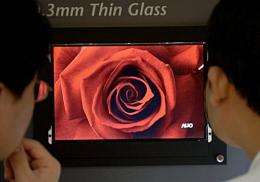
Taiwan's producers of liquid crystal displays know that venturing into the Chinese market is risky, but they are also fully aware they have no choice, analysts said.
Even though they are major revenue earners, the island's LCD makers got off to a late start, struggling for years to match stronger Japanese and Korean rivals, and they hope China will give them the leverage they need to catch up.
"We're eager, if the government can give the go-ahead," said Hsiao Ya-wen of AU Optronics, the world's third-largest flat panel maker after Samsung Electronics Co and LG Philips Co.
AU Optronics currently operates two Chinese module plants -- low-end facilities that do not give away much know-how -- and announced in June plans for a third one in a joint venture with Sichuan Changhong Electric Co.
It could soon see its activities move to a whole new level. Economics Minister Shih Yen-hsiang told parliament last week Taiwan may relax curbs on high-tech investments in the mainland by local LCD companies.
A bigger role in China could be a huge boon for makers of LCDs -- used in everything from cell phones to computers and e-books -- due to the strong appetite among the mainland's newly rich for cutting-edge electronic products.
The interest runs both ways, with AU Optronics vice president Paul Peng confirming recently that his company had received invitations from several Chinese city governments to set up plants once the high-tech curbs are eased.
But analysts also see risks that may face Taiwanese panel makers once they are permitted by the government to open up "eighth-generation" production plants in the mainland, introducing sensitive technologies.
"Chinese companies may ditch Taiwanese partners once they acquire their badly needed cutting-edge LCD know-how," said Nancy Liu, an analyst with Taiwan's quasi-official Industrial Technology Research Institute.
Liu added the same concerns are factors for Seoul and Tokyo while considering whether to share their state-of-the-art technologies.
But in Taipei the concerns are all the more serious, because Taiwan and China were arch foes for decades after they split at the end of a civil war in 1949.
However, ties between Taipei and Beijing have been warming fast since Ma Ying-jeou of the China-friendly Kuomintang party was elected president last year on a promise to boost trade and allow in more Chinese tourists.
"It would be a very good opportunity for local flat panel makers," said Alex Huang of Mega International Investment Services.
"It would allow them to get close to their Chinese clients in addition to reducing costs."
AU Optronics is a prime example of how the entire industry is still burdened by having joined late.
The company started from scratch in 1996 and merged with a Taiwanese company in 2001 and another one in 2006, fast becoming the leading flat panel maker here. But it faces intense competition from abroad.
"The huge number of patent rights owned by the Japanese and Korean makers have formed high barriers for the latecomers," said Liu of the Industrial Technology Research Institute.
They may have to pay high royalties for the patent rights owned by the industry leaders or face infringement charges, she said.
The huge demand from the Chinese market may not just help Taiwan's LCD makers with their long-term problem of narrowing the gap with rivals, but also the more immediate issue of coping with the global crisis.
Taiwan's screen manufacturers were hit harder by the worldwide economic downturn than their Japanese and Korean competitors.
"Local panel makers are short of brand names like Sharp, Samsung and LG," said Liu.
In order to meet overseas demand, the three global brands purchased panels from Taiwan suppliers, but slashed orders when the economic meltdown bit and demand slumped late last year.
As a result, the utilisation rate of Taiwanese makers tumbled to below 40 percent while their Korean rivals still enjoyed a comfortable 80 percent utilisation rate, according to Liu.
"But they would be able to ensure outlets for their products if they can secure orders from China by making products there," she said.
(c) 2009 AFP


