October 5, 2009 weblog
The 2009 Ig Nobel prizewinners
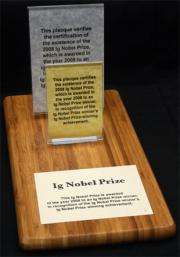
(PhysOrg.com) -- The Ig Nobels are a highlight of the scientific calendar and award research that makes people laugh as well as think. The awards were presented last week at Harvard University in the U.S, and winning research included a bra that doubles as two face masks, a process for making diamonds from tequila, and Zimbabwe's scheme to simplify the handling of money.
The Ig Nobels began in 1991 and are awarded each October from Oslo and Stockholm. The awards are presented at a ceremony at Harvard, run by the university magazine Annals of Improbable Research.
The Ig Nobels are awarded in categories such as Biology, Chemistry, Economics, Literature, Mathematics, Medicine, Peace, Physics, Public Health, and Veterinary Medicine. They are presented by Nobel laureates. This year's winners are...
Biology
A group of scientists from Sagamihara in Japan won the Biology accolades for showing the world that bacteria from panda poo helps to reduce the mass of kitchen waste by over 90%.
Chemistry
The Ig Nobel for Chemistry was awarded to a team of Mexican scientists for their work on creating diamonds from tequila.
Economics
The Economics prize went to executives and auditors of four Icelandic banks, the Landsbanki, Glitnir, Kaupthing and Central bank. They showed that tiny banks can rapidly become big banks, and big banks can rapidly become tiny banks again. The same thing can happen to a nation's economy. Such as Iceland's economy.
Literature
Ireland's police service took out the literature prize for writing over fifty traffic tickets and presenting them to Prawo Jazdy, Ireland's most notorious traffic offender. Prawo Jazdy is Polish for "Driving License".
Mathematics
The Governor of the Reserve Bank in Zimbabwe, Gideon Gono, won the Mathematics prize for simplifying the currency for the people and helping them cope with rampant inflation. He simply had the bank print money in denominations that covered all the bases, with note values ranging from one cent to one hundred trillion dollars.
Medicine
Winner of the Medicine prize was 83-year old Donald L. Unger from Thousand Oaks in California who cracked the knuckles of his left hand every day for over sixty years. He never once cracked the knuckles of his right hand. The aim of this experiment was to see if his mother was right and that cracking the knuckles causes arthritis. It doesn't.
Peace
Stephan Bolliger, a pathologist from the University of Bern in Switzerland accepted the Ig Nobel Peace Prize on behalf of his team for finally solving the long-pondered question of whether being bashed on the head with a full bottle of beer is preferable to being bashed on the head with an empty one.
If you happen to be in a bar brawl, the full bottle is the one to choose because empty ones are sturdier, but both are strong enough to break the human skull, Bolliger said. Full beer bottles are likely to quickly explode because of the pressure built up in the bottle. The study's findings are relevant to court cases in which bottles have been used as weapons.
Physics
Three American scientists won the physics award for finding out why pregnant women don't tip over. It seems the structure of the lumbar vertebrae in women helps to compensate when the center of gravity changes as the weight of their unborn child increases.
One of the researchers, anthropologist, Professor Shapiro of the University of Texas, explained that women have spines that are more curved than men's, and in pregnancy that curve is accentuated and protects the back muscles and bones from the extra stress.
Public Health
Elena Bodnar, Sandra Marijan, and Raphael Lee of Illinois won the public health prize for their patent for a bra that can be converted quickly to two emergency face masks. Elena Bodnar attended the ceremony, but it is not known if she wore the invention herself - just in case.
Bodnar, originally from Ukraine began her career studying the after effects of the Chernobyl disaster. If the convertible bra had been available in the early hours of that disaster they might have protected wearers from Iodine-131 and the subsequent radiation sickness. The bra could also have protected people from asbestos and other dust in New York on September 11, 2001.
Veterinary Medicine
Winners in the Veterinary Medicine category were researchers from Newcastle University, Catherine Douglas and Peter Rowlinson, who showed that cows give more milk if they are given names and affection. The findings arose from research aimed at improving the welfare of dairy cows.
Rowlinson attended the ceremony, but Douglas, a new mother, sent a picture of herself, a cow, and her baby wearing a cow suit. She dedicated her award to three cows: Purslane, Wendy and Tina.
Many of the researchers stressed that while their studies may sound funny, they are serious. Professor Shapiro said that while she understood why her research would qualify, it was actually "100 percent serious."
More information: Official website: improbable.com/ig/winners/#ig2009
© 2009 PhysOrg.com


