Wi-Fi signals can see through walls

October 5, 2009 by Lin Edwards weblog
Wi-Fi signals can see through walls
Enlarge

Image: arXiv:0909.5417.

(PhysOrg.com) -- Researchers at the University of Utah, USA, have discovered that variations in signal strengths in wireless networks can be used to "see" movements of people on the other side of walls or doors.

The scientists, Joey Wilson and Neal Patwari, detected movements by measuring the of the between the nodes of wireless network devices. The presence of people moving through the field is registered as a change in signal strength. The space is interrogated by many signals that are picked up by many receivers, and this allows a picture of the movement in the space to be built up. The technique is called variance-based radio tomographic imaging.

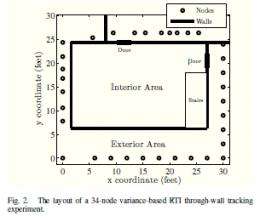
Wilson and Patwari set up a 34-node network outside a living room in a house to test the system, and were able to detect movements to about three feet through the wall. At present the scientists are only able to detect movements, and are not yet able to generate images, but they are sure this will be possible in the future. They are equally confident they will be able to improve accuracy, even with fewer nodes. They also say that adding GPS to each node would enable it to work out its own location, and this should improve the imaging process.

The researchers expect the system to find application in search and rescue operations, such as finding people trapped under collapsed buildings after earthquakes. The scientists envisage emergency workers using radio technologies to install a network of sensors around an emergency area to detect the presence of survivors and bodies.

According to Wilson and Patwari, the radio sensors could be deployed around a disaster site by the emergency workers, either by dropping them or throwing or launching them in some way. Each sensor would then form part of a network and begin to transmit information about signal strength measurements across the web of to a base station computer. The computer would correlate the information and determine the likely locations of survivors.

The advantage of this technique over existing systems capable of sensing what is on the other side of a wall is the price, since the nodes in the network are cheap and off-the shelf. The disadvantage of a cheap and simple system is its potential use as a spy tool by nosy neighbors, peeping toms or burglars, and all the privacy and safety issues such uses raise.

This video is not supported by your browser at this time.

More information: Through-Wall Tracking Using Variance-Based Radio Tomography Networks, Joey Wilson, Neal Patwari, arXiv:0909.5417

© 2009 PhysOrg.com

4.3 /5 (8 votes)  

Filter


Move the slider to adjust rank threshold, so that you can hide some of the comments.


Display comments: newest first

Andrux
Oct 05, 2009

Rank: not rated yet
How does it make the difference between solid matter and a human ( a large rock or a human beneath a pile of rubble seems hard to distinguish) unless maybe the water content causes more interference with the signal but even then..., And how would we manage to place a node under the ground we are trying to scan for the signal to go through the volume that is being searched? if we have to dig to place the nodes, might as well dig to look for people...????
drel
Oct 05, 2009

Rank: 5 / 5 (1)
How does it make the difference between solid matter and a human?


"The presence of people moving through the field is registered as a change in signal strength." Movement is the key from what I read.
Rank 4.3 /5 (8 votes)
Related Stories
Relevant PhysicsForums posts
  • Need help reading 3-D
    created20 hours ago
  • A way to send and receive wireless data
    createdFeb 11, 2012
  • Calling function with no input argument
    createdFeb 10, 2012
  • Force free body diagram problem on gym equipment
    createdFeb 10, 2012
  • Empirical data regarding shower heads and water
    createdFeb 10, 2012
  • feed hold button on CNC lathe
    createdFeb 09, 2012
  • More from Physics Forums - General Engineering

More news stories

Iran blocks email, restricts net access: reports

Iran has further restricted access to the Internet and blocked popular email services for the past few days, in a move a top lawmaker said could "cost the regime dearly," media reports said on Sunday.

Technology / Internet

created 1 hour ago | popularity 5 / 5 (1) | comments 2

Google might launch Drive for cloud storage soon

(PhysOrg.com) -- Google's next big move, according to the Wall Street Journal, is a cloud storage service called Drive. Hardly first to the plate, Google is simply catching up to introducing its cloud reposi ...

Technology / Internet

created 8 hours ago | popularity 4.8 / 5 (4) | comments 4 | with audio podcast report

Love a click away in Indonesia's Twitter Republic

He was a geeky kid from Yogyakarta, she a glamorous city girl in Jakarta. In a country with one of the world's most vibrant social networking scenes they fell in love on Twitter.

Technology / Internet

created 9 hours ago | popularity 4 / 5 (1) | comments 0

Walney offshore wind farm is world's biggest (for now)

(PhysOrg.com) -- The Walney wind farm on the Irish Sea--characterized by high tides, waves and windy weather--officially opened this week. The farm is treated in the press as a very big deal as the Walney ...

Technology / Energy & Green Tech

created Feb 11, 2012 | popularity 4 / 5 (11) | comments 35 | with audio podcast weblog

Navy to begin tests on electromagnetic railgun prototype launcher

The Office of Naval Research (ONR)'s Electromagnetic (EM) Railgun program will take an important step forward in the coming weeks when the first industry railgun prototype launcher is tested at a facility ...

Technology / Engineering

created Feb 06, 2012 | popularity 4.7 / 5 (16) | comments 93 | with audio podcast


Lab study raises questions over nano-particle impact

Tests involving chickens have raised questions about the impact on health from engineered nano-particles, the ultra-fine grains commonly used in drugs and processed foods, scientists said on Sunday.

Salvage workers begin pumping fuel from Italian shipwreck

Salvage workers Sunday began pumping fuel from the shipwrecked Italian cruise liner Costa Concordia, a day ahead of schedule, officials said.

Scientists discover molecular secrets of 2,000-year-old Chinese herbal remedy

For roughly two thousand years, Chinese herbalists have treated Malaria using a root extract, commonly known as Chang Shan, from a type of hydrangea that grows in Tibet and Nepal. More recent studies suggest that halofuginone, ...

New method to examine batteries -- MRI from the inside

There is an ever-increasing need for advanced batteries for portable electronics, such as phones, cameras, and music players, but also to power electric vehicles and to facilitate the distribution and storage of energy derived ...

A mitosis mystery solved: How chromosomes align perfectly in a dividing cell

Although the process of mitotic cell division has been studied intensely for more than 50 years, Whitehead Institute researchers have only now solved the mystery of how cells correctly align their chromosomes during symmetric ...

Starve a virus, feed a cure? Findings show how some cells protect themselves against HIV

A protein that protects some of our immune cells from the most common and virulent form of HIV works by starving the virus of the molecular building blocks that it needs to replicate, according to research published online ...