The Athenians: Another warning from history?
October 5, 2009
(PhysOrg.com) -- The collapse of Greek democracy 2,400 years ago occurred in circumstances so similar to our own it could be read as a dark and often ignored lesson from the past, a new study suggests.
In a new history of the 4th century BC, Cambridge University Classicist Dr. Michael Scott reveals how the implosion of Ancient Athens occurred amid a crippling economic downturn, while politicians committed financial misdemeanours, sent its army to fight unpopular foreign wars and struggled to cope with a surge in immigration.
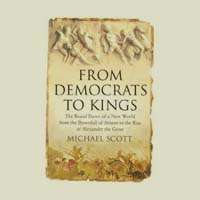
The book, entitled From Democrats To Kings, aims to overhaul Athens' traditional image as the ancient world's "golden city", arguing that its early successes have obscured a darker history of blood-lust and mob rule.
Other reputations are also taken to task: The "heroic" Spartans of Thermopylae, immortalised in the film 300, are unmasked as warmongering bullies of the ancient world. Alexander the Great, for all his achievements, is described as a "mummy's boy" whose success rested in many ways on the more pragmatic foundations laid by his father, Philip II.
Perhaps more significantly, however, the study suggests that the collapse of Greek democracy and of Athens in particular offer a stark warning from history which is often overlooked.
It argues that it was not the loss of its empire and defeat in war against Sparta at the end of the 5th century that heralded the death knell of Athenian democracy - as it is traditionally perceived. Athens' democracy in fact recovered from these injuries within years. Instead, Dr. Scott argues that the strains and stresses of the 4th century BC, which our own times seem to echo, proved too much for the Athenian democratic system and ultimately caused it to destroy itself.
"If history can provide a map of where we have been, a mirror to where we are right now and perhaps even a guide to what we should do next, the story of this period is perfectly suited to do that in our times," Dr. Scott said.
"It shows how an earlier generation of people responded to similar challenges and which strategies succeeded. It is a period of history that we would do well to think about a little more right now - and we ignore it at our peril."
Although the 4th century was one of critical transition, the era has been overlooked by many ancient historians in favour of those which bookend it - the glory days of Athenian democracy in the 5th century and the supremacy of Alexander the Great from 336 to 323 BC.
This, the study says, has led to a two-dimensional view of the intervening decades as a period of unimportant decline. Instead, Dr. Scott argues that this period is fundamental to understanding what really happened to Athenian democracy.
Athens was already a waning star on the international stage resting on past imperial glories, and the book argues that it struggled to keep pace with a world in a state of fast-paced globalisation and political transition.
In an effort to remain a major player in world affairs, it abandoned its ideology and values to ditch past allies while maintaining special relationships with emerging powers like Macedonia and supporting old enemies like the Persian King. This "slippery-fish diplomacy" helped it survive military defeats and widespread political turbulence, but at the expense of its political system. At the start of the century Athens, contrary to traditional reports, was a flourishing democracy. By the end, it was hailing its latest ruler, Demetrius, as both a king and a living God.
Dr. Scott argues that this was caused by a range of circumstances which in many cases were the ancient world's equivalent of those faced by Britain today. Athens, for example, committed itself to unpopular wars which ultimately brought it into direct conflict with the vastly more powerful Macedonia. Its economy, heavily dependent on trade and resources from overseas, crashed when in the 4th century instability in the region began to affect the arterial routes through which those supplies flowed.
The result was a series of domestic problems, including an inability to fund the traditional police force. In an effort to cope, Athens began to create a system of self-regulation, described as a "giant Neighbourhood Watch", asking citizens not to trouble its overstretched bureaucracy with non-urgent, petty crimes.
Ultimately, the city was to respond positively to some of these challenges. Many of its economic problems were gradually solved by attracting wealthy immigrants to Athens - which as a name still carried considerable prestige.
Democracy itself, however, buckled under the strain. Persuasive speakers who seemed to offer solutions - such as Demosthenes - came to the fore but ultimately took it closer to military defeat and submission to Macedonia. Critically, the emphasis on "people power" saw a revolving door of political leaders impeached, exiled and even executed as the inconstant international climate forced a tetchy political assembly into multiple changes in policy direction.
The name of "democracy" became an excuse to turn on anyone regarded as an enemy of the state, even good politicians who have, as a result, almost been forgotten. Dr Scott's study also marks an attempt to recognise figures such as Isocrates and Phocion - sage political advisers who tried to steer it away from crippling confrontations with other Greek states and Macedonia.
"In many ways this was a period of total uncertainty just like our own time," Dr. Scott added. "There are grounds to consider whether we want to go down the same route that Athens did. It survived the period through slippery-fish diplomacy, at the cost of a clear democratic conscience, a policy which, in the end, led it to accept a dictator King and make him a God."
From Democrats To Kings is published by Icon Books.
Provided by University of Cambridge (news : web)


Athens lost most of it's power as a result of the disastrous Sicilian expedition. They did recover temporarily but poor judgment of their politicians soon brought their downfall.
http://en.wikiped...sian_War
“Democracy is nothing more than mob rule, where fifty-one percent of the people may take away the rights of the other forty-nine.”
- Thomas Jefferson
Our Western governments are growing. They steal money from people that work (income tax). They tap our phone calls and spy on us with their surveillance cameras. They spend large amounts of our financial capital (read: hard earned money that was stolen from us) on wars and development aid, which goes straight to corrupt politicians in foreign countries. They tell us we have to go to war and spy on our own people to remain safe. We fall for their lies and eagerly give up our freedoms for their temporary safety. Our democracies are failing. Our "free" Western societies are swiftly turning into socialist police states. Let us end them and start a new society. A free, Libertarian society. Just like the brilliant American Founding Fathers would have wanted our societies to be!
The way I see it, the People of America (if not the West) have become too lazy in their prosperity of the Industrial Age. They know nothing accept this economic growth rate that is impossible to maintain into probably even the near future.
All this time we've been conditioned to believe our voice doesn't matter in the government. And that so long as you can buy X-item, life is good. And certainly life is good, compared to some places, but it can so easily turn bad with such big gov't. People are perfectly happy selling their days for a paycheck, and to let absolutely anyone tell them what to do and what to believe so long as they don't have to take responsibility for their own life. How can you fight such conditioned apathy? People just don't care. They don't want to have to care.
But we should not forget that the alternative is a system wher 0.001% of the people can take away the rights of the other 99.999%
That said the current system is probably more along the lines of 5%/95% than the above mentioned 51%/49%
The problem with "starting over" is that if you burn down the house in order to build a new one, you don't have anything left to build with, unless of course you can get someone else to chip in. Typical liberaian fantasy.
If Jefferson and his contemporaries had not compromised on slavery, the USA would have not started with 13 states. It may not have started at all.
Aim high and you may not hit your mark, aim low and you surely will.
And don't forget that the great Athenian 'democracy' was nothing of the sort as slaves had no vote and the number of citizens who could vote were a very small minority.
Recall how Rome dealt with Spartacus? Rome understood their 'republic' depended upon slaves.
What does America have to do with commonwealth Britain?--but I guess with the jump to conclusion about America, Britain made another loyalist mistake.
This is the foundation of the US Constitution.
Predictions of the fall of democracy, and, hence, the fall of the West, are greatly exaggerated. The American Federal Republic is over 200 years old, with no major signs of weakness. Indeed, it has shown incredible resilience. Imagine, a nation which 50 years ago would not even let blacks eat with whites elected a black man as its leader. Extraordinary!
The ties that bind North America and Europe are strong. As long as one endures, the West endures.
Check out "Darkness and the Light" by Olaf Stapledon.
"The brave men, living and dead who struggled here have consecrated it far above our poor power to add or detract. The world will little note nor long remember what we say here, but it can never forget what they did here. It is for us the living rather to be dedicated here to the unfinished work which they who fought here have thus far so nobly advanced. It is rather for us to be here dedicated to the great task remaining before us--that from these honored dead we take increased devotion to that cause for which they gave the last full measure of devotion--that we here highly resolve that these dead shall not have died in vain, that this nation under God shall have a new birth of freedom, and that government of the people, by the people, for the people shall not perish from the earth."
The fatal flaw is the system's trust in the common man and a misunderstanding how easy it is to manipulate the people. The unscrupulous have learned and exploited this fact,it is no suprise those make up the majority of our leaders. The leaders that we need for our own sake are prevented from attaining power in our system, only charlatans make it.
I would argue there is no democracy anywhere, just an illusion of democratic rule. In some countries this is more obvious than others; the US is a good example with its rigid two-party system.
Democracy is still an experiment that will probably again fail the test of time. Nobody else to blame but ourselves. If all people were Thomas Jeffersons then democracy would work,unfortunately that clearly isn't the case
200 years is but the briefest of portions in the history of human civilization/government. And while the Union has withstood several tests, as indicated by some posters, America's government doesn't actually resemble much of a democracy at all in it's present state. It diverges farther and farther from the Founding Father's vision every day. Our government swells and inflation increases far, far faster than our population grows (which in pure market economics the only purpose of inflation should be to keep up with population growth), the People will become more and more dependent upon the government, as the economy cannot sustain it's assumed growth rate indefinitely and the value of our currency will dwindle. The cost of living will also increase as our wages become worth less. After this trend persists long enough, there will not even a semblance of democracy, at best is socialism at worst...
Government has NO rights.
It does NOT have:
The right to free speech
The right to bear arms
The right to protect itself
The right to do anything whatsoever of itself
It doesn't even have the right to exist.
Only real human beings have rights, and the only valid government of the United States are the People of the United States.
It's a fallacy to consider the US government a separate entity from the People. If it considers itself such, it has violated its charter and become a occupying force.
i find it hilarious actually that our government (the US that is) seems to be primarily based off the roman type of government (president = caesar of course)...which failed miserably over time and went extinct...seems like one helluva a history lesson too...
and yes..sounds like the athenians had a good bit in common with the whole worlds current economic situation (perpetuated of course by those same democracies that should be overthrown)
If people voted on the facts and our elected officials were actual scholars and leaders, we might be better off.
"If the American people ever allow private banks
to control the issue of their money,
first by inflation and then by deflation,
the banks and corporations that will
grow up around them (around the banks),
will deprive the people of their property
until their children will wake up homeless
on the continent their fathers conquered."
-Thomas Jefferson
There WAS no stronger enemy that the Imperium Romanum could tangle with.
Now, that's called hybris.
Sic transit gloria mundi.
As the popular joke states it: "Macedonian looks at the Moon and say - Eh, land of Macedonians, one day, we'll fight for you too". As much as I love Macedonians, this joke makes a lot of sense, so be careful with the wording :)
As for democracy itself - you're very ignorant, if you really believe you're living in a democracy. Even the election in the USA are not democratic, what's left for the rest of the world.