Building a better qubit: Combining 6 photons together results in highly robust qubits
October 5, 2009 Building a better qubit

Enlarge

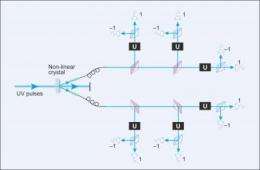
A new method for combining six photons together results in a highly robust qubit capable of transporting quantum information over long distances. Credit: Image courtesy of Carin Cain

Exploiting quantum mechanics for transmitting information is a tantalizing possibility because it promises secure, high speed communications. Unfortunately, the fragility of methods for storing and sending quantum information has so far frustrated the enterprise. Now a team of physicists in Sweden and Poland have shown that photons that encode data have strength in numbers. Their experiment is reported in Physical Review Letters and Physical Review A and highlighted in the October 5 issue of Physics.

In classical communications, a bit can represent one of two states - either 0 or 1. But because photons are quantum mechanical objects, they can exist in multiple states at the same time. Photons can also be combined, in a process known as entanglement, to store a bit of (i.e. a qubit).

Unlike data stored in a computer or typically sent through conventional fiber optic cables, however, qubits are extremely fragile. A kink in a cable, the properties of the cable material, or even changes in temperature can corrupt a and destroy the information it carries. But now a group lead by Magnus Rľdmark at Stockholm University has shown that six entangled photons can encode information that stands up to some knocking around.

Rľdmark and his team proved experimentally that their six qubits are robust and should be able to reliably carry information over long distances. The technology to encode useful information on the qubits and subsequently read it back is still lacking, but once those problems are solved, we will be well on our way to secure, reliable, and speedy quantum communication.

More information:

• Experimental filtering of two-, four-, and six-photon singlets from a single parametric down-conversion source, Magnus Rľdmark, Marcin Wieśniak, Marek Żukowski, and Mohamed Bourennane, Phys. Rev. A 80, 040302 (2009) - Published October 05, 2009, Download PDF (free)

• Experimental Test of Fidelity Limits in Six-Photon Interferometry and of Rotational Invariance Properties of the Photonic Six-Qubit Entanglement Singlet State, Magnus Rľdmark, Marek Żukowski, and Mohamed Bourennane, Phys. Rev. Lett. 103, 150501 (2009) - Published October 05, 2009, Download PDF (free)

Source: American Physical Society


print this article email this article download pdf blog this article bookmark this article     Stumble it Digg this share on Facebook retweet share on Reddit add to delicious
Rate this story - 5 /5 (2 votes)


October 5, 2009 all stories

Comments: 0

5 /5 (2 votes)
  • Stumble this up

  • Digg this

  • share this

  • hide
  • Related Stories

  • Quantum Communication Over Flawed Networks may be Possible
    created Dec 14, 2007 | popularity not rated yet | comments 0
  • Physicists Investigate Unusual Four-Qubit Entanglement
    created Sep 30, 2009 | popularity not rated yet | comments 0
  • Physicists Entangle Photon and Atom in Atomic Cloud
    created Jul 26, 2005 | popularity not rated yet | comments 0
  • Researchers Demonstrate Quantum Teleportation and Memory in Tandem
    created Jan 30, 2008 | popularity not rated yet | comments 0
  • Researchers violate Bell’s inequality with an atom and a photon
    created Aug 31, 2004 | popularity not rated yet | comments 0


Other News

Quick restart of Big Bang machine stuns scientists (AP)

Quick restart of Big Bang machine stuns scientists

Physics / General Physics

created 2 hours ago | popularity 4.4 / 5 (10) | comments 2

(AP) -- Scientists moved Saturday to prepare the world's largest atom smasher for exploring the depths of matter after successfully restarting the $10 billion machine following more than a year of repairs.


A view of a superconducting solenoid magnet at the European Organization for Nuclear Research (CERN) near Geneva

CERN atom-smasher restarts after 14-month hiatus: official

Physics / General Physics

created 22 hours ago | popularity 4.6 / 5 (22) | comments 0

The world's biggest atom-smasher, shut down after its inauguration in September 2008 amid technical faults, restarted on Friday, a spokesman for the European Organisation for Nuclear Research said.


Tapering a Free-Electron Laser to Extract More Juice

Tapering a Free-Electron Laser to Extract More Juice

Physics / General Physics

created 22 hours ago | popularity 4 / 5 (1) | comments 0

(PhysOrg.com) -- Researchers from the NSLS and Science Applications International Corporation (SAIC) have demonstrated a technique that could be used to significantly improve the quantity and quality of light ...


Ultra-Powerful Laser Reproduces How Star's Jets Travel through Interstellar Space

Ultra-Powerful Laser Reproduces How Star's Jets Travel through Interstellar Space

Physics / General Physics

created 23 hours ago | popularity 4.4 / 5 (7) | comments 0

(PhysOrg.com) -- A multi-trillion-watt laser at the University of Rochester has simulated a stellar jet -- an outpouring of matter from a fledgling star -- with unprecedented realism.


nuclear power plant

Doubts raised on nuclear industry viability

Physics / General Physics

created Nov 19, 2009 | popularity 3.2 / 5 (17) | comments 18

(PhysOrg.com) -- The investment in nuclear power has been growing around the world over the last few years, being viewed as a means for countries to control their energy security, avoid the price fluctuations ...