Color sensors for better vision
October 5, 2009 Color sensors for better vision

Enlarge

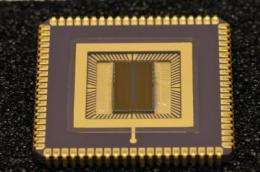
The innovative CMOS image sensor can distinguish color and is much more light-sensitive than conventional sensors. Credit: Fraunhofer IMS

CMOS image sensors in special cameras -- as used for driver assistance systems -- mostly only provide monochrome images and have a limited sensitivity to light. Thanks to a new production process these sensors can now distinguish color and are much more sensitive to light.

The car of the future will have lots of smart assistants onboard - helping to park the car, recognize traffic signs and to warn the driver of blind spot hazards. Many driver assistance systems incorporate high-tech cameras which have to meet a wide range of requirements. They must be able to withstand high ambient temperatures and be particularly small, light and robust. What's more, they have to reliably capture all the required images and should cost as little as possible. Nowadays CMOS sensors are used for most in-car systems. These semiconductor chips convert light signals into electrical pulses and are installed in most digital cameras. At present, however, the sensors used for industrial and other special cameras are mostly color blind.

Now researchers at the Fraunhofer Institute for Microelectronic Circuits and Systems IMS in Duisburg are adding some color to the picture. They have developed a new process for producing CMOS image sensors which enables the chips to see color. Normally the image sensors are produced on using a semiconductor technique, the CMOS process.

"We have integrated a color filter system in the process," explains Prof. Dr. Holger Vogt, Deputy Director of the IMS. "In the same way as the human eye needs color-specific cone types, color filters have to be inserted in front of the sensors so that they can distinguish ." This job is handled by polymers dyed in the primary colors red, green and blue. Each pixel on the sensor is coated with one of the three colors by a machine which coats the sensor disk propels with a micrometer-thick polymer layer. Using UV light and a mask which is only transparent on the desired pixels, the dye is fixed at the requisite points and the rest is then washed off. In addition, the researchers have developed special microlenses which help the sensor to capture and measure the light more efficiently. With the aid of a transparent polyimide they create a separate lens for each individual pixel, which almost doubles the light-sensitivity of the .

The optimized CMOS process not only makes it possible to cost-efficiently improve the performance of driver assistance systems. Endoscopes can also benefit from the new properties of CMOS image sensors. The researchers are presenting the CMOS process at the Vision trade fair from November 3 to 5 in Stuttgart.

Source: Fraunhofer-Gesellschaft (news : web)


print this article email this article download pdf blog this article bookmark this article     Stumble it Digg this share on Facebook retweet share on Reddit add to delicious
Rate this story - not rated yet


October 5, 2009 all stories

Comments: 0

not rated yet
  • Stumble this up

  • Digg this

  • share this

  • hide
  • Related Stories

  • IBM Announces New CMOS Image Sensor Foundry Offering
    created Jul 14, 2005 | popularity not rated yet | comments 0
  • Panasonic develops a next-generation robust image sensor
    created May 14, 2007 | popularity not rated yet | comments 0
  • Sony develops new back-illuminated CMOS image sensor
    created Jun 11, 2008 | popularity not rated yet | comments 0
  • Canon Awarded for Most Innovative CMOS Image Sensor Technology
    created Aug 12, 2004 | popularity not rated yet | comments 0
  • Kodak Announces 39-megapixel CCD Image Sensor
    created Oct 21, 2005 | popularity not rated yet | comments 0


  • hide
  • Relevant PhysicsForums posts

  • Aspiring Engineering major looking for general answers
    created Nov 19, 2009
  • Calculating max load of square tube (steel)
    created Nov 19, 2009
  • Passive Chemical Heating
    created Nov 19, 2009
  • Shortening Boat Trailer
    created Nov 18, 2009
  • More from Physics Forums - General Engineering

Other News

Analysts say AmEx is most interested in the so-called peer-to-peer services of Revolution

American Express takes aim at PayPal with Revolution

Technology / Internet

created 23 minutes ago | popularity not rated yet | comments 0

With its deal to buy Revolution Money, American Express is taking aim at the growing market for online and alternative payments, in a challenge to recognized leader PayPal, analysts say.


China is the world's largest emitter of the greenhouse gases blamed for global warming

China harnesses mountain wind power

Technology / Energy

created 3 hours ago | popularity not rated yet | comments 0

In the mountains above the southwestern Chinese town of Dali, dozens of new wind turbines dot the landscape -- a symbol of the country's sky-high ambitions for clean, green energy.


Hackers leak e-mails, stoke climate debate

Technology / Internet

created 14 hours ago | popularity 4.4 / 5 (20) | comments 16

(AP) -- Computer hackers have broken into a server at a well-respected climate change research center in Britain and posted hundreds of private e-mails and documents online - stoking debate over whether some scientists have ...


Ubisoft steps up videogame fitness with virtual coach

Technology / Software

created 3 hours ago | popularity not rated yet | comments 0

French videogame powerhouse Ubisoft will have a virtual fitness coach whipping Wii users into shape starting Tuesday.


plug-in hybrid electric vehicle

Pulling the plug on hybrid myths

Technology / Energy

created Nov 19, 2009 | popularity 3.8 / 5 (12) | comments 17

(PhysOrg.com) -- Whether you call them myths, urban legends, fables or old wives' tales, there's a lot of misinformation out there about plug-in electric hybrid vehicles. These vehicles, abbreviated PHEVs, ...